THE CLASSIC COLLECTION✦A dead man’s diaryCLASSIC FREE BOOKS
A dead man’s diary
Coulson Kernahan
THE CLASSIC COLLECTION · 1916
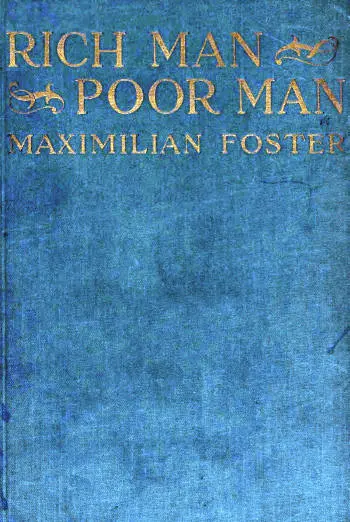
"Rich Man, Poor Man" by Maximilian Foster is a novel written in the early 20th century. The story explores themes of class, wealth, and personal connections, particularly focusing on the lives of Mr. Mapleson, a timid clerk in New York City, and Bab Wynne, a spirited young woman who is on the verge of discovering her true heritage. The interplay between these characters and their relationships will likely form a central part of the narrative as the plot unfolds. At the start of the novel, we meet Mr. Mapleson, an elderly clerk whose life appears mundane and lonely. On Christmas Eve, his character is established as he reflects on the loneliness and alienation he experiences, despite the joyful holiday spirit surrounding him. Meanwhile, the narrative shifts to Bab Wynne, who is depicted with a spirited demeanor that subtly suggests her yearning for a more exciting life, free from the confines of her boarding house existence. The initial chapters set the stage for a forthcoming transformation in their lives, hinting at the intertwining fates of the characters against the backdrop of societal expectations and personal dreams.
Introduction adapted from the source catalogue; source summaries may be automatically generated.
Free to read · English · 58,624 words · No account needed
MAKE TIME FOR A GOOD BOOK
On by default. Untick to stop anonymous reading totals. Each page counts after 10 seconds in view. How this works.
Anonymous counting is on unless you have switched it off.
As in a dream, the tides of confusion coming and going in her face, Bab watched him as he crossed the room, threading his way among the dancers. Varick, she saw, had many friends in that throng. On every side the men called him a greeting as he passed; the girls, their partners, waving him a gay, friendly welcome. In spite of this, however, Varick's air was hardly what one would call festive.
A smile, half grim, half disdainful, lurked in his eyes. It was as if his presence there somehow grotesquely seemed amusing, and about him, too, was a look of stubborn purpose she had never seen before. If Bab, after their last encounter, had thought to find him ill at ease she was doomed to disappointment. However, the thoughts in her mind were of quite a different nature. What was he doing there, she was asking herself. How came he to be in that house? Her mind working swiftly even in its bewilderment, she recalled that moment, only a few days past, when she herself had heard Beeston say Varick should not set foot inside his door. And yet here he was! That David had not asked him was evident. She was standing there, her mind still a maze, when she heard David speak. Obviously his astonishment was as great as hers.
"Varick!" he exclaimed.
Varick's air had not altered. But for all its grimness he returned the
greeting cheerfully.
"Hello, Davy!"
Then he turned to Bab. As Bab looked at him she saw the hardness fade from his face. A look of sadness, of regret took its place, as if in that glimpse of her, his first for days, his resolution, whatever it may have been, had died.
"Why, Bab," he said, his eyes eloquent now; "you are lovely!"
Bab offered a limp hand to him.
"How do you do, Mr. Varick?" she returned.
A hobbledehoy could not have done worse. Self-conscious, nettled that she had been so awkward, she snatched away her hand. Varick, however, seemed too absorbed to notice. Then to her relief she again heard David speak. "It's good of you to have come, Bayard," he said hesitatingly. "I didn't know you would."
Varick looked at him queerly.
"I suppose you know I wasn't asked," he returned slowly, his tone
deliberate.
"Not asked?"
A low murmur of embarrassment escaped David, and Bab, watching, saw his eyes flutter uncomfortably.
"Then my aunt didn't send you a card?"
Varick shook his head.
"No, Davy; it's as I say, I just came."
Your reading position is saved on this browser. Take it to another device with a library code. Reading pages adapt to text, rather than matching a printed edition.
BEHIND THE BOOK
This eBook is for the use of anyone anywhere in the United States and most other parts of the world at no cost and with almost no restrictions whatsoever. You may copy it, give it away or re-use it under the terms of the Project Gutenberg License included with this eBook or online at www.gutenberg.org. If you are not located in the United States, you will have to check the laws of the country where you are located before using this eBook. Read the source licence.
The original source file, including credits and licence, is retained by this library. Request an original-format copy at no charge. Please include the book title and Project Gutenberg identifier #46945.
KEEP YOUR CURIOSITY GOING
Coulson Kernahan

Maurice Baring
Frances Wright
Cécile Tormay

Frederic Jesup Stimson

W. H. P. (William Henry Pope) Jarvis