THE CLASSIC COLLECTION✦An outlaw’s diary: the CommuneCLASSIC FREE BOOKS
An outlaw’s diary: the Commune
Cécile Tormay
THE CLASSIC COLLECTION · 1904
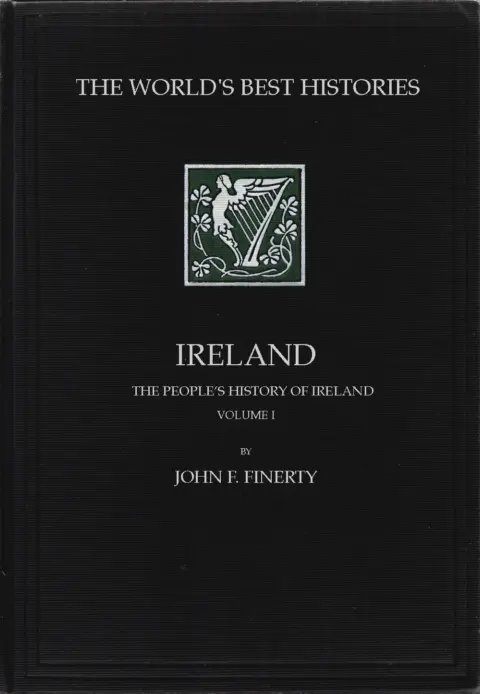
"Ireland: The People's History of Ireland, Volume 1" by John F. Finerty is a historical account written in the early 20th century. The text delves into the rich and complex history of Ireland, addressing the narrative from ancient times through significant events, such as the Reformation and invasions. It aims to provide a comprehensive understanding of the people and culture of Ireland, particularly for those unfamiliar with its past. At the start of the volume, Finerty discusses geographical and physical characteristics of Ireland, outlining its divisions into provinces and detailing the nation's fertile land and vibrant resources. The text emphasizes the importance of Ireland's history, noting the influence of its early inhabitants, the establishment of social structures, and the impact of various invasions, including the Danish and Norman incursions. Finerty aims to illuminate the contributions of the Irish people to the wider world and their enduring legacy, especially as it relates to the Irish diaspora in America.
Introduction adapted from the source catalogue; source summaries may be automatically generated.
Free to read · English · 128,763 words · No account needed
MAKE TIME FOR A GOOD BOOK
On by default. Untick to stop anonymous reading totals. Each page counts after 10 seconds in view. How this works.
Anonymous counting is on unless you have switched it off.
Ireland is very rich in monastic and martial ruins. The round towers which sentinel the island are declared by many antiquaries to antedate the Christian period, and are supposed to have been pagan temples dedicated to the worship of the sun, which, some historians claim, was Ireland’s chief form of the Druidic belief.
“The names of their founders have vanished in the gloom, Like the dry branch in the fire, or the body in the tomb, But to-day, in the ray, their shadows still they cast— These temples of forgotten gods, these relics of the past.”
The grass-grown circular raths, or “forts,” as the peasantry call them, varying greatly in diameter, are supposed to be remnants of the Danish invasion, but many archæologists place them at a much earlier date, and give them not a Danish but a Danaan origin—the latter tribe being claimed as among the first settlers of Ireland. The largest “fort” or “dun” in the island is that near Downpatrick, which is sixty feet high and three-quarters of a mile in circumference. Much of the stately architecture seen in the ruins of abbeys, churches, and chapels belongs to the Anglo-Norman period, as does also the military architecture, which survives in such types as the keeps of Limerick, Nenagh, and Trim; but the Celtic type of church construction is preserved, after the lapse of more than a thousand years, in its primitive purity, at Glendalough in Wicklow, Clonmacnois in King’s County, and Cong in Galway.
Three hundred years of warfare with the pagan Danes, and five hundred with the Anglo-Normans and Anglo-Saxons, made Ireland the Island of Ruins, as well as the Island of Saints and Scholars.
Before January 1, 1801, Ireland was a distinct and separate kingdom, having a Parliament of her own and connected with Great Britain by what has been called “the golden link of the crown.” How that Parliament was, unfortunately for all concerned, abolished will appear in its proper order. Since 1801 Ireland has been governed by the Imperial Parliament, sitting in London, composed of representatives from England, Scotland, Ireland, and Wales—670 in all, of whom 103 are Irish members. Of these latter, 82 are Nationalists, or Repealers of the Act of Union, while 21 are Unionists, or adherents of the present political connection. The preponderating vote of Great Britain hopelessly overwhelms the Irish representation, and hence the work of reform, as far as Ireland is concerned, is slow and difficult. The executive functions are intrusted to a Lord Lieutenant, who is appointed by each succeeding Ministry, to represent the monarch of Great Britain. He is assisted in his duties by a Chief Secretary, two Under Secretaries, a Lord Chancellor, a Lord Chief Justice, a Master of the Rolls, a Chief Baron of the Exchequer, many less prominent officers, and a Privy Council, which comprises several of the officials mentioned, together with the leading supporters of the crown in the capital and throughout the country. Some of the official members of this Council are not natives of Ireland; and the Lord Lieutenant himself is almost invariably an English or Scotch aristocrat of high rank and liberal fortune. No Catholic can fill the office of Viceroy of Ireland. The authority of the latter is, to all intents and purposes, absolute. In seasons of political agitation, even when there is no violence, he can suspend the ordinary law without having recourse to Parliament. This power has been frequently exercised even in this generation. The Lord Lieutenant’s official residence is Dublin Castle, but he has also a commodious viceregal lodge in the Phœnix Park. His salary is $100,000 per annum—just twice that of our President—but, in general, he spends much more out of his private fortune, as he is, nearly always, chosen for his wealth as much as for his rank. When he goes among the people, he is, almost invariably, attended by a strong cavalry escort and a dashing staff of aides-de-camp, glittering in silver, steel, and gold. The military garrison of Dublin is strong, not often under 10,000 men, and at the Curragh Camp, about twenty miles distant, in Kildare, there is a much larger force. Most of the large towns are also heavily garrisoned. Thus, after an occupation, either nominal or actual, of seven and one-third centuries, England still finds it expedient to govern Ireland as a military district—a sad commentary on the chronic misgovernment of ages.
Your reading position is saved on this browser. Take it to another device with a library code. Reading pages adapt to text, rather than matching a printed edition.
BEHIND THE BOOK
This eBook is for the use of anyone anywhere in the United States and most other parts of the world at no cost and with almost no restrictions whatsoever. You may copy it, give it away or re-use it under the terms of the Project Gutenberg License included with this eBook or online at www.gutenberg.org. If you are not located in the United States, you will have to check the laws of the country where you are located before using this eBook. Read the source licence.
The original source file, including credits and licence, is retained by this library. Request an original-format copy at no charge. Please include the book title and Project Gutenberg identifier #67845.
KEEP YOUR CURIOSITY GOING
Cécile Tormay

Moritz Busch
John L. Ransom
Frances Wright
Cécile Tormay

Mabel Potter Daggett