THE CLASSIC COLLECTION✦An outlaw’s diary: the CommuneCLASSIC FREE BOOKS
An outlaw’s diary: the Commune
Cécile Tormay
THE CLASSIC COLLECTION · 1904
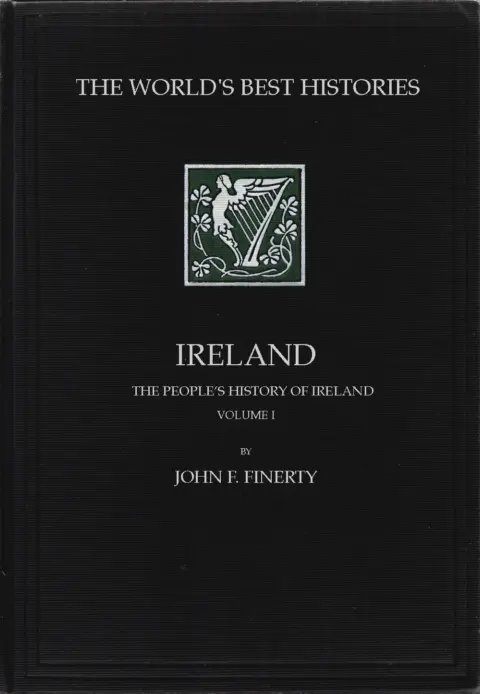
"Ireland: The People's History of Ireland, Volume 1" by John F. Finerty is a historical account written in the early 20th century. The text delves into the rich and complex history of Ireland, addressing the narrative from ancient times through significant events, such as the Reformation and invasions. It aims to provide a comprehensive understanding of the people and culture of Ireland, particularly for those unfamiliar with its past. At the start of the volume, Finerty discusses geographical and physical characteristics of Ireland, outlining its divisions into provinces and detailing the nation's fertile land and vibrant resources. The text emphasizes the importance of Ireland's history, noting the influence of its early inhabitants, the establishment of social structures, and the impact of various invasions, including the Danish and Norman incursions. Finerty aims to illuminate the contributions of the Irish people to the wider world and their enduring legacy, especially as it relates to the Irish diaspora in America.
Introduction adapted from the source catalogue; source summaries may be automatically generated.
Free to read · English · 128,763 words · No account needed
MAKE TIME FOR A GOOD BOOK
On by default. Untick to stop anonymous reading totals. Each page counts after 10 seconds in view. How this works.
Anonymous counting is on unless you have switched it off.
This same year, in Italy, under Catinat, the “Old” Brigade made its mark at Marsaglia, where it defeated the Savoyard centre, drew the whole French army after it, and chased Victor Amadeus almost to the gates of Turin.
Thenceforth, Lord Mountcashel having died of his wounds, the two brigades were united as one. The younger Schomberg, son of the hero of the Boyne, fell before the Irish bayonets at Marsaglia. At the battle of Montgry, in Spain, fought in 1694, by the French against the Spanish, the “Brigade,” under Marshal de Noailles, renewed its laurels, and the Irish charge proved potent in bringing the Spaniards to terms.
This war terminated gloriously for France by the Peace of Ryswick.
The War of the Spanish Succession broke out in 1700. England and Austria supported the Archduke Charles against Philip of Anjou, the Bourbon heir. This struggle brought upon the stage the Duke of Marlborough, for England, and Prince Eugene, of Savoy, for Austria, two of the greatest generals of modern times. Marshals, the Duke of Berwick, Catinat, Villeroy, Vendome, Villairs, Boufflers, and Noailles, commanded the armies of France. In this frightful struggle, the Irish flag always blazed in the vanguard of victory, in the rearguard of defeat, and the Irish name became the synonym of valor.
In the winter of 1702, the citadel of Cremona, in northern Italy, was held for France by Marshal Villeroy, with a strong garrison. The French gave themselves up to revelry, and the walls were poorly guarded. Caissioli, an Italian, informed Prince Eugene, the Austrian commander, of the state of affairs. The traitor agreed to let in a portion of the enemy by means of a sewer running from outside the walls under his house. At the same time the French sentinels at the gate of St. Margaret, badly defended, were to be drawn off, so that Eugene himself, with a strong body of cuirassiers, might enter and join the other party. Count Merci was to attack the “Gate of the Po,” defended by an Irish company, and Prince Vaudemont and Count Freiberg were to support the attack with the cavalry of their respective commands. The attack was made at midnight, and the plans were admirably executed. The Austrians were in possession of the town before the garrison was alarmed. Count Merci, however, met bad fortune at the “Gate of the Po.” The Irish guard, chatting over old times by the Shannon, the Barrow, or the Suir, kept faithful watch. The clatter of hoofs aroused them, as Merci, attended by several regiments of dragoons, rode up to the gate and called upon them to surrender. The Irish replied with a sharp volley, which laid some of the Austrians out in the roadway. The fire aroused the sleeping Irish regiments of Dillon and Burke, who, in their shirts only, as they sprang from bivouac, grasped their muskets and hastened to the rescue. They were met in the square by Eugene’s cuirassiers, who charged them fiercely. Major O’Mahoney formed his Irish into a square and let the Austrians have a fusillade. The cuirassiers, urged by Eugene and Freiberg, dashed madly at the Irish battalions, but, despite the bravest efforts of this iron cavalry, the Irish actually routed them and slew their leader, Baron Freiberg. Marshal Villeroy was made prisoner by Macdonald, an Irishman in the Austrian service, and the French general second in command shared the same fate. But the Irish still held out, fighting desperately and losing half their men. This prolonged resistance alarmed the French, who now, thoroughly aroused, gallantly seconded their Irish comrades, and, after a terrible carnage of eight hours’ duration, Prince Eugene, with all that remained of the flower of the Austrian cavalry, gave up in despair, and was hurled pell-mell through the gates of St. Margaret, by the victorious garrison. This exploit of the Irish saved northern Italy to the French monarch—the Austrians retreated to the Alps. All Europe rang applause. Louis raised the pay of his Irish troops, and made O’Mahoney a general. He also decreed that Irishmen, who deserved the honor, should thenceforth be recognized as French citizens, without undergoing the form of naturalization.
Your reading position is saved on this browser. Take it to another device with a library code. Reading pages adapt to text, rather than matching a printed edition.
BEHIND THE BOOK
This eBook is for the use of anyone anywhere in the United States and most other parts of the world at no cost and with almost no restrictions whatsoever. You may copy it, give it away or re-use it under the terms of the Project Gutenberg License included with this eBook or online at www.gutenberg.org. If you are not located in the United States, you will have to check the laws of the country where you are located before using this eBook. Read the source licence.
The original source file, including credits and licence, is retained by this library. Request an original-format copy at no charge. Please include the book title and Project Gutenberg identifier #67845.
KEEP YOUR CURIOSITY GOING
Cécile Tormay

Moritz Busch
John L. Ransom
Frances Wright
Cécile Tormay

Mabel Potter Daggett