THE CLASSIC COLLECTION✦An outlaw’s diary: the CommuneCLASSIC FREE BOOKS
An outlaw’s diary: the Commune
Cécile Tormay
THE CLASSIC COLLECTION · 1904
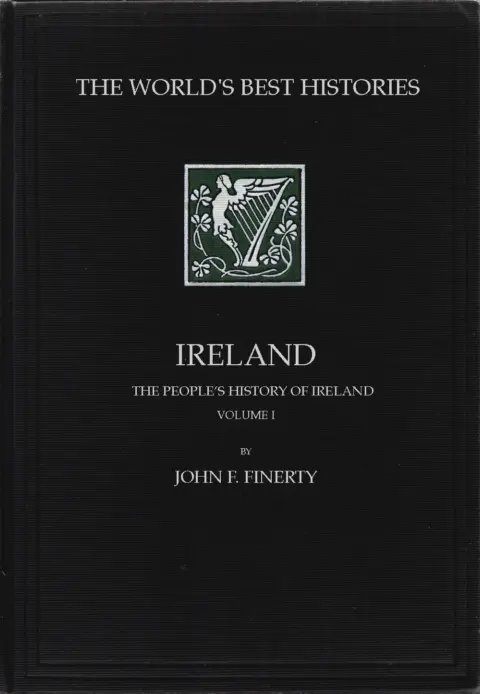
"Ireland: The People's History of Ireland, Volume 1" by John F. Finerty is a historical account written in the early 20th century. The text delves into the rich and complex history of Ireland, addressing the narrative from ancient times through significant events, such as the Reformation and invasions. It aims to provide a comprehensive understanding of the people and culture of Ireland, particularly for those unfamiliar with its past. At the start of the volume, Finerty discusses geographical and physical characteristics of Ireland, outlining its divisions into provinces and detailing the nation's fertile land and vibrant resources. The text emphasizes the importance of Ireland's history, noting the influence of its early inhabitants, the establishment of social structures, and the impact of various invasions, including the Danish and Norman incursions. Finerty aims to illuminate the contributions of the Irish people to the wider world and their enduring legacy, especially as it relates to the Irish diaspora in America.
Introduction adapted from the source catalogue; source summaries may be automatically generated.
Free to read · English · 128,763 words · No account needed
MAKE TIME FOR A GOOD BOOK
On by default. Untick to stop anonymous reading totals. Each page counts after 10 seconds in view. How this works.
Anonymous counting is on unless you have switched it off.
“Carew and Audley deep had sworn the Irish foe to tame, But thundering on their dying ear his shout of victory came; And burns with shame De Grey’s knit brow and throbs with rage his eye, To see his best, in wildest rout, from Erin’s clansmen fly.”
The defeat and death of “Shane the Proud” had left Ulster, temporarily, without a military chief competent to make head against the English, and, therefore, the Desmonds were left, practically, without help from the northern province. Notwithstanding, the new Lord Deputy, Perrott, kept his eyes fixed steadily on Ulster, the fighting qualities of whose sons he knew only too well. In Tyrconnel young Hugh Roe, or Red Hugh, O’Donnell, was growing fast to manhood, and his fame as an athlete, a hunter, and hater of the English, spread throughout Ireland. Hugh O’Neill, the son of Matthew, Baron of Dungannon, was enjoying himself at Elizabeth’s court, where he made the acquaintance of Cecil, Essex, Bacon, Marshal Bagnal, Mountjoy, and numerous other celebrities, and basked in the sunshine of the royal favor, which he took particular pains to cultivate. He was a handsome young man, of middle size, rigidly trained to arms, and “shaped in proportion fair.” The queen’s object was to make him an instrument in her hands for the final subjugation of Ireland. He seemed to enter readily into her plans, which his quick intellect at once comprehended, and he met her wiles with a dissimulation as profound as her own. If any man ever outwitted Elizabeth, politically, that man was Hugh O’Neill, whom she finally created Earl of Tyrone—a title which, in his inmost heart, he despised, much preferring his hereditary designation of “The O’Neill.” But it was not Hugh’s immediate purpose to quarrel with Elizabeth about titles, or, in fact, anything else. He was graciously permitted to raise a bodyguard of his own clansmen, and to arm and drill them at his pleasure. Nay, more, the queen allowed him to send from England shiploads of lead wherewith to put a new roof on his castle of Dungannon. And he went to Ireland to look after his interests in person. Soon, rumors reached Elizabeth that O’Neill, when he had sufficiently drilled one batch of clansmen, substituted another; and that enough lead had been shipped by him from England to Tyrone to roof twenty castles. It was further rumored that the clanswomen of Tyrone were employed casting bullets at night, instead of spinning and weaving. O’Neill, learning of these rumors from English friends, repaired to London, and, at once, reassured the queen as to his “burning loyalty and devotion to her person.” So he was permitted to return to Dungannon unmolested. Unlike his fierce kinsman, John the Proud, Hugh cultivated the friendship of all the Ulster chiefs, within reach, and more particularly that of the brave and handsome young Red Hugh O’Donnell. Nor did he confine his friendly relations to the chiefs of Ulster. He also perfected good understandings with many in the other three provinces, and managed to keep on good terms with the English also. Indeed, he did not hesitate to take the field occasionally “in the interest of the queen,” and, on one occasion, during a skirmish in Munster, received a wound in the thigh. How could Elizabeth doubt that one who shed his blood for her could be otherwise than devoted to her service? O’Neill, no doubt, liked the queen, but he loved Ireland and liberty much better. In his patriotic deceit he only followed the example set him at the English court. He kept “open house” at Dungannon Castle for all who might choose or chance to call. Among others, he received the wrecked survivors of the Spanish Armada cast away on the wild Ulster coast, and shipped them back to Spain, at his own expense, laden with presents for their king. A kinsman, Hugh of the Fetters—an illegitimate son of John the Proud by the wife of O’Donnell, already mentioned—betrayed his secret to the English Government. He explained his action to the satisfaction of the Lord Deputy, for he had a most persuasive tongue. Having done so, he exercised his hereditary privilege of the chief O’Neill, arrested Hugh of the Fetters, had him tried for treason, and, it is said, executed him with his own hand, because he could find no man in Tyrone willing to kill an O’Neill, even though proven a craven traitor.
Your reading position is saved on this browser. Take it to another device with a library code. Reading pages adapt to text, rather than matching a printed edition.
BEHIND THE BOOK
This eBook is for the use of anyone anywhere in the United States and most other parts of the world at no cost and with almost no restrictions whatsoever. You may copy it, give it away or re-use it under the terms of the Project Gutenberg License included with this eBook or online at www.gutenberg.org. If you are not located in the United States, you will have to check the laws of the country where you are located before using this eBook. Read the source licence.
The original source file, including credits and licence, is retained by this library. Request an original-format copy at no charge. Please include the book title and Project Gutenberg identifier #67845.
KEEP YOUR CURIOSITY GOING
Cécile Tormay

Moritz Busch
John L. Ransom
Frances Wright
Cécile Tormay

Mabel Potter Daggett