THE CLASSIC COLLECTION✦An outlaw’s diary: the CommuneCLASSIC FREE BOOKS
An outlaw’s diary: the Commune
Cécile Tormay
THE CLASSIC COLLECTION · 1904
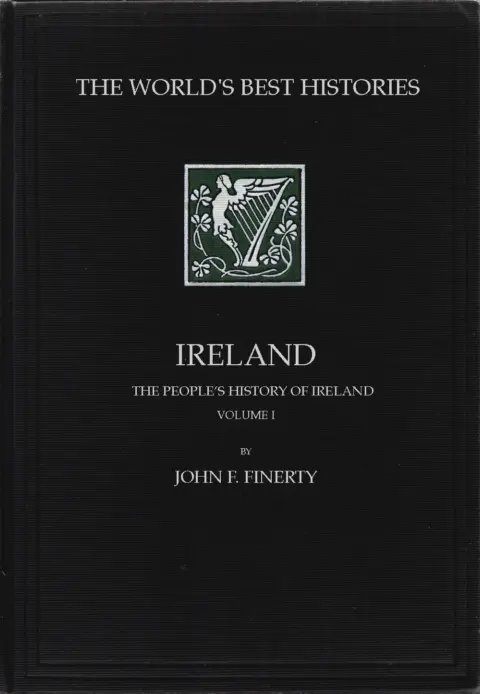
"Ireland: The People's History of Ireland, Volume 1" by John F. Finerty is a historical account written in the early 20th century. The text delves into the rich and complex history of Ireland, addressing the narrative from ancient times through significant events, such as the Reformation and invasions. It aims to provide a comprehensive understanding of the people and culture of Ireland, particularly for those unfamiliar with its past. At the start of the volume, Finerty discusses geographical and physical characteristics of Ireland, outlining its divisions into provinces and detailing the nation's fertile land and vibrant resources. The text emphasizes the importance of Ireland's history, noting the influence of its early inhabitants, the establishment of social structures, and the impact of various invasions, including the Danish and Norman incursions. Finerty aims to illuminate the contributions of the Irish people to the wider world and their enduring legacy, especially as it relates to the Irish diaspora in America.
Introduction adapted from the source catalogue; source summaries may be automatically generated.
Free to read · English · 128,763 words · No account needed
MAKE TIME FOR A GOOD BOOK
On by default. Untick to stop anonymous reading totals. Each page counts after 10 seconds in view. How this works.
Anonymous counting is on unless you have switched it off.
Elizabeth, called by her admiring English subjects “Good Queen Bess,” on very insufficient grounds, ascended the throne in 1558. She had, apparently, “conformed” to Catholicity during the lively reign of her half-sister, fearing, no doubt, for her head in case of refusal. Henry VIII’s daughter, by Anne Boleyn, she inherited great energy of character, a masculine intellect, superabundant vanity, a passion for empire, and a genius for intrigue. Her morals were none of the best, according to many historians. She was, for that age, highly educated, could speak divers tongues, and possessed many of the polite accomplishments. Indeed, she was somewhat of a female pedant. In person, while yet young, she was not ill-favored, being well-formed and of good stature. Her complexion was fair, her hair auburn, and her eyes small, but dark and sparkling. Her temper was irritable; she swore when angry, and, at times, her disposition was as ferocious as that of “Old Hal” himself. Like his, her loves were passing passions, and her friendship dangerous to those on whom she lavished it most freely. Flattery was the surest way by which to reach her consideration, but, in affairs of state, not even that could cloud her powerful understanding or balk her resolute will. She resolved to finish what her father and brother had begun, and finish it to the purpose—namely, the Reformation—in both England and Ireland. In the former country, her will soon became law, and Rome ceased to be considered, for generations, as a factor in English affairs. In Ireland, it was different. The people there refused, as a great majority, to conform to the new order of things. They obeyed the Pope, as their spiritual chief, and went to mass and received the sacraments as usual. In Ulster, particularly, the people, headed by John O’Neill, Prince of Tyrone, surnamed “The Proud,” resisted all English encroachments, civil and religious. A bloody war resulted. The English generals and some of the Anglo-Irish lords were commissioned by Elizabeth to force the new religion down the throats of the Irish people at the point of the sword. The Liturgy, she proclaimed, must be read in English, the mass abandoned, and she herself be recognized as Pope in Ireland, as well as in England. Accordingly, the English armies burned the Catholic churches and chapels, assassinated the clergy, and butchered the people wherever resistance was offered. But John O’Neill was a great soldier and managed, for many years, to defend his country with great success, defeating the best of the English captains in several fierce conflicts. Elizabeth, struck with his bravery and ability, invited him to visit her at her palace of Greenwich. The invitation was sent through Gerald of Kildare, O’Neill’s cousin. The Irish prince accepted and proceeded to court with a following of three hundred galloglasses, or heavy infantry, clad in saffron-colored jackets, close-fitting pantaloons, heavy shoes, short cloaks, and with their hair hanging down their backs, defiant of Poynings’ Law, and all other English enactments. They were gigantic warriors—all more than six feet tall—and with huge mustaches, the drooping ends of which touched their collarbones. They also carried truculent-looking daggers and immense battle-axes, such as might have won the admiration of Richard Cœur de Lion himself. The English courtiers—pigmies compared with the galloglasses—might have been inclined to make fun of their costumes, but those deadly appearing axes inspired awe, and no unpleasant incident occurred during the visit. “Shane the Proud” made a deep impression on Elizabeth, for he was physically magnificent and as fierce as her dreaded father. “By what right do you oppose me in Ulster?” she asked. “By very good right, madam,” he answered. “You may be queen here, but I am king in Ulster, and so have been the O’Neills for thousands of years!” Then she offered to make him Earl of Tyrone by letters patent. “Earl me no earls, madam,” he replied. “The O’Neill is my title! By it I stand or fall!” There was nothing more to be said, so the queen made him rich presents, after asking him to be her “good friend,” which, being a gallant, he promised, and then he went back to Ulster.
Your reading position is saved on this browser. Take it to another device with a library code. Reading pages adapt to text, rather than matching a printed edition.
BEHIND THE BOOK
This eBook is for the use of anyone anywhere in the United States and most other parts of the world at no cost and with almost no restrictions whatsoever. You may copy it, give it away or re-use it under the terms of the Project Gutenberg License included with this eBook or online at www.gutenberg.org. If you are not located in the United States, you will have to check the laws of the country where you are located before using this eBook. Read the source licence.
The original source file, including credits and licence, is retained by this library. Request an original-format copy at no charge. Please include the book title and Project Gutenberg identifier #67845.
KEEP YOUR CURIOSITY GOING
Cécile Tormay

Moritz Busch
John L. Ransom
Frances Wright
Cécile Tormay

Mabel Potter Daggett