THE CLASSIC COLLECTION✦An outlaw’s diary: the CommuneCLASSIC FREE BOOKS
An outlaw’s diary: the Commune
Cécile Tormay
THE CLASSIC COLLECTION · 1904
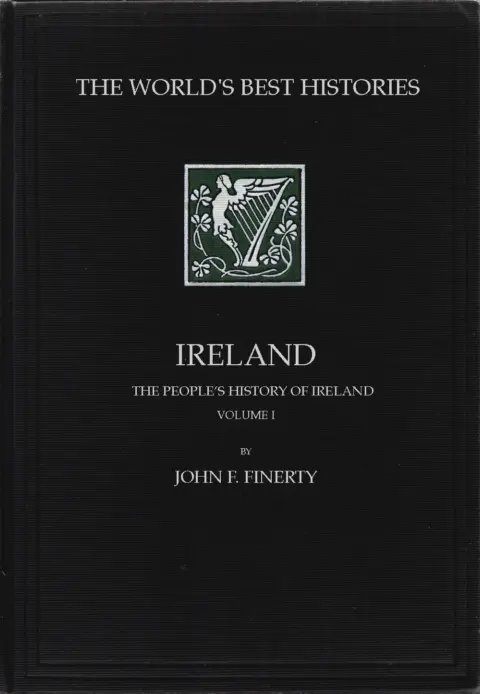
"Ireland: The People's History of Ireland, Volume 1" by John F. Finerty is a historical account written in the early 20th century. The text delves into the rich and complex history of Ireland, addressing the narrative from ancient times through significant events, such as the Reformation and invasions. It aims to provide a comprehensive understanding of the people and culture of Ireland, particularly for those unfamiliar with its past. At the start of the volume, Finerty discusses geographical and physical characteristics of Ireland, outlining its divisions into provinces and detailing the nation's fertile land and vibrant resources. The text emphasizes the importance of Ireland's history, noting the influence of its early inhabitants, the establishment of social structures, and the impact of various invasions, including the Danish and Norman incursions. Finerty aims to illuminate the contributions of the Irish people to the wider world and their enduring legacy, especially as it relates to the Irish diaspora in America.
Introduction adapted from the source catalogue; source summaries may be automatically generated.
Free to read · English · 128,763 words · No account needed
MAKE TIME FOR A GOOD BOOK
On by default. Untick to stop anonymous reading totals. Each page counts after 10 seconds in view. How this works.
Anonymous counting is on unless you have switched it off.
Henry married Anne Boleyn when he had “divorced” Queen Catherine. After the Princess Elizabeth was born, he tired of his new wife, had her tried for faithlessness and high treason and beheaded. Scarcely was she dead when the inhuman brute married Lady Jane Seymour, of the great Somerset family. She gave birth to Prince Edward and died. Then he married Anne of Cleves, but, not liking her person, “divorced” her and sent her back to Germany. For “imposing” her on him, he disgraced, and finally beheaded, the Lord Chancellor, Thomas Cromwell, who had been his great friend. The monster next espoused Lady Catherine Howard, of the House of Surrey, but he had her beheaded, on charges almost similar to those urged against Anne Boleyn, within the year. At last he married a widow of two experiences, Lady Catharine Parr, who, being a woman of tact and cleverness, managed to save her head, although frequently in danger, until the ferocious king, who must have been somewhat insane, finally fell a victim to his own unbridled vices. “The plain truth,” says Charles Dickens, in his “Child’s History,” “is that Henry VIII was a most intolerable ruffian, a disgrace to human nature, and a blot of blood and grease upon the history of England.”
This was the crowned “fiend in human shape” who sought to effect his “Reformation in Ireland,” where both the Old Irish and the Old English had united against his tyranny. The weight of his wrath fell first upon the Leinster Geraldines, whom he dreaded. He contrived to pick a quarrel with Gerald, ninth Earl of Kildare, who had been for many years his favorite viceroy in Ireland, and summoned him to London in hot haste, on flimsy, notoriously “trumped-up” charges of treason. He flung him into a dungeon in the Tower of London. Lord Thomas Fitzgerald, son of the Earl, called “Silken Thomas,” because of the beauty of his person and the splendor of his apparel, was appointed deputy by his father, who thought his absence in England might be brief. Lord Thomas was young, brave, and rash, and, in short, the very man to fall an easy victim to the wiles of his House’s enemies. Tradition says that the false news of Earl Gerald’s execution, by order of King Henry, was spread in Dublin by one of the Butlers. The privy council, over which he usually presided, was already in session at St. Mary’s Abbey, when “Silken Thomas” heard the story. He, at once, with a large escort, proceeded to the abbey, renounced his allegiance to the English monarch, and, seizing the sword of state from the sword-bearer, threw it, with violent gesture, on the council table, “the English Thanes among.” Protests availed nothing. He rushed to arms, and for nearly two years held at bay Henry’s power. Had he but laid his plans with care and judgment, he would, no doubt, have ended the rule of England over Ireland, which, although not his primary, became his ultimate, object. In the end, his stronghold of Maynooth Castle was betrayed into the hands of the English general, Sir William Skeffington, by Lord Thomas’s foster-brother, Parez, for a sum in gold. General Skeffington paid the money on the surrender of the castle, and immediately hanged the traitor. For this act of chivalric justice, the name of that stern Englishman is still held in respect by all readers of Irish history. The loss of Maynooth depleted the strength of “Silken Thomas.” He struggled on for some time longer, but, at last, accepted the terms of Lord Deputy Gray, who offered him his life and guaranteed the safety of his five uncles—two, at least, of whom had had no hand in the outbreak. They were invited to a banquet by the Lord Deputy, and there, while drinking with their false hosts, were treacherously seized, placed in irons, and sent to England in a ship called the Cow. One of the uncles, hearing the name of the vessel, said: “We are lost! I have dreamed that six of us, Geraldines, would be carried to England in the belly of a cow and there lose our heads!” The augury was fulfilled. Henry VIII, with his usual disregard of terms, had them beheaded immediately after their arrival in London, at Tyburn. The old Earl of Kildare had not been executed after all, but died of a broken heart in the Tower on learning of the revolt and misfortunes of his son. Only one heir-male of the noble House of Kildare now survived, and for him, although only twelve years old, Henry sought, through his agents, with the relentless ferocity of a Herod. The boy was related to the great Celtic houses, for the Geraldines of that period preferred Irish wives, and his mother was a princess of the House of O’Neill of Ulster. By her, and by other noble Irish ladies, he was concealed and protected until he was enabled to escape to France. Thence he proceeded to Rome, where he was educated as befitted his rank and lineage. This young Gerald was restored to his titles and estates by Queen Mary I, but he accepted Protestantism when Elizabeth came to the throne, because, otherwise, he could not have saved land and title—a most unworthy motive, but one very common in that violent and sanguinary era. In his descendants the elder Geraldine branch still lives in Ireland—the present head of the family being Maurice Fitzgerald, “the boy-Duke” of Leinster.
Your reading position is saved on this browser. Take it to another device with a library code. Reading pages adapt to text, rather than matching a printed edition.
BEHIND THE BOOK
This eBook is for the use of anyone anywhere in the United States and most other parts of the world at no cost and with almost no restrictions whatsoever. You may copy it, give it away or re-use it under the terms of the Project Gutenberg License included with this eBook or online at www.gutenberg.org. If you are not located in the United States, you will have to check the laws of the country where you are located before using this eBook. Read the source licence.
The original source file, including credits and licence, is retained by this library. Request an original-format copy at no charge. Please include the book title and Project Gutenberg identifier #67845.
KEEP YOUR CURIOSITY GOING
Cécile Tormay

Moritz Busch
John L. Ransom
Frances Wright
Cécile Tormay

Mabel Potter Daggett