THE CLASSIC COLLECTION✦An outlaw’s diary: the CommuneCLASSIC FREE BOOKS
An outlaw’s diary: the Commune
Cécile Tormay
THE CLASSIC COLLECTION · 1904
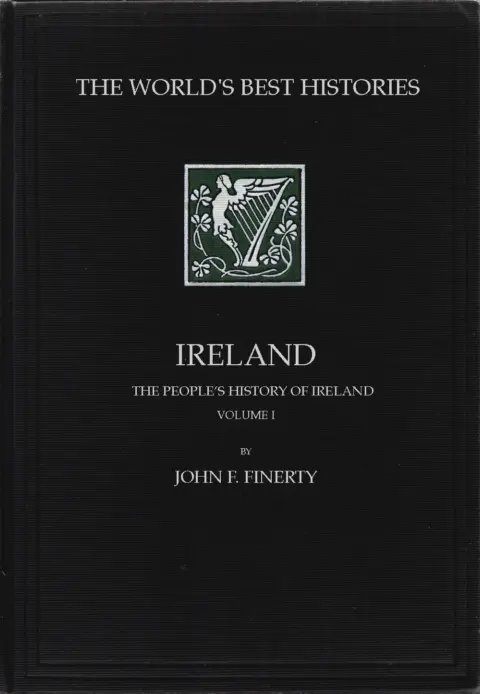
"Ireland: The People's History of Ireland, Volume 1" by John F. Finerty is a historical account written in the early 20th century. The text delves into the rich and complex history of Ireland, addressing the narrative from ancient times through significant events, such as the Reformation and invasions. It aims to provide a comprehensive understanding of the people and culture of Ireland, particularly for those unfamiliar with its past. At the start of the volume, Finerty discusses geographical and physical characteristics of Ireland, outlining its divisions into provinces and detailing the nation's fertile land and vibrant resources. The text emphasizes the importance of Ireland's history, noting the influence of its early inhabitants, the establishment of social structures, and the impact of various invasions, including the Danish and Norman incursions. Finerty aims to illuminate the contributions of the Irish people to the wider world and their enduring legacy, especially as it relates to the Irish diaspora in America.
Introduction adapted from the source catalogue; source summaries may be automatically generated.
Free to read · English · 128,763 words · No account needed
MAKE TIME FOR A GOOD BOOK
On by default. Untick to stop anonymous reading totals. Each page counts after 10 seconds in view. How this works.
Anonymous counting is on unless you have switched it off.
Geraldus Cambrensis, or Gerald Barry, a Norman priest of Welsh birth, accompanied, A.D. 1185, King Henry’s son, John, as chronicler, to Ireland. Like nearly every man of his race, he hated the native Irish, but, occasionally, as if by accident, spoke well of some of them. In general, however, his book is a gross libel on the Irish Church and the Irish people. He purports to give Roderick O’Conor’s address to his army on the eve of battle with the Anglo-Normans, and the concluding words of the speech are alleged to have been as follows: “Let us then,” said the Irish king, “following the example of the Franks, and fighting bravely for our country, rush against our enemies, and as these foreigners have come over few in numbers, let us crush them by a general attack. Fire, while it only sparkles, may be speedily quenched, but when it has burst into a flame, being fed with fresh materials, its power increases with the bulk, and it can not be easily extinguished. It is always best to meet difficulties half way, and check the first approaches of disease, for (the Latin quotation of the king is here translated)
“Too late is medicine, after long delay, To stop the lingering course of slow decay.
Wherefore, defending our country and liberty, and acquiring for ourselves eternal renown, let us, by a resolute attack, and the extermination of our enemies, though they are but few in number, strike terror into the many, and, by their defeat, evermore deter foreign nations from such nefarious attempts.”
Henry’s astute policy disarmed, for a time, even Roderick himself. The Anglo-Norman monarch, who would have made an admirable modern politician, does not seem to have desired the absolute ruin of the Irish nation, but his greedy Norman captains were of a different mind, and when Henry, after having wined and dined the Irish princes to their hearts’ content, in Dublin and other cities, at last returned to England, in the fall of 1173, the Norman leaders showed their teeth to the Irish people, and forced most of those who had submitted into fierce revolt. As a result, the Norman forces were crushed in the field. Strongbow, himself, was shut up in Waterford, and his comrades were similarly placed in Dublin, Drogheda, and Wexford. Henry, incensed at this unlooked-for sequel to his Irish pilgrimage, sent over a commission to inquire into the facts. The result was that an Irish delegation went to London to explain, and, at Windsor, where Henry held his court, a treaty was entered into, finally, between King Roderick and himself, by which the former acknowledged Henry as “suzerain,” and Roderick was recognized as High King of Ireland, except the portions thereof held by the Normans under Henry. This was a sad ending of Roderick’s heroic beginning. As usual with English monarchs, when dealing with the Irish people, Henry, urged by his greedy dependants in Ireland, soon found means to grossly violate the Treaty of Windsor, as the compact between the representatives of Roderick and himself was called, thus vitiating it forever and absolving the Irish nation from observing any of its provisions. Another fierce rebellion followed, in which the southern and western Irish—the Anglo-Normans having now grown more numerous and powerful—were remorselessly crushed. Roderick’s rascally son, Prince Murrough O’Conor, who thought his father should be satisfied with the titular High Kingship, and that he himself should be King of Connaught, rose in revolt and attempted to seize the provincial crown. The Connacians, indignant at his baseness, stood by the old king. Murrough was defeated and received condign punishment. This bad prince must have been familiar with the unseemly course pursued by the sons of Henry II in Normandy, for he allied himself with his country’s, and his father’s, enemies, the Anglo-Normans, under the treacherous De Cogan, and this act, more even than his filial impiety, inflamed the minds of his countrymen against the unnatural miscreant. King Roderick, unhappy man, whose pride was mortally wounded, and whose paternal heart, tender and manly, was wrung with sorrow at the crime of his son and its punishment—decreed by the Clans and not by himself—disgusted, besides, with the hopeless condition of Irish affairs, made up his mind to retire from the world, its pomps and vexations. He repaired to the ancient monastery of Cong, in Galway, and there, after twelve years of pious devotion, on the 29th day of November, 1198, in the 82d year of his age, this good and noble but irresolute monarch surrendered his soul to God. He was not buried at Cong, as some annalists have asserted, but in the chancel of the Temple Mor, or Great Church, of Clonmacnois, in the present King’s County, where he was educated. Tradition has failed to preserve the location of the exact place of sepulture within the ruined shrine. And so ended the last Ard-Righ, or High King, that had swayed the sceptre of an independent Ireland.
Your reading position is saved on this browser. Take it to another device with a library code. Reading pages adapt to text, rather than matching a printed edition.
BEHIND THE BOOK
This eBook is for the use of anyone anywhere in the United States and most other parts of the world at no cost and with almost no restrictions whatsoever. You may copy it, give it away or re-use it under the terms of the Project Gutenberg License included with this eBook or online at www.gutenberg.org. If you are not located in the United States, you will have to check the laws of the country where you are located before using this eBook. Read the source licence.
The original source file, including credits and licence, is retained by this library. Request an original-format copy at no charge. Please include the book title and Project Gutenberg identifier #67845.
KEEP YOUR CURIOSITY GOING
Cécile Tormay

Moritz Busch
John L. Ransom
Frances Wright
Cécile Tormay

Mabel Potter Daggett