THE CLASSIC COLLECTION✦The Knight of MaltaCLASSIC FREE BOOKS
The Knight of Malta
Eugène Sue
THE CLASSIC COLLECTION · 1839
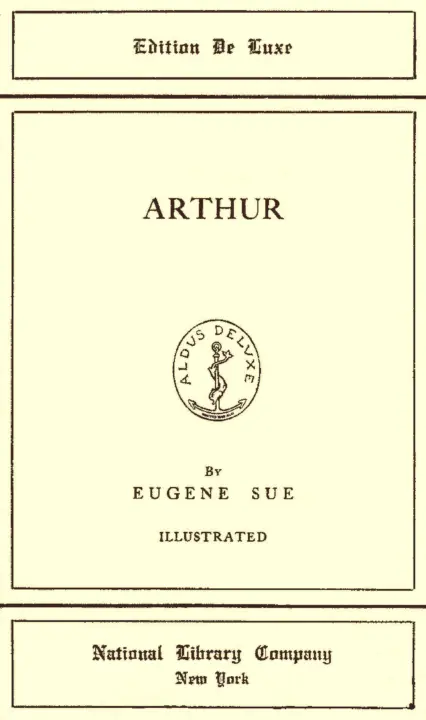
"Arthur" by Eugène Sue is a novel written in the late 19th century. The story unfolds through the intertwining lives of various characters, with an emphasis on the mysterious figure of Count Arthur and the tragedy surrounding his household. The opening portions hint at themes of intrigue, love, and loss, captivating readers who are drawn to character-driven narratives steeped in emotion and moral complexity. At the start of the novel, the protagonist, who remains unnamed, recounts a chance encounter that leads him to explore a quaint southern village, drawn by the allure of a country house rumored to be for sale. As he journeys through the picturesque landscape, he learns intriguing tales of previous travelers to the village, notably one ominous story involving a mysterious carriage that never returned. Upon reaching the village, he meets the curé and his sister, who are steeped in sadness related to the house's past. This foreshadows deeper explorations of love and loss and sets the stage for revelations regarding Count Arthur, a character woven into the fabric of the village's tragic history. The sense of curiosity and impending revelations builds a compelling narrative thread that invites readers further into the novel's intricate plot.
Introduction adapted from the source catalogue; source summaries may be automatically generated.
Free to read · English · 180,723 words · No account needed
MAKE TIME FOR A GOOD BOOK
On by default. Untick to stop anonymous reading totals. Each page counts after 10 seconds in view. How this works.
Anonymous counting is on unless you have switched it off.
"This is my niece, monsieur," said the fermière, who neither noticed my surprise nor Desdemona's trouble. "She is the daughter of my poor brother, lieutenant in the Old Guard, who was killed at Waterloo. Thanks to the protection of Monseigneur the Bishop of Nantes, we were permitted to send Marie to St. Denis, where she was educated like a demoiselle. She remained there until her marriage, which took place at Nantes about a year ago." Madame Kerouët said this with a sigh. Then she continued: "But sit down, monsieur; and thou, Marie, go get a bottle of wine and a bit of warm galette."
"A thousand thanks, madame," said I, "I would rather not take anything. As soon as the rain is over I will continue on my journey."
To keep herself in countenance, Marie sat down to her aunt's
spinning-wheel.
"Perhaps you are on your way to the château de Serval?"
"Non, madame; I told you I was going to Blémur."
"Ah, yes, to be sure, to Blémur; pardon, monsieur,--so much the better
for you."
"How is that, madame? Is the master of Serval inhospitable?"
"I don't know anything about that, monsieur; but they do say that he has no more wish to see human faces than human faces have to see him," replied Madame Kerouët.
"And why is that? Does he wish to live alone?"
"Hum, hum!" said the fermière, shaking her head, "I have only just come to these parts, and don't know the truth of the ugly stories they tell about him; besides, monsieur, the count is our master, and a very good master, they say; so I won't speak of what is none of my business. But, Marie, you are tangling all my flax again," she called out to the young woman. "Never wilt thou know how to use a distaff; hand it to me."
"And you, madame," I said to Marie, "have you any more certain
information than madame your aunt as to the redoubtable inhabitant of
Serval?"
"No, monsieur, I have only heard them say that M. the count lived a very retired life; and as I love solitude myself, I can understand that others care for it as well."
"You have so many means of charming your retreat, madame, that I can readily believe it must be attractive; in the first place, you are an excellent musician. I can say so, because I have just been fortunate enough to hear you sing."
"And she can draw and paint, too," added Madame Kerouët, admiringly.
Your reading position is saved on this browser. Take it to another device with a library code. Reading pages adapt to text, rather than matching a printed edition.
Eugène Sue
Eugène Sue
Eugène Sue
Eugène Sue
BEHIND THE BOOK
This eBook is for the use of anyone anywhere in the United States and most other parts of the world at no cost and with almost no restrictions whatsoever. You may copy it, give it away or re-use it under the terms of the Project Gutenberg License included with this eBook or online at www.gutenberg.org. If you are not located in the United States, you will have to check the laws of the country where you are located before using this eBook. Read the source licence.
The original source file, including credits and licence, is retained by this library. Request an original-format copy at no charge. Please include the book title and Project Gutenberg identifier #66473.
KEEP YOUR CURIOSITY GOING
Coulson Kernahan

Maurice Baring
Frances Wright
Cécile Tormay

Frederic Jesup Stimson

W. H. P. (William Henry Pope) Jarvis