THE CLASSIC COLLECTION✦The Knight of MaltaCLASSIC FREE BOOKS
The Knight of Malta
Eugène Sue
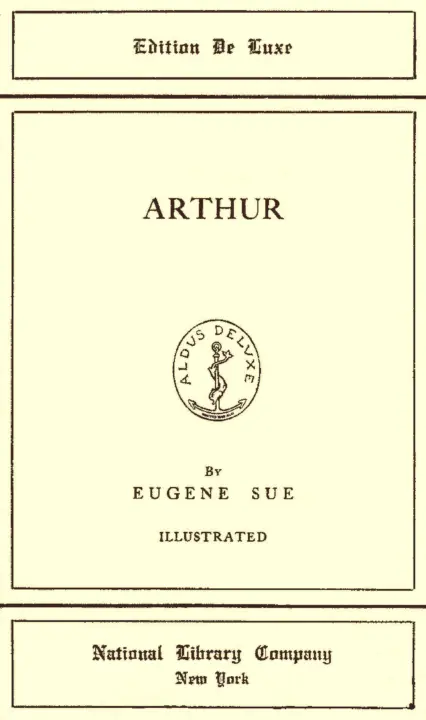
THE CLASSIC COLLECTION · 1839
"Arthur" by Eugène Sue is a novel written in the late 19th century. The story unfolds through the intertwining lives of various characters, with an emphasis on the mysterious figure of Count Arthur and the tragedy surrounding his household. The opening portions hint at themes of intrigue, love, and loss, captivating readers who are drawn to character-driven narratives steeped in emotion and moral complexity. At the start of the novel, the protagonist, who remains unnamed, recounts a chance encounter that leads him to explore a quaint southern village, drawn by the allure of a country house rumored to be for sale. As he journeys through the picturesque landscape, he learns intriguing tales of previous travelers to the village, notably one ominous story involving a mysterious carriage that never returned. Upon reaching the village, he meets the curé and his sister, who are steeped in sadness related to the house's past. This foreshadows deeper explorations of love and loss and sets the stage for revelations regarding Count Arthur, a character woven into the fabric of the village's tragic history. The sense of curiosity and impending revelations builds a compelling narrative thread that invites readers further into the novel's intricate plot.
Introduction adapted from the source catalogue; source summaries may be automatically generated.
Free to read · English · 180,723 words · No account needed
MAKE TIME FOR A GOOD BOOK
On by default. Untick to stop anonymous reading totals. Each page counts after 10 seconds in view. How this works.
Anonymous counting is on unless you have switched it off.
At the risk of being seen, she took my hand, and in a voice almost extinct she said: "Arthur, have pity on me! What I am suffering is beyond my strength, beyond my courage!"
At this moment, M. de ---- also entered the parlour to see the picture.
Madame de Fersen had so completely lost her head, that I had abruptly to withdraw my hand from hers.
I believe M. de ---- noticed the movement, for he appeared confused.
"This picture is very good," I said to Catherine, "the expression is charming. Art has never more closely approached to nature."
Madame de Fersen was so weak that she leaned upon an easy chair.
M. de ---- admired the picture complacently. The servant announced to the princess that tea was ready.
We returned to the drawing-room. Catherine could scarcely stand.
According to her custom, she stood near the table pouring out the tea; she offered me a cup, and was gazing at me almost wildly, when the cracking of a whip and the jingling of bells were heard in the courtyard.
Struck by a terrible presentiment, Catherine allowed the cup to slip from her fingers just as I was about to take hold of it, and cried, in a strangled voice: "What is that?"
"A thousand pardons for my awkwardness, madame, and for the noise those wretches are making. As I take my departure to-night, I have taken the liberty to order my travelling carriage to come for me here, not wishing to lose one moment of the precious time I might enjoy your society."
Catherine could not resist this last shock; she forgot herself completely, and, in a smothered voice, resting her trembling hands upon my arm, she cried: "It is impossible, you are not leaving, you shall not leave! I will not allow you to leave!"
At the movement of general consternation, at the confused, embarrassed expression of the spectators of this scene, I could see that Madame de Fersen's reputation, hitherto unassailed, was now for ever lost.
I remained inflexible.
Gently disengaging my arm from her hands, I said:
"I feel so happy and proud, madame, at the regret my departure seems to give you, that I would already be thinking of my return, were it not unfortunately impossible to predict it." Then in saluting her I added: "Here, madame, are the particulars you asked of me."
And I handed her a duplicate of the commentary I had written on her
love.
Catherine no longer heard me; she had fallen prostrated into an armchair, mechanically holding in her hands the notes I had left her.
I took my departure.
The next evening I was here,--at Serval.
Your reading position is saved on this browser. Take it to another device with a library code. Reading pages adapt to text, rather than matching a printed edition.
Eugène Sue
Eugène Sue
Eugène Sue
Eugène Sue
BEHIND THE BOOK
This eBook is for the use of anyone anywhere in the United States and most other parts of the world at no cost and with almost no restrictions whatsoever. You may copy it, give it away or re-use it under the terms of the Project Gutenberg License included with this eBook or online at www.gutenberg.org. If you are not located in the United States, you will have to check the laws of the country where you are located before using this eBook. Read the source licence.
The original source file, including credits and licence, is retained by this library. Request an original-format copy at no charge. Please include the book title and Project Gutenberg identifier #66473.
KEEP YOUR CURIOSITY GOING
Coulson Kernahan

Maurice Baring
Frances Wright
Cécile Tormay

Frederic Jesup Stimson

W. H. P. (William Henry Pope) Jarvis