THE CLASSIC COLLECTION✦The Knight of MaltaCLASSIC FREE BOOKS
The Knight of Malta
Eugène Sue
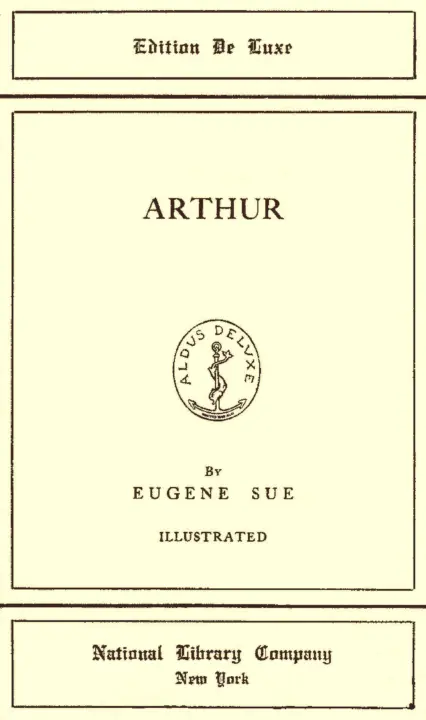
THE CLASSIC COLLECTION · 1839
"Arthur" by Eugène Sue is a novel written in the late 19th century. The story unfolds through the intertwining lives of various characters, with an emphasis on the mysterious figure of Count Arthur and the tragedy surrounding his household. The opening portions hint at themes of intrigue, love, and loss, captivating readers who are drawn to character-driven narratives steeped in emotion and moral complexity. At the start of the novel, the protagonist, who remains unnamed, recounts a chance encounter that leads him to explore a quaint southern village, drawn by the allure of a country house rumored to be for sale. As he journeys through the picturesque landscape, he learns intriguing tales of previous travelers to the village, notably one ominous story involving a mysterious carriage that never returned. Upon reaching the village, he meets the curé and his sister, who are steeped in sadness related to the house's past. This foreshadows deeper explorations of love and loss and sets the stage for revelations regarding Count Arthur, a character woven into the fabric of the village's tragic history. The sense of curiosity and impending revelations builds a compelling narrative thread that invites readers further into the novel's intricate plot.
Introduction adapted from the source catalogue; source summaries may be automatically generated.
Free to read · English · 180,723 words · No account needed
MAKE TIME FOR A GOOD BOOK
On by default. Untick to stop anonymous reading totals. Each page counts after 10 seconds in view. How this works.
Anonymous counting is on unless you have switched it off.
"His Excellency the Russian ambassador," announced the footman.
Madame de Fersen had barely time to disappear behind the portière which concealed the door between the parlour and her bedchamber.
"I am, like you, waiting for Madame de Fersen," I said to M. P. de B----, "she is doubtless finishing her toilet. You are going to the Chambers, I believe?"
"Yes; it will be a most brilliant and interesting sitting; they say that Benjamin Constant, Foy, and Casimir Perier are going to speak, and that M. de Villèle will answer."
Catherine entered, calm and composed, as if nothing had passed between
us.
Her control over herself angered me.
After a few unmeaning words M. P. de B---- remarked that it was getting late, and it was best to start at once in order to find places in the diplomatic gallery. He offered his arm to Madame de Fersen, who suggested that I should go with them, accompanying the proposal with an imploring glance to which I was insensible.
I left Madame de Fersen in a state of irritation, dissatisfied with her
and with myself.
My carriage drove me to the Tuileries, where I got down for a walk.
By chance I met Pommerive.
I had not seen him since I left Paris in the spring.
I felt so sad, so gloomy, that I was not sorry to find some distraction
for my thoughts.
"Where do you come from, M. de Pommerive?" I inquired.
"Don't speak of it! I have been for three months in Franche-Comté, at St. Prix, with the D'Aranceys. Don't speak of it, it is disgusting!"
"They are certainly rich enough to give you some of those excellent dinners you are so fond of, and for which you show yourself so grateful, M. de Pommerive."
"The only way to show one's gratitude for a good dinner is to eat it with pleasure," said the cynic. "I don't complain of the table at D'Arancey's, they have first-rate fare. The father of D'Arancey has stolen enough by his contracts and otherwise; he has brought about enough fraudulent bankruptcies to enable his son to display all that luxury. By the bye, do you know that he has as much right to call himself D'Arancey, as I have to call myself Jeroboam! His name is simply something like Polimard; now, this common, low name is not pleasing to this fine gentleman, so, by means of a slight change, skilfully substituting D'Aran for Poli, and cey for mard, he has changed the distinguished name of Polimard into D'Arancey. He likes that better. You may tell me that this bankrupt's son had no reason to cling to his name, since he had none at all, for he had never been acknowledged by old Polimard, who died the victim of an epizooty, which made havoc in his district. This, however, is not a reason for him to take the name of the D'Aranceys, and what is worse, their arms, which that vulgar and impudent little creature, forsooth, calls her arms, and which she displays, I believe, even on her scullery maids' kitchen aprons. This is certainly very nice for the escutcheon of the D'Aranceys, whose name unfortunately is extinct; without that, the Polimards, male and female, should be whipped and branded, as ought to have been done to old Polimard, the first of the name."
Your reading position is saved on this browser. Take it to another device with a library code. Reading pages adapt to text, rather than matching a printed edition.
Eugène Sue
Eugène Sue
Eugène Sue
Eugène Sue
BEHIND THE BOOK
This eBook is for the use of anyone anywhere in the United States and most other parts of the world at no cost and with almost no restrictions whatsoever. You may copy it, give it away or re-use it under the terms of the Project Gutenberg License included with this eBook or online at www.gutenberg.org. If you are not located in the United States, you will have to check the laws of the country where you are located before using this eBook. Read the source licence.
The original source file, including credits and licence, is retained by this library. Request an original-format copy at no charge. Please include the book title and Project Gutenberg identifier #66473.
KEEP YOUR CURIOSITY GOING
Coulson Kernahan

Maurice Baring
Frances Wright
Cécile Tormay

Frederic Jesup Stimson

W. H. P. (William Henry Pope) Jarvis