THE CLASSIC COLLECTION✦The Knight of MaltaCLASSIC FREE BOOKS
The Knight of Malta
Eugène Sue
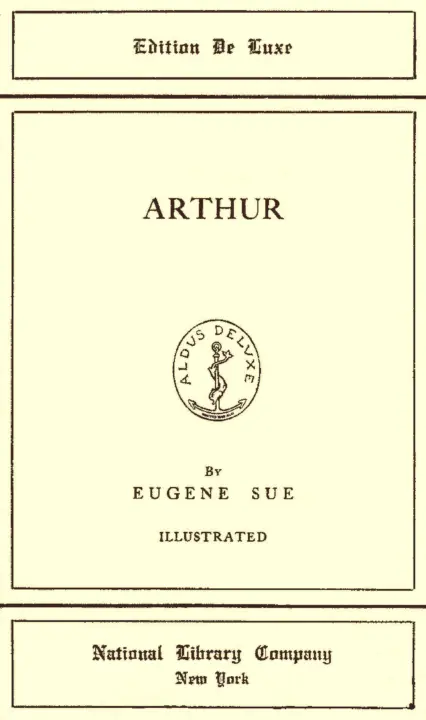
THE CLASSIC COLLECTION · 1839
"Arthur" by Eugène Sue is a novel written in the late 19th century. The story unfolds through the intertwining lives of various characters, with an emphasis on the mysterious figure of Count Arthur and the tragedy surrounding his household. The opening portions hint at themes of intrigue, love, and loss, captivating readers who are drawn to character-driven narratives steeped in emotion and moral complexity. At the start of the novel, the protagonist, who remains unnamed, recounts a chance encounter that leads him to explore a quaint southern village, drawn by the allure of a country house rumored to be for sale. As he journeys through the picturesque landscape, he learns intriguing tales of previous travelers to the village, notably one ominous story involving a mysterious carriage that never returned. Upon reaching the village, he meets the curé and his sister, who are steeped in sadness related to the house's past. This foreshadows deeper explorations of love and loss and sets the stage for revelations regarding Count Arthur, a character woven into the fabric of the village's tragic history. The sense of curiosity and impending revelations builds a compelling narrative thread that invites readers further into the novel's intricate plot.
Introduction adapted from the source catalogue; source summaries may be automatically generated.
Free to read · English · 180,723 words · No account needed
MAKE TIME FOR A GOOD BOOK
On by default. Untick to stop anonymous reading totals. Each page counts after 10 seconds in view. How this works.
Anonymous counting is on unless you have switched it off.
"Very much, my poor Irene."
"When a child is suffering, her mother comes to suffer in her stead, so that the little one may not suffer any more, is it not so?" she inquired, gravely.
Astonished at this reasoning, I looked at her attentively without
replying. She continued:
"I wish to suffer in my mother's place, take me to the doctor."
This childish trait, which, under other circumstances, would have made me smile, gave me a heart pang, and I kissed Irene to conceal my tears.
THE GROVE, 17th May, 18--.
There is hope; the delirium ceases; an alarming prostration has followed. Doctor Ralph dreaded the heat of her fevered blood. Now he fears excessive languor, heart failure.
Her consciousness has returned. Her first utterance was her child's
name.
The nurse told me that the doctor had not yet allowed Irene to go near
her mother.
Twenty times have I been on the point of asking Madame Paul if Catherine had inquired after me, but I dared not.
THE GROVE, 18th May, 18--.
To-day, for the first time, Doctor Ralph permitted the nurse to take
Irene to her mother.
I waited with anxious and irritable impatience for the moment when I would see Irene, hoping from her to have some particulars about her mother, perhaps a word, a remembrance, from Catherine.
Once returned to consciousness, I know not what course Madame de Fersen
will take towards me.
During the paroxysm of remorseful despair which follows a first fault, a woman often hates the man to whom she has succumbed; she overwhelms him with reproaches as violent as her regrets, as vehement as her sorrow; it is on him alone the sole responsibility weighs for their guilt; she is not his accomplice, but his victim.
If her soul has remained pure, notwithstanding that for a moment she was involuntarily led astray, she takes the sincere resolution never again to see the man who has seduced her, and to have to weep over one sole betrayal, one sole defeat.
To this resolution she at first remains faithful.
She seeks, not to excuse, but to redeem her error, by the rigorous fulfilment of her duties; but the remembrance of her fault is there, ever there.
The more noble the heart, the more austere the conscience, so will the remorse be the more implacable. Then, alas! she suffers terribly, the poor creature, for she stands alone, and is compelled in secret to devour her tears, while to the world she still wears a smile.
Your reading position is saved on this browser. Take it to another device with a library code. Reading pages adapt to text, rather than matching a printed edition.
Eugène Sue
Eugène Sue
Eugène Sue
Eugène Sue
BEHIND THE BOOK
This eBook is for the use of anyone anywhere in the United States and most other parts of the world at no cost and with almost no restrictions whatsoever. You may copy it, give it away or re-use it under the terms of the Project Gutenberg License included with this eBook or online at www.gutenberg.org. If you are not located in the United States, you will have to check the laws of the country where you are located before using this eBook. Read the source licence.
The original source file, including credits and licence, is retained by this library. Request an original-format copy at no charge. Please include the book title and Project Gutenberg identifier #66473.
KEEP YOUR CURIOSITY GOING
Coulson Kernahan

Maurice Baring
Frances Wright
Cécile Tormay

Frederic Jesup Stimson

W. H. P. (William Henry Pope) Jarvis