THE CLASSIC COLLECTION✦The Knight of MaltaCLASSIC FREE BOOKS
The Knight of Malta
Eugène Sue
THE CLASSIC COLLECTION · 1839
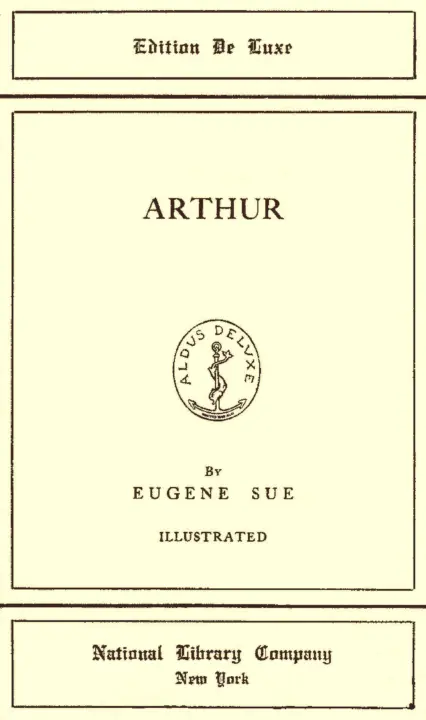
"Arthur" by Eugène Sue is a novel written in the late 19th century. The story unfolds through the intertwining lives of various characters, with an emphasis on the mysterious figure of Count Arthur and the tragedy surrounding his household. The opening portions hint at themes of intrigue, love, and loss, captivating readers who are drawn to character-driven narratives steeped in emotion and moral complexity. At the start of the novel, the protagonist, who remains unnamed, recounts a chance encounter that leads him to explore a quaint southern village, drawn by the allure of a country house rumored to be for sale. As he journeys through the picturesque landscape, he learns intriguing tales of previous travelers to the village, notably one ominous story involving a mysterious carriage that never returned. Upon reaching the village, he meets the curé and his sister, who are steeped in sadness related to the house's past. This foreshadows deeper explorations of love and loss and sets the stage for revelations regarding Count Arthur, a character woven into the fabric of the village's tragic history. The sense of curiosity and impending revelations builds a compelling narrative thread that invites readers further into the novel's intricate plot.
Introduction adapted from the source catalogue; source summaries may be automatically generated.
Free to read · English · 180,723 words · No account needed
MAKE TIME FOR A GOOD BOOK
On by default. Untick to stop anonymous reading totals. Each page counts after 10 seconds in view. How this works.
Anonymous counting is on unless you have switched it off.
I wish now for new words to describe what I had never before felt.
Not only does it seem to me impossible to use the words of other days to describe my feelings of to-day, it seems to me a blasphemy, a profanation.
Am I not the dupe of a delusion? Is it I, my own self, who is writing this at the Grove, in the chalet?
Yes, yes, it is my own self. I am looking at the clock which points to the hour of five. I see the lake reflecting the rays of the sun. I hear the trees rustling in the breeze. I scent the fragrance of the flowers, and in the distance I see her dwelling,--hers.
It is not, then, a dream?
Let me see, let me gather my thoughts, let me go back step by step to the source of that torrent of happiness which intoxicates me.
What day is this? I know not. Ah, yes, it is Sunday. She went to mass this morning, and there she wept, she wept abundantly.
Blessed be those precious tears!
But when did we receive those papers? Ah, here they are,--it was the day
before yesterday.
The day before yesterday! 'Tis strange! If years had passed since that day it would not seem to me further away!
Between the past of yesterday, which was almost indifferent to us, and the present to-day, which is all in all to us, is there not the distance of centuries?
Yes, it was the day before yesterday that Catherine begged me to leave
her to herself.
I obeyed her wishes, but felt very sad.
Irene came to play on the steps of the chalet.
The dinner bell sounded.
Instead of appearing at table, as usual, Catherine sent word begging me to dine by myself, for she was suffering.
In the evening the air was sultry. Catherine came down to the parlours. I found her looking very pale.
"I am stifling," she said, "I am restless, nervous, agitated, the
weather is so stormy."
She then asked me to give her my arm, as she was going to walk in the park. Contrary to her custom, she requested Madame Paul, Irene's nurse, to follow us with the little girl.
We followed the winding avenue of the woods, and soon came upon the arbour, covered with glycynia, where she had waited for me with Irene the first day of my arrival at the Grove.
I know not whether it was emotion, or fatigue, or indisposition, but Catherine complained of feeling tired, and seated herself on a bench.
Your reading position is saved on this browser. Take it to another device with a library code. Reading pages adapt to text, rather than matching a printed edition.
Eugène Sue
Eugène Sue
Eugène Sue
Eugène Sue
BEHIND THE BOOK
This eBook is for the use of anyone anywhere in the United States and most other parts of the world at no cost and with almost no restrictions whatsoever. You may copy it, give it away or re-use it under the terms of the Project Gutenberg License included with this eBook or online at www.gutenberg.org. If you are not located in the United States, you will have to check the laws of the country where you are located before using this eBook. Read the source licence.
The original source file, including credits and licence, is retained by this library. Request an original-format copy at no charge. Please include the book title and Project Gutenberg identifier #66473.
KEEP YOUR CURIOSITY GOING
Coulson Kernahan

Maurice Baring
Frances Wright
Cécile Tormay

Frederic Jesup Stimson

W. H. P. (William Henry Pope) Jarvis