THE CLASSIC COLLECTION✦The Knight of MaltaCLASSIC FREE BOOKS
The Knight of Malta
Eugène Sue
THE CLASSIC COLLECTION · 1839
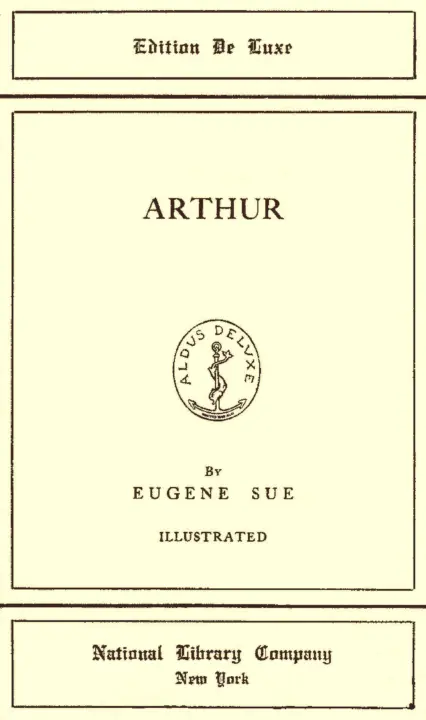
"Arthur" by Eugène Sue is a novel written in the late 19th century. The story unfolds through the intertwining lives of various characters, with an emphasis on the mysterious figure of Count Arthur and the tragedy surrounding his household. The opening portions hint at themes of intrigue, love, and loss, captivating readers who are drawn to character-driven narratives steeped in emotion and moral complexity. At the start of the novel, the protagonist, who remains unnamed, recounts a chance encounter that leads him to explore a quaint southern village, drawn by the allure of a country house rumored to be for sale. As he journeys through the picturesque landscape, he learns intriguing tales of previous travelers to the village, notably one ominous story involving a mysterious carriage that never returned. Upon reaching the village, he meets the curé and his sister, who are steeped in sadness related to the house's past. This foreshadows deeper explorations of love and loss and sets the stage for revelations regarding Count Arthur, a character woven into the fabric of the village's tragic history. The sense of curiosity and impending revelations builds a compelling narrative thread that invites readers further into the novel's intricate plot.
Introduction adapted from the source catalogue; source summaries may be automatically generated.
Free to read · English · 180,723 words · No account needed
MAKE TIME FOR A GOOD BOOK
On by default. Untick to stop anonymous reading totals. Each page counts after 10 seconds in view. How this works.
Anonymous counting is on unless you have switched it off.
"Poor child!" said Madame de Fersen, embracing her daughter. "Have you no ill-will towards her, for her strange, her absurd prediction?"
"No, madame, for in turn I shall make a forecast, and then we shall be quits. Mlle. Irene," said I, very seriously, taking her little hand in mine, "I shall not tell you that you will go up there, but I promise that ten or twelve years hence a beautiful angel will come down here from up there expressly for you. He will be beautiful like you, good like you, charming like you, and will lead you to a gorgeous palace, all marble and gold, where you will live a long, long time, the happiest of the happy with this beautiful angel, for he will love you as you love your mother; and then, one day, this palace being no longer beautiful enough for you, you and your angel together will fly away to go and occupy a more beautiful one up there."
"And will you be there in that palace, with my mamma?" asked the child, fixing her large, inquiring eyes by turns on Madame de Fersen and on me.
It was folly, but I could not help feeling delighted at the association made by Irene in speaking of her mother and of me.
I know not whether Madame de Fersen noticed the sentiment, but she
blushed, and said to her daughter, doubtless to avoid answering her
question:
"Yes, my child, I shall be there,--at least I hope so."
"But will you be there with him?" persisted the child pointing at me
with her little finger.
Whether she was annoyed at Irene's strange insistence, or whether she felt embarrassed, Madame de Fersen kissed her tenderly, took her in her arms and pressed her to her heart, saying, "You are a little goose; go to sleep, my pet."
Then with an absent air she looked through the window of the saloon, saying, "It is a lovely day! How calm is the sea!"
"Very calm," said I, with some irritation at seeing the conversation
taking another turn.
Irene closed her eyes and seemed about to go to sleep. Her mother, with infinite grace, caught some of her child's curls and drew them across her eyes, saying softly with motherly fondness, "Sleep, my child, now that I have closed your pretty curtains."
In the early phases of love, there are entrancing trifles which give
delight to sensitive souls.
It seemed to me delightful to be able to speak to Madame de Fersen in a half whisper, under pretext of not waking the child. There was in this apparently slight shade of difference something tender, mysterious, veiled, which entranced me.
Your reading position is saved on this browser. Take it to another device with a library code. Reading pages adapt to text, rather than matching a printed edition.
Eugène Sue
Eugène Sue
Eugène Sue
Eugène Sue
BEHIND THE BOOK
This eBook is for the use of anyone anywhere in the United States and most other parts of the world at no cost and with almost no restrictions whatsoever. You may copy it, give it away or re-use it under the terms of the Project Gutenberg License included with this eBook or online at www.gutenberg.org. If you are not located in the United States, you will have to check the laws of the country where you are located before using this eBook. Read the source licence.
The original source file, including credits and licence, is retained by this library. Request an original-format copy at no charge. Please include the book title and Project Gutenberg identifier #66473.
KEEP YOUR CURIOSITY GOING
Coulson Kernahan

Maurice Baring
Frances Wright
Cécile Tormay

Frederic Jesup Stimson

W. H. P. (William Henry Pope) Jarvis