THE CLASSIC COLLECTION✦The Knight of MaltaCLASSIC FREE BOOKS
The Knight of Malta
Eugène Sue
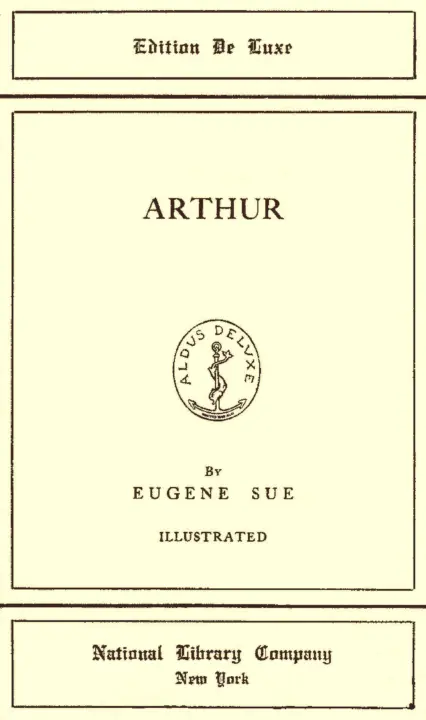
THE CLASSIC COLLECTION · 1839
"Arthur" by Eugène Sue is a novel written in the late 19th century. The story unfolds through the intertwining lives of various characters, with an emphasis on the mysterious figure of Count Arthur and the tragedy surrounding his household. The opening portions hint at themes of intrigue, love, and loss, captivating readers who are drawn to character-driven narratives steeped in emotion and moral complexity. At the start of the novel, the protagonist, who remains unnamed, recounts a chance encounter that leads him to explore a quaint southern village, drawn by the allure of a country house rumored to be for sale. As he journeys through the picturesque landscape, he learns intriguing tales of previous travelers to the village, notably one ominous story involving a mysterious carriage that never returned. Upon reaching the village, he meets the curé and his sister, who are steeped in sadness related to the house's past. This foreshadows deeper explorations of love and loss and sets the stage for revelations regarding Count Arthur, a character woven into the fabric of the village's tragic history. The sense of curiosity and impending revelations builds a compelling narrative thread that invites readers further into the novel's intricate plot.
Introduction adapted from the source catalogue; source summaries may be automatically generated.
Free to read · English · 180,723 words · No account needed
MAKE TIME FOR A GOOD BOOK
On by default. Untick to stop anonymous reading totals. Each page counts after 10 seconds in view. How this works.
Anonymous counting is on unless you have switched it off.
I took care to do nothing of the kind, being conceited enough to believe that there would be another revolt among the good creatures, if they thought I was about to abandon them.
I told them, on the contrary, that I was going again on board the ship as I had several times gone before, and that they must try and amuse my friend during my absence.
Noémi looked at Du Pluvier with a deceitful smile, Daphné looked disgusted, and Anathasia began to pout.
Having my misgivings on the future harmony in which the girls were to live with Du Pluvier, I shook his hand, and, quite overcome by my feelings, left the palace.
The ship's boat was waiting at the wharf, and I was soon on board.
M. de Fersen was very gracious and obliging to me, and the Russian captain granted me my passage with the greatest hospitality.
Two hours after leaving the palace we were under way.
Du Pluvier's decision was the subject of our pleasantries for quite a
long time.
After tacking a few times, we arrived opposite the Carina Palace, which was half-way up the hillside; a portion of the park extended down to the waterside.
With a field-glass I gazed sadly on this beautiful spot, that I was about to leave for ever, when a strange sight attracted my attention.
No doubt the renegade had told of my departure, and they had seen the frigate sailing away, for I saw the slaves, rush suddenly down the bank, and over the lawn, and assemble on the beach, where they stretched out their arms towards the frigate in attitudes of despair.
Then, seeing that the ship was going farther and farther away, Noémi tore off her fez in a rage, threw it on the ground, and stamped on it with both feet; soon her thick black hair was flying in the wind. She looked like a beautiful fury.
Daphné, who perhaps had not yet given up all hope, waved her silken
scarf by way of a signal.
Anathasia, the blonde, was kneeling on the beach.
Soon I beheld Du Pluvier, very much at his ease in my Albanian costume, rush down to the beach, followed by the old Cypriote and the two dwarfs, who were indulging in a thousand capers.
Doubtless the new sultan was inviting his odalisks to return to their
seraglio.
But unfortunately the odalisks were not very obedient, and the sultan was not very persuasive, for after some exchange of words, with the old Cypriote as an interpreter, all the women fell like so many furies on Du Pluvier, who was lost to sight amid their raised and threatening arms.
Your reading position is saved on this browser. Take it to another device with a library code. Reading pages adapt to text, rather than matching a printed edition.
Eugène Sue
Eugène Sue
Eugène Sue

Eugène Sue
BEHIND THE BOOK
This eBook is for the use of anyone anywhere in the United States and most other parts of the world at no cost and with almost no restrictions whatsoever. You may copy it, give it away or re-use it under the terms of the Project Gutenberg License included with this eBook or online at www.gutenberg.org. If you are not located in the United States, you will have to check the laws of the country where you are located before using this eBook. Read the source licence.
The original source file, including credits and licence, is retained by this library. Request an original-format copy at no charge. Please include the book title and Project Gutenberg identifier #66473.
KEEP YOUR CURIOSITY GOING
Coulson Kernahan

Maurice Baring
Frances Wright
Cécile Tormay

Frederic Jesup Stimson

W. H. P. (William Henry Pope) Jarvis