THE CLASSIC COLLECTION✦The Knight of MaltaCLASSIC FREE BOOKS
The Knight of Malta
Eugène Sue
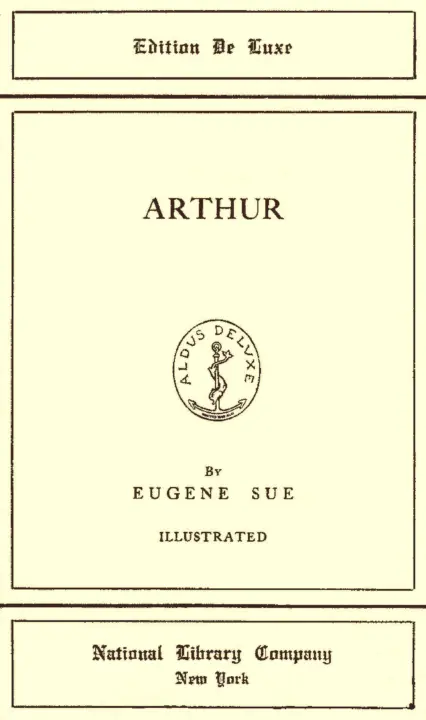
THE CLASSIC COLLECTION · 1839
"Arthur" by Eugène Sue is a novel written in the late 19th century. The story unfolds through the intertwining lives of various characters, with an emphasis on the mysterious figure of Count Arthur and the tragedy surrounding his household. The opening portions hint at themes of intrigue, love, and loss, captivating readers who are drawn to character-driven narratives steeped in emotion and moral complexity. At the start of the novel, the protagonist, who remains unnamed, recounts a chance encounter that leads him to explore a quaint southern village, drawn by the allure of a country house rumored to be for sale. As he journeys through the picturesque landscape, he learns intriguing tales of previous travelers to the village, notably one ominous story involving a mysterious carriage that never returned. Upon reaching the village, he meets the curé and his sister, who are steeped in sadness related to the house's past. This foreshadows deeper explorations of love and loss and sets the stage for revelations regarding Count Arthur, a character woven into the fabric of the village's tragic history. The sense of curiosity and impending revelations builds a compelling narrative thread that invites readers further into the novel's intricate plot.
Introduction adapted from the source catalogue; source summaries may be automatically generated.
Free to read · English · 180,723 words · No account needed
MAKE TIME FOR A GOOD BOOK
On by default. Untick to stop anonymous reading totals. Each page counts after 10 seconds in view. How this works.
Anonymous counting is on unless you have switched it off.
Perhaps, had it not been for this strange caprice of Du Pluvier's, I might have hesitated to take this step. Perhaps I might have struggled against this desire of reëntering society.
But, placed between the alternatives of returning to France with Madame de Fersen, who was charming, or of remaining in Khios with my slaves, that were beginning to be hateful to me, and sharing my solitude with Du Pluvier, I had no hesitation in leaving the island.
I have always come to grave decisions with promptness.
As Du Pluvier continued to insist, I told him that I had not yet given him my real reason for declining his offer, but that, since he forced me to it, I must tell him that I was obliged to return to France.
"Leave your beautiful palace,--those adorable women,--that light your pipe, and pour out your wine,--who dance for you as though you were at the Opéra,--real houris! It is impossible!"
"Unfortunately, my dear Du Pluvier, there are some confessions that are hard to make even to a friend, but to tell the truth, I have sustained losses, and my diminished fortune obliges me to return to France, and live less like a sultan."
"Really, really, my dear count," said Du Pluvier, who seemed sincerely grieved, "you can't tell how sad that makes me. But what are you going to do with all this establishment?"
"I am going to free the women, the birds, the dogs, and the dwarfs, pay an indemnity to the Marquis Justiniani, and sell all the furniture in Khios."
"You have decided to do that?"
"Quite decided."
"Positively?"
"Yes, yes, yes,--a hundred times yes."
"Then, my dear Arthur, you will not reproach me if I profit by your
decision?"
"How can that be? What do you mean?"
"This is my scheme. The life you are living in this earthly paradise has turned my head. Will you sell me all of these treasures,--palace, women, dogs, dwarfs, and parrots?"
I thought that he was joking, and looked at him incredulously.
"Is it a bargain? You will lose less than in selling everything piecemeal," said he, with a resolute air. "But what do you ask for the slaves and the furniture?"
"It is useless for you to ask the price of the slaves, for I will only leave them with you on condition that when you leave the island you will set them free."
"But how do you expect to get back to France?"
"I shall ask M. de Fersen to allow me to take your place on the
frigate."
"But the ship is to sail to-day."
Your reading position is saved on this browser. Take it to another device with a library code. Reading pages adapt to text, rather than matching a printed edition.
Eugène Sue
Eugène Sue
Eugène Sue
Eugène Sue
BEHIND THE BOOK
This eBook is for the use of anyone anywhere in the United States and most other parts of the world at no cost and with almost no restrictions whatsoever. You may copy it, give it away or re-use it under the terms of the Project Gutenberg License included with this eBook or online at www.gutenberg.org. If you are not located in the United States, you will have to check the laws of the country where you are located before using this eBook. Read the source licence.
The original source file, including credits and licence, is retained by this library. Request an original-format copy at no charge. Please include the book title and Project Gutenberg identifier #66473.
KEEP YOUR CURIOSITY GOING
Coulson Kernahan

Maurice Baring
Frances Wright
Cécile Tormay

Frederic Jesup Stimson

W. H. P. (William Henry Pope) Jarvis