THE CLASSIC COLLECTION✦The Knight of MaltaCLASSIC FREE BOOKS
The Knight of Malta
Eugène Sue
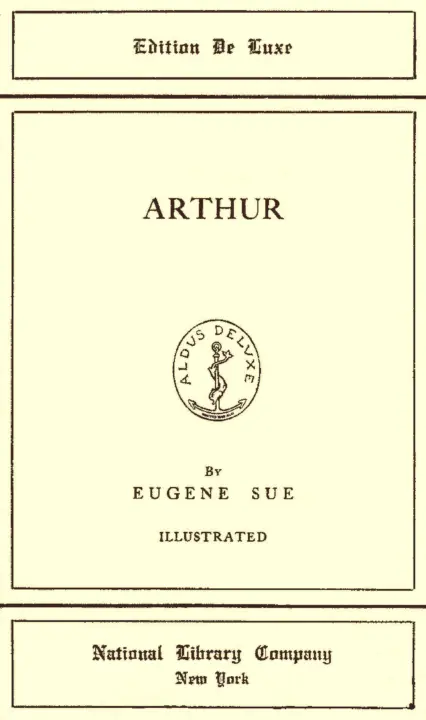
THE CLASSIC COLLECTION · 1839
"Arthur" by Eugène Sue is a novel written in the late 19th century. The story unfolds through the intertwining lives of various characters, with an emphasis on the mysterious figure of Count Arthur and the tragedy surrounding his household. The opening portions hint at themes of intrigue, love, and loss, captivating readers who are drawn to character-driven narratives steeped in emotion and moral complexity. At the start of the novel, the protagonist, who remains unnamed, recounts a chance encounter that leads him to explore a quaint southern village, drawn by the allure of a country house rumored to be for sale. As he journeys through the picturesque landscape, he learns intriguing tales of previous travelers to the village, notably one ominous story involving a mysterious carriage that never returned. Upon reaching the village, he meets the curé and his sister, who are steeped in sadness related to the house's past. This foreshadows deeper explorations of love and loss and sets the stage for revelations regarding Count Arthur, a character woven into the fabric of the village's tragic history. The sense of curiosity and impending revelations builds a compelling narrative thread that invites readers further into the novel's intricate plot.
Introduction adapted from the source catalogue; source summaries may be automatically generated.
Free to read · English · 180,723 words · No account needed
MAKE TIME FOR A GOOD BOOK
On by default. Untick to stop anonymous reading totals. Each page counts after 10 seconds in view. How this works.
Anonymous counting is on unless you have switched it off.
Although this threatened mode of death was worthy of Sardanapalus, I preferred to live as I was, and being now quite convinced that I was adored by my household, I told them that I renounced my projects of departure.
My modesty forbids me saying with what effusion, what transports of joy, my decision was welcomed by those good girls.
The whole twelve of them took hold of each other's hands, and formed a circle. Noémi, as the antique theorist, improvised these simple words, which her companions repeated to the air of their national hymn, "The Swallows."
"At Khios we remain,
Dance, sisters, dance,
At Khios we remain,
We stay with the good Frank.
"He never beats us, he treats us well,
Dance, sisters, dance,
We will always have beautiful fezzes,
Beautiful embroidered yellaks,
Beautiful silk sashes.
"We will eat tender roasted kids,
Fat partridges and quails,
Honey from Hymettus, wine from Scyros.
Dance, sisters, dance,
The good Frank lets us stay.
"Dance, sisters, dance,
We till the soil no more,
No more we mend the roads,
Dance, sisters, dance.
"We will bathe beneath the sycamores,
We will not work at all,
Only pluck fruit and flowers for him,
The good Frank who keeps us."
If I had been blinded by any conceit, I should have had my self-respect somewhat wounded on learning that the roast kid, fat partridges, Scyros wine, beautiful clothes, and idleness, were prominent features in the intense affection these simple creatures bore me.
But, fortunately, I am wiser than that, and can see through their devotion. Formerly I had some doubts as to my powers of attraction, but now, how can I help believing in the charm with which I was invested if it can attach these slaves to me so devotedly?
My charms are easily understood, they are the fat partridges, the roasted kids, the golden belts, and embroidered yellaks.
Oh, happy future! As long as there are any embroiderers and silk weavers in the Isle of Khios, I will be sure of admiration.
I, who until now could never believe in disinterested affection, am obliged to have blind faith in the love I inspire.
It is surely easy to believe these truthful creatures, when they tell me that they love to be elegantly clothed, well fed, and not beaten. I cannot accuse them of duplicity when they say that they like to do nothing harder than pick fruit and flowers, or bathe in the marble pool, in the shade of the plane-trees.
Your reading position is saved on this browser. Take it to another device with a library code. Reading pages adapt to text, rather than matching a printed edition.
Eugène Sue
Eugène Sue
Eugène Sue
Eugène Sue
BEHIND THE BOOK
This eBook is for the use of anyone anywhere in the United States and most other parts of the world at no cost and with almost no restrictions whatsoever. You may copy it, give it away or re-use it under the terms of the Project Gutenberg License included with this eBook or online at www.gutenberg.org. If you are not located in the United States, you will have to check the laws of the country where you are located before using this eBook. Read the source licence.
The original source file, including credits and licence, is retained by this library. Request an original-format copy at no charge. Please include the book title and Project Gutenberg identifier #66473.
KEEP YOUR CURIOSITY GOING
Coulson Kernahan

Maurice Baring
Frances Wright
Cécile Tormay

Frederic Jesup Stimson

W. H. P. (William Henry Pope) Jarvis