THE CLASSIC COLLECTION✦The Knight of MaltaCLASSIC FREE BOOKS
The Knight of Malta
Eugène Sue
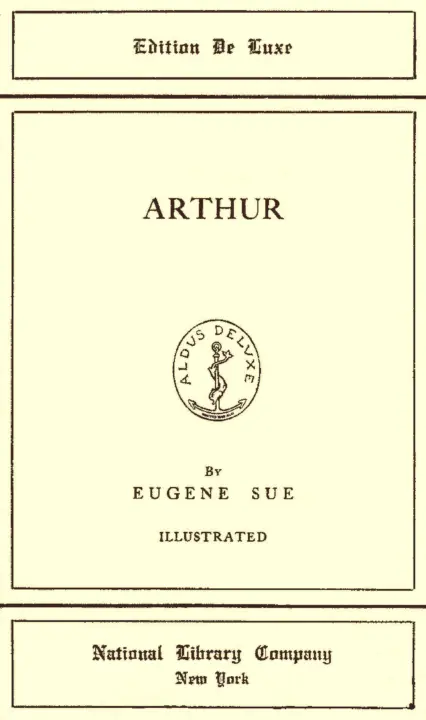
THE CLASSIC COLLECTION · 1839
"Arthur" by Eugène Sue is a novel written in the late 19th century. The story unfolds through the intertwining lives of various characters, with an emphasis on the mysterious figure of Count Arthur and the tragedy surrounding his household. The opening portions hint at themes of intrigue, love, and loss, captivating readers who are drawn to character-driven narratives steeped in emotion and moral complexity. At the start of the novel, the protagonist, who remains unnamed, recounts a chance encounter that leads him to explore a quaint southern village, drawn by the allure of a country house rumored to be for sale. As he journeys through the picturesque landscape, he learns intriguing tales of previous travelers to the village, notably one ominous story involving a mysterious carriage that never returned. Upon reaching the village, he meets the curé and his sister, who are steeped in sadness related to the house's past. This foreshadows deeper explorations of love and loss and sets the stage for revelations regarding Count Arthur, a character woven into the fabric of the village's tragic history. The sense of curiosity and impending revelations builds a compelling narrative thread that invites readers further into the novel's intricate plot.
Introduction adapted from the source catalogue; source summaries may be automatically generated.
Free to read · English · 180,723 words · No account needed
MAKE TIME FOR A GOOD BOOK
On by default. Untick to stop anonymous reading totals. Each page counts after 10 seconds in view. How this works.
Anonymous counting is on unless you have switched it off.
"For the last seven years, monsieur," and he showed me his large silver medal, hung on a long chain of the same metal, which he wore under his cape.
On the medal I read the name Joseph Belmont, royal pilot, No. 18. On the other side of the medal were the royal arms of England.
"But you are a Frenchman," said I to him, speaking French.
"Oui, monsieur," he replied.
I was more astonished even than before.
Williams now appeared on deck, and, addressing the pilot, said:
"Go ahead, do as you think best. My lord has given his consent."
"The sea is getting so rough," said the pilot to Williams, "that I am going to tell my sailors to heave off the tow-rope, and follow us a little ways off." So the sailboat, abandoning the tow-rope, continued to follow in our wake.
Night was coming on.
According to the usual custom, Williams handed his speaking-trumpet, the sign of command, to the pilot.
The predictions of the latter as to the weather were soon realised, for though the new direction we had taken put us, in a short time, under the lee of the island, and in a sheltered position, the tempest augmented in violence.
The pilot, standing at the helm, gave his orders with perfect calmness, and Williams admitted that he managed the ship with rare ability and coolness.
While waiting for the moon to rise, which would facilitate our coming to anchor, we were skirting along the coast, parallel to the southern shore of the island of Malta.
The night was very dark.
The lamps of the compasses, shut up in their copper boxes, shone in a pale circle on the deck, at the foot of the mainmast.
This light shone only on the pilot and the helmsman, while the rest of the yacht remained plunged in an obscurity that the contrasting luminous circle only made darker. Lit up from below, as actors are by the footlights of the theatre, the features of the pilot had a peculiar expression of audacity, deceit, and wickedness.
Although the sea was tremendous, so that the prow of the yacht was almost constantly covered by the furious waves, from time to time I could see the pilot rub his hands with savage satisfaction, and laugh in a way that showed his white, sharp, and wide apart teeth.
In these moments I believed thoroughly that I recognised the pirate with whom I had fought. This idea became so fixed in my mind that, in spite of my resolve to say nothing on the subject, I could not help asking Williams if he was perfectly sure of the man.
Your reading position is saved on this browser. Take it to another device with a library code. Reading pages adapt to text, rather than matching a printed edition.
Eugène Sue
Eugène Sue
Eugène Sue
Eugène Sue
BEHIND THE BOOK
This eBook is for the use of anyone anywhere in the United States and most other parts of the world at no cost and with almost no restrictions whatsoever. You may copy it, give it away or re-use it under the terms of the Project Gutenberg License included with this eBook or online at www.gutenberg.org. If you are not located in the United States, you will have to check the laws of the country where you are located before using this eBook. Read the source licence.
The original source file, including credits and licence, is retained by this library. Request an original-format copy at no charge. Please include the book title and Project Gutenberg identifier #66473.
KEEP YOUR CURIOSITY GOING
Coulson Kernahan

Maurice Baring
Frances Wright
Cécile Tormay

Frederic Jesup Stimson

W. H. P. (William Henry Pope) Jarvis