THE CLASSIC COLLECTION✦The Knight of MaltaCLASSIC FREE BOOKS
The Knight of Malta
Eugène Sue
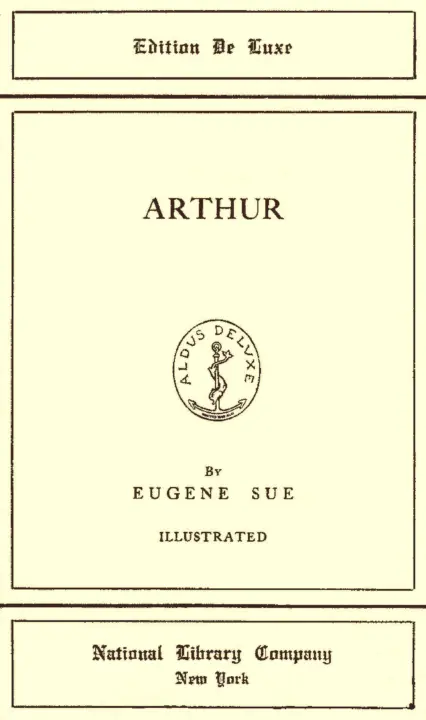
THE CLASSIC COLLECTION · 1839
"Arthur" by Eugène Sue is a novel written in the late 19th century. The story unfolds through the intertwining lives of various characters, with an emphasis on the mysterious figure of Count Arthur and the tragedy surrounding his household. The opening portions hint at themes of intrigue, love, and loss, captivating readers who are drawn to character-driven narratives steeped in emotion and moral complexity. At the start of the novel, the protagonist, who remains unnamed, recounts a chance encounter that leads him to explore a quaint southern village, drawn by the allure of a country house rumored to be for sale. As he journeys through the picturesque landscape, he learns intriguing tales of previous travelers to the village, notably one ominous story involving a mysterious carriage that never returned. Upon reaching the village, he meets the curé and his sister, who are steeped in sadness related to the house's past. This foreshadows deeper explorations of love and loss and sets the stage for revelations regarding Count Arthur, a character woven into the fabric of the village's tragic history. The sense of curiosity and impending revelations builds a compelling narrative thread that invites readers further into the novel's intricate plot.
Introduction adapted from the source catalogue; source summaries may be automatically generated.
Free to read · English · 180,723 words · No account needed
MAKE TIME FOR A GOOD BOOK
On by default. Untick to stop anonymous reading totals. Each page counts after 10 seconds in view. How this works.
Anonymous counting is on unless you have switched it off.
The man was apparently about forty. He was tall, thin, and bony; his face very sunburnt, his cheeks hollow; his eyes were green, and his hair black and very thick. He wore a Scotch cap of red and blue plaid woollen stuff, which was pulled down to his eyebrows. A cape of heavy brown cloth, dripping with salt water, hung down to the tops of his great fisherman's boots, and completed his costume.
It seemed to me that I had met this man before. I had a vague remembrance of just such a sinister face, though I found it impossible to recall the circumstances or place of our meeting; but there came over me an uncomfortable feeling which I attributed to my feverish condition.
"Can we get in to anchor at Malta to-night, pilot?" said Williams to
him.
After having looked at the compass and questioned the state of the sky, the sea, and the wind, the pilot answered in very good English: "We might get to an island to-night, but not to the island of Malta, sir."
"No!" cried Williams; "and why not?"
"Because you can't, it is impossible," said the pilot, carelessly.
"But," continued Williams, "though the wind is very strong, and blowing from the north, it is not strong enough to send us ashore. The yacht sails beautifully, she rises with every wave."
"Could she resist a current that runs seven or eight knots an hour, sir, and that driving us right ashore the same way the wind is doing?"
"I tell you, pilot," replied Williams, "that two years ago I ran into the harbour of Malta in a worse storm than this."
"But not worse than what we are to have to-night," said the pilot.
"To-night?" replied Williams, incredulously.
"Yes, to-night," replied the pilot, firmly.
"How do you know that we will have a bad night, pilot?"
"The point of Tamea and the rocks of Kamich are all under water at sundown, and that is the sign of a terrible storm."
"That is all superstition and old women's tales!" exclaimed Williams.
The pilot gave him a look out of his piercing green eyes, shrugged his shoulders, and smiled. When the man smiled, I felt as though I had the nightmare, or an oppressive dream, for I recognised the sharp, white, pointed teeth of the pirate with whom I had struggled hand to hand when the yacht had been attacked.
My astonishment was so great, that I strode forward and stared at the pilot in a state of stupefaction; but he withstood my gaze with perfect indifference, and it was I who lowered my eyes, all abashed by the calm, unconcerned look he gave me.
Your reading position is saved on this browser. Take it to another device with a library code. Reading pages adapt to text, rather than matching a printed edition.
Eugène Sue
Eugène Sue
Eugène Sue
Eugène Sue
BEHIND THE BOOK
This eBook is for the use of anyone anywhere in the United States and most other parts of the world at no cost and with almost no restrictions whatsoever. You may copy it, give it away or re-use it under the terms of the Project Gutenberg License included with this eBook or online at www.gutenberg.org. If you are not located in the United States, you will have to check the laws of the country where you are located before using this eBook. Read the source licence.
The original source file, including credits and licence, is retained by this library. Request an original-format copy at no charge. Please include the book title and Project Gutenberg identifier #66473.
KEEP YOUR CURIOSITY GOING
Coulson Kernahan

Maurice Baring
Frances Wright
Cécile Tormay

Frederic Jesup Stimson

W. H. P. (William Henry Pope) Jarvis