THE CLASSIC COLLECTION✦The Knight of MaltaCLASSIC FREE BOOKS
The Knight of Malta
Eugène Sue
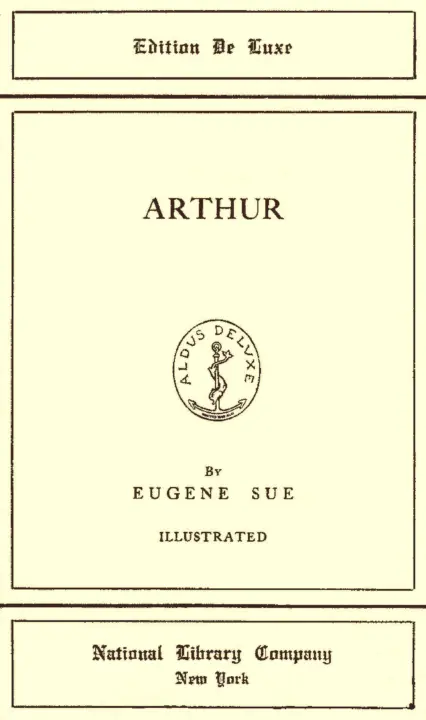
THE CLASSIC COLLECTION · 1839
"Arthur" by Eugène Sue is a novel written in the late 19th century. The story unfolds through the intertwining lives of various characters, with an emphasis on the mysterious figure of Count Arthur and the tragedy surrounding his household. The opening portions hint at themes of intrigue, love, and loss, captivating readers who are drawn to character-driven narratives steeped in emotion and moral complexity. At the start of the novel, the protagonist, who remains unnamed, recounts a chance encounter that leads him to explore a quaint southern village, drawn by the allure of a country house rumored to be for sale. As he journeys through the picturesque landscape, he learns intriguing tales of previous travelers to the village, notably one ominous story involving a mysterious carriage that never returned. Upon reaching the village, he meets the curé and his sister, who are steeped in sadness related to the house's past. This foreshadows deeper explorations of love and loss and sets the stage for revelations regarding Count Arthur, a character woven into the fabric of the village's tragic history. The sense of curiosity and impending revelations builds a compelling narrative thread that invites readers further into the novel's intricate plot.
Introduction adapted from the source catalogue; source summaries may be automatically generated.
Free to read · English · 180,723 words · No account needed
MAKE TIME FOR A GOOD BOOK
On by default. Untick to stop anonymous reading totals. Each page counts after 10 seconds in view. How this works.
Anonymous counting is on unless you have switched it off.
"My dear Henry," I replied, deeply touched by his tone, "on the contrary, let us thank this chance which has furnished us this proof. Does not the emotion that we both feel show us that this friendship is already first in our hearts? Could we have found a similar revelation in the ordinary uniform life of the world? Believe me, we see in this a good fortune; let us bless it and profit by it. It is by fire that pure gold is proved."
A sailor descending precipitately, came to beg Falmouth to ascend to the
deck.
When he had gone, Henry threw himself into my arms with effusion, and said: "You have a noble heart,--my instinct has not deceived me."
I remained alone.
If Falmouth feared the chances of this combat for me, I also feared them
keenly for him.
This uneasiness revealed to me all the strength of the affection I bore
him.
By what miracle had this friendship so suddenly developed? How came its roots to be already so deep, in spite of my distrust, in spite of my habitual incredulity?
I do not know, but it was so, and we had travelled together scarcely one
month.
Perhaps this rapid progress would seem less surprising, if one considered the secret instinct which had attracted us to each other before our departure.
I took up my arms.
I had then a moment of frightful agony.
In thinking of the danger we were to run, I feared being cowardly, or, rather, that my courage might not reach the height of a noble sacrifice; I asked myself if, in supreme danger, I could sacrifice my life to save Falmouth's, and, I confess to my shame, I dared not reply with certainty.
It is true, I knew myself to be brave, with a cool, stubborn bravery. I had had a duel in which my calm energy had done me honour: but was that true courage? Can a man, well born, refuse a duel? Can he bear himself becomingly, except through good breeding or pride?
I did not know, therefore, if I should have the thoughtless, fulgurating courage which turns to danger as steel to the magnet, which exalts itself still more in a bloody conflict, and which, hovering above all danger, directs its blows with a sure hand, choosing its victims.
I believed I felt, in a word, the cool and inert bravery of the artillery man, who, near his battery, awaits a bullet without turning pale, but not the excited intrepidity of the partisan who, sword in hand, throws himself, with ferocious zeal, into the midst of the carnage.
Your reading position is saved on this browser. Take it to another device with a library code. Reading pages adapt to text, rather than matching a printed edition.
Eugène Sue
Eugène Sue
Eugène Sue
Eugène Sue
BEHIND THE BOOK
This eBook is for the use of anyone anywhere in the United States and most other parts of the world at no cost and with almost no restrictions whatsoever. You may copy it, give it away or re-use it under the terms of the Project Gutenberg License included with this eBook or online at www.gutenberg.org. If you are not located in the United States, you will have to check the laws of the country where you are located before using this eBook. Read the source licence.
The original source file, including credits and licence, is retained by this library. Request an original-format copy at no charge. Please include the book title and Project Gutenberg identifier #66473.
KEEP YOUR CURIOSITY GOING
Coulson Kernahan

Maurice Baring
Frances Wright
Cécile Tormay

Frederic Jesup Stimson

W. H. P. (William Henry Pope) Jarvis