THE CLASSIC COLLECTION✦The Knight of MaltaCLASSIC FREE BOOKS
The Knight of Malta
Eugène Sue
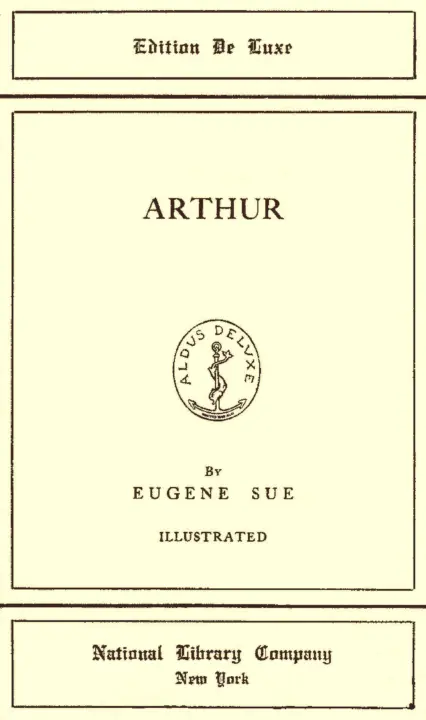
THE CLASSIC COLLECTION · 1839
"Arthur" by Eugène Sue is a novel written in the late 19th century. The story unfolds through the intertwining lives of various characters, with an emphasis on the mysterious figure of Count Arthur and the tragedy surrounding his household. The opening portions hint at themes of intrigue, love, and loss, captivating readers who are drawn to character-driven narratives steeped in emotion and moral complexity. At the start of the novel, the protagonist, who remains unnamed, recounts a chance encounter that leads him to explore a quaint southern village, drawn by the allure of a country house rumored to be for sale. As he journeys through the picturesque landscape, he learns intriguing tales of previous travelers to the village, notably one ominous story involving a mysterious carriage that never returned. Upon reaching the village, he meets the curé and his sister, who are steeped in sadness related to the house's past. This foreshadows deeper explorations of love and loss and sets the stage for revelations regarding Count Arthur, a character woven into the fabric of the village's tragic history. The sense of curiosity and impending revelations builds a compelling narrative thread that invites readers further into the novel's intricate plot.
Introduction adapted from the source catalogue; source summaries may be automatically generated.
Free to read · English · 180,723 words · No account needed
MAKE TIME FOR A GOOD BOOK
On by default. Untick to stop anonymous reading totals. Each page counts after 10 seconds in view. How this works.
Anonymous counting is on unless you have switched it off.
The accents of his voice were so true, his features had an expression of such sincerity, that I had entirely forgotten my mistrust; I yielded with happiness to the impulse of an affection which I had never known before.
Then came the endless conversations, whose attractions I know not how to describe. Falmouth's imagination was lively and brilliant, his wit well embellished. We both possessed quite varied and extended knowledge; we never for a moment felt wearied with one another, in spite of the long hours of the voyage.
In proportion as our intimacy increased, my faith in myself and in Falmouth increased. I felt happy and better, a new future opened before me; I had plenty of courage not to subject this happiness, so fresh and young, to a withering analysis. I gave myself up innocently to impressions which I found so pure and so refreshing.
We had been at sea five days.
One evening, quite late, towards eleven o'clock, having left Falmouth in the saloon, I ascended to the deck to enjoy the freshness of the night, and seated myself in a yawl suspended in the stern of the schooner.
I had been some time absorbed in my dreams, when the sailor on watch
hailed an approaching ship.
I arose.
The watch hailed a second time.
Almost immediately I saw sailing silently towards us, and at a very short distance from us, a ship, whose immense sails I recognised as those of the Sardinian boat of the bay of Porquerolles.
The night was clear, the boat sailing rather fast; upon the deck of this long, narrow ship a great number of men were crowding against one another. From the mast was hung a ship's lantern. Lighted by its red, uncertain reflection, I distinguished at the helm, and holding the tiller, the man with the black cowl that I had already noticed during the approach of the long-boat.
Strange encounter, the consequences of which were to be still more
strange!
The mystic withdrew; the noise of its track died away.
For a few minutes I could follow it with my eye, thanks to its white sails; then they became less distinct, and, finally, altogether effaced, until I could see only a luminous point in the darkness, which in time disappeared with the play of the ship's sails, like a star under a cloud.
Upon the appearance of this suspicious boat, Williams had ordered his brother to look for Falmouth.
"Well, Williams," said the latter, mounting the bridge, "we are again meeting our ugly acquaintance of Porquerolles!"
"The mystic has just passed athwart us, my lord."
"And what do you advise?"
Your reading position is saved on this browser. Take it to another device with a library code. Reading pages adapt to text, rather than matching a printed edition.
Eugène Sue
Eugène Sue
Eugène Sue
Eugène Sue
BEHIND THE BOOK
This eBook is for the use of anyone anywhere in the United States and most other parts of the world at no cost and with almost no restrictions whatsoever. You may copy it, give it away or re-use it under the terms of the Project Gutenberg License included with this eBook or online at www.gutenberg.org. If you are not located in the United States, you will have to check the laws of the country where you are located before using this eBook. Read the source licence.
The original source file, including credits and licence, is retained by this library. Request an original-format copy at no charge. Please include the book title and Project Gutenberg identifier #66473.
KEEP YOUR CURIOSITY GOING
Coulson Kernahan

Maurice Baring
Frances Wright
Cécile Tormay

Frederic Jesup Stimson

W. H. P. (William Henry Pope) Jarvis