THE CLASSIC COLLECTION✦The Knight of MaltaCLASSIC FREE BOOKS
The Knight of Malta
Eugène Sue
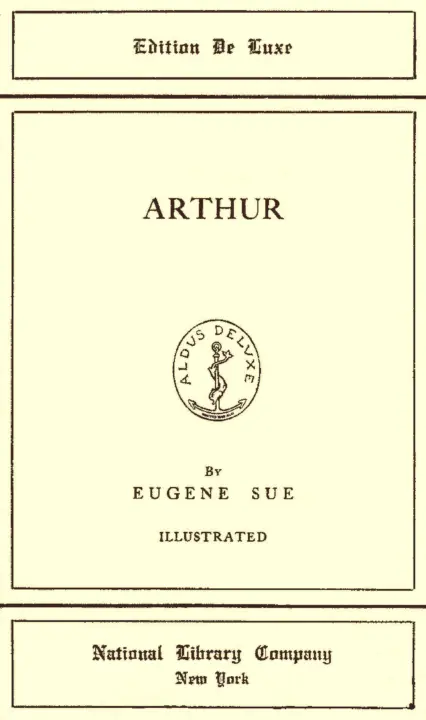
THE CLASSIC COLLECTION · 1839
"Arthur" by Eugène Sue is a novel written in the late 19th century. The story unfolds through the intertwining lives of various characters, with an emphasis on the mysterious figure of Count Arthur and the tragedy surrounding his household. The opening portions hint at themes of intrigue, love, and loss, captivating readers who are drawn to character-driven narratives steeped in emotion and moral complexity. At the start of the novel, the protagonist, who remains unnamed, recounts a chance encounter that leads him to explore a quaint southern village, drawn by the allure of a country house rumored to be for sale. As he journeys through the picturesque landscape, he learns intriguing tales of previous travelers to the village, notably one ominous story involving a mysterious carriage that never returned. Upon reaching the village, he meets the curé and his sister, who are steeped in sadness related to the house's past. This foreshadows deeper explorations of love and loss and sets the stage for revelations regarding Count Arthur, a character woven into the fabric of the village's tragic history. The sense of curiosity and impending revelations builds a compelling narrative thread that invites readers further into the novel's intricate plot.
Introduction adapted from the source catalogue; source summaries may be automatically generated.
Free to read · English · 180,723 words · No account needed
MAKE TIME FOR A GOOD BOOK
On by default. Untick to stop anonymous reading totals. Each page counts after 10 seconds in view. How this works.
Anonymous counting is on unless you have switched it off.
Then, sinister and fading as spectres, slowly one by one the harrowing regrets of the past spring up around you, and the charming visions of a future which will never be; then appear before you the phantoms of the happiest, the most radiant, the most brilliant hours of former times,--for your grief forgets nothing,--the most distant echo, the faintest perfume, the most mysterious murmur, all are mercilessly reproduced in your thoughts; but this mirage of a lost happiness is strange and sinister. You believe you see a magnificent landscape, bathed in azure, of light and sun, across the glassy pupil of a dying man, and all seems veiled in a gray and sepulchral mist.
The suffering is then in its paroxysm, but it can only diminish; it is sharp and penetrating, but it can be analysed; your enemies are numerous, are threatening, are terrible, but you see them, you can fight them.
You struggle so, or, like a wounded wolf, which, in the depths of its cave, awaits his recovery only in time, wrapped in your solitary suffering, you can, near or far, assign a term to your grief, and hope, at least, in forgetfulness. Forgetfulness,--this only inexorable reality of life! Forgetfulness,--this fathomless ocean, wherein come unceasingly to be lost all sorrow, all love, and all curses.
And yet, strange impotency which is called human philosophy! You know that one day,--that soon, perhaps,--time must efface many griefs, and this certain conviction can in no way calm or alleviate your torment.
It is for this reason, I repeat, that it has always seemed to me that to divert oneself from one's sorrow, instead of confronting it resolutely, is to begin each day this cruel initiation of suffering, instead of exhausting it by its own excess.
It will therefore be seen that, in the disposition of mind in which I found myself, this journey, adventurously undertaken, might sometimes seem to me painful.
We had travelled the whole night. We were about forty leagues from Paris. Falmouth awakened soon, took me by the hand, and said: "Night induces counsel. Now that I reflect upon everything, my plan may seem very stupid to you. I also wish to tell you my secret while we are still quite near to Paris, in order that you may be able to return there to-night, if what I have to propose is not agreeable to you."
"Let us see,--tell me this mysterious plan."
"Here it is, then," replied Falmouth. "Do you know the Yacht Club?"
"Yes,--and you are, I believe, one of its members."
Your reading position is saved on this browser. Take it to another device with a library code. Reading pages adapt to text, rather than matching a printed edition.
Eugène Sue
Eugène Sue
Eugène Sue
Eugène Sue
BEHIND THE BOOK
This eBook is for the use of anyone anywhere in the United States and most other parts of the world at no cost and with almost no restrictions whatsoever. You may copy it, give it away or re-use it under the terms of the Project Gutenberg License included with this eBook or online at www.gutenberg.org. If you are not located in the United States, you will have to check the laws of the country where you are located before using this eBook. Read the source licence.
The original source file, including credits and licence, is retained by this library. Request an original-format copy at no charge. Please include the book title and Project Gutenberg identifier #66473.
KEEP YOUR CURIOSITY GOING
Coulson Kernahan

Maurice Baring
Frances Wright
Cécile Tormay

Frederic Jesup Stimson

W. H. P. (William Henry Pope) Jarvis