THE CLASSIC COLLECTION✦The Knight of MaltaCLASSIC FREE BOOKS
The Knight of Malta
Eugène Sue
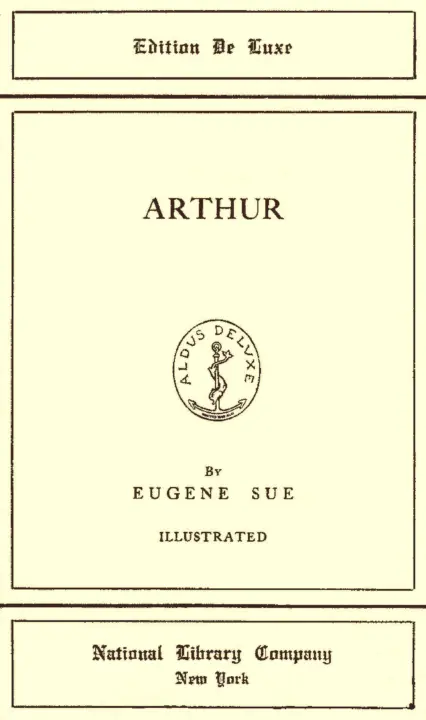
THE CLASSIC COLLECTION · 1839
"Arthur" by Eugène Sue is a novel written in the late 19th century. The story unfolds through the intertwining lives of various characters, with an emphasis on the mysterious figure of Count Arthur and the tragedy surrounding his household. The opening portions hint at themes of intrigue, love, and loss, captivating readers who are drawn to character-driven narratives steeped in emotion and moral complexity. At the start of the novel, the protagonist, who remains unnamed, recounts a chance encounter that leads him to explore a quaint southern village, drawn by the allure of a country house rumored to be for sale. As he journeys through the picturesque landscape, he learns intriguing tales of previous travelers to the village, notably one ominous story involving a mysterious carriage that never returned. Upon reaching the village, he meets the curé and his sister, who are steeped in sadness related to the house's past. This foreshadows deeper explorations of love and loss and sets the stage for revelations regarding Count Arthur, a character woven into the fabric of the village's tragic history. The sense of curiosity and impending revelations builds a compelling narrative thread that invites readers further into the novel's intricate plot.
Introduction adapted from the source catalogue; source summaries may be automatically generated.
Free to read · English · 180,723 words · No account needed
MAKE TIME FOR A GOOD BOOK
On by default. Untick to stop anonymous reading totals. Each page counts after 10 seconds in view. How this works.
Anonymous counting is on unless you have switched it off.
"It is strange," said she. "I, too, am happy, completely happy. And yet you see I am weeping. I have to weep."
Then we talked of signs and omens, and, finally, of divination and fortune-tellers. As we were wont to do, we discussed the worn out theme, Is there such a thing as foretelling the future? We ended by coming to the decision that to-morrow we would meet at Mlle. Lenormand's in the Rue de Tournon, and have our fortunes told.
I left Marguerite's at half-past six. She forbade me to come again in the evening, as she said she wished to spend it in writing letters.
When I was alone, and only influenced by my own thoughts, I was more than ever surprised at the great difference between the impressions of men and those of women.
After such a morning of sensual intoxication, Marguerite needed silence, reverie, and solitude, while I felt a positive want of noise, excitement, and animation. Though intense, my happiness was exuberant. I felt gay, talkative, amiable, perfectly contented with everything. In such a mood the gay world, with all its joy and splendour, was the only place to display my felicity.
Before going to one or two soirées, I went to the theatre to hear the second act of "Othello." I saw Madame de V---- alone in her box. She looked, as she always does, charming and exquisitely dressed.
There is nothing prettier ever seen than a beautiful, smiling woman's face, standing out in brilliant light, against the dark background of an opera box.
In the entr'acte I went to pay Madame de V---- a visit. She received me very graciously, I would almost say in a coquettish and provocative manner, if it were not her usual way, she being born coquettish and provoking as some women are born blonde or brunette. She is so original, and bright, and wild, and says everything in such a graceful, lively way, and with such innocent maliciousness, that people are willing to forgive her for anything she does.
She began by a lively attack on my devotion to a certain marquise, saying that the belle marquise was fortunate in being one of her enemies, as otherwise she would have taken great satisfaction in disturbing the serenity of our love scenes.
"How is that? You refrain from revenge because she is an enemy?"
"Certainly, we save those nice little treacheries for our best friends," said she, "and it is a great pity, for in twenty-four hours, if I chose, I could make you so much in love with me that you would have to be tied hand and foot."
Your reading position is saved on this browser. Take it to another device with a library code. Reading pages adapt to text, rather than matching a printed edition.
Eugène Sue
Eugène Sue
Eugène Sue
Eugène Sue
BEHIND THE BOOK
This eBook is for the use of anyone anywhere in the United States and most other parts of the world at no cost and with almost no restrictions whatsoever. You may copy it, give it away or re-use it under the terms of the Project Gutenberg License included with this eBook or online at www.gutenberg.org. If you are not located in the United States, you will have to check the laws of the country where you are located before using this eBook. Read the source licence.
The original source file, including credits and licence, is retained by this library. Request an original-format copy at no charge. Please include the book title and Project Gutenberg identifier #66473.
KEEP YOUR CURIOSITY GOING
Coulson Kernahan

Maurice Baring
Frances Wright
Cécile Tormay

Frederic Jesup Stimson

W. H. P. (William Henry Pope) Jarvis