
The Writing of News A Handbook with Chapters on Newspaper Correspondence and Copy Reading
Charles G. (Charles Griffith) Ross
THE CLASSIC COLLECTION · 1905
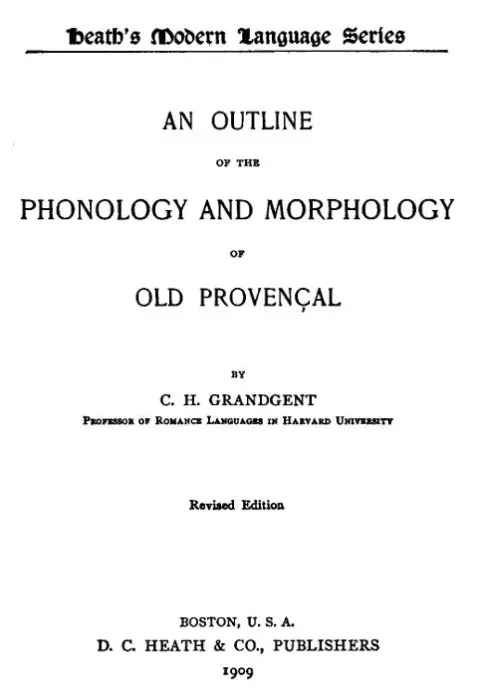
"An Outline of the Phonology and Morphology of Old Provençal" by C. H. Grandgent is a scientific publication written in the early 20th century. This work serves as a comprehensive guide for students of Romance Philology, specifically examining the phonetic and grammatical aspects of the Old Provençal language. It focuses on the literary language used mainly by the poets of Southern France during the 12th and 13th centuries. The opening portion of the work provides a preface from the author, outlining his extensive research journey that spanned two decades. Grandgent discusses the resources he utilized, including foundational grammars and various treatises on Provençal linguistics. He clarifies that while his study centers on the older literary language of Provençal, it also considers regional dialects to illuminate historical phonetic variations across time. The subsequent sections promise a detailed examination of phonology, accent, vowels, and consonants, ultimately aiming to present a systematic understanding for students of the language.
Introduction adapted from the source catalogue; source summaries may be automatically generated.
Free to read · English · 49,465 words · No account needed
MAKE TIME FOR A GOOD BOOK
On by default. Untick to stop anonymous reading totals. Each page counts after 10 seconds in view. How this works.
Anonymous counting is on unless you have switched it off.
2. Some words have ü: iüs (also iọs) < deōrsum shows the influence of süs < sūrsum; lür (usually lọr) < illōrum (cf. lur in the dialects of Navarre and Aragon) comes through an ✱illūrum due to the analogy of illūi = illi; melhüra (ọ), peiüra (ọ) perhaps follow aüra < ✱a(u)gūrat; rancüra is a mixture of rancōrem and cūra; üis is from V. L. ūstium = ōstium (cf. Zs., XXV, 355); üpa < ŭpŭpa is due to onomatopœia.
3. The adverbs ar, ara, er, era, eras, meaning ‘now,’ are hardly to be connected with hōra. Meyer-Lübke takes era, etc., from a Latin ✱era corresponding to Greek άρα; ara, ar may come directly from άρα, άρ: cf. Gr., III, 552, note.
4. Tonleu, ‘tariff,’ from τελώνιον, shows double metathesis. For adoutz, ‘fount,’ see A. Thomas, Essais de philologie française, 1897, 205.
34. Before tš, dž (and it, id), before n´, and before final i, an ọ becomes ü in various dialects: cōgĭtat > cüia cüida, ✱stŭdiat > estüia, fŭgit > füg, refŭgium > refüg; jŭngĕre > iünher, ŭngĕre > ünher, pŭgnum > pünh; dŭī > düi, sŭm > sọ + i > süi. The ü before tš, dž apparently occurs everywhere except in Dauphiné; before n´ it is to be found in nearly all the dialects of the north and west; before final i it seems to be limited to Bordeaux, Auvergne, and a part of Languedoc.
ǫ
35. Cl. L. ŏ > V. L. ǫ > Pr. ǫ: cŏr > cǫr, cŏrpus > cǫrs, mŏrtem > mǫrt, ŏpĕra > ǫbra, rŏta > rǫda.
1. For demọra (also ǫ) < ✱demŏrat, see Meyer-Lübke, Gram., I, 204, § 220. For prọa (also prǫa, prueva) < prŏbat, see Rom., XXXI, 10, footnote 3.
36. Before a nasal, in most of the dialects of Limousin, Languedoc, and Gascony, ǫ became ọ: bŏnum > bọn, fŏntem > fọnt, pŏntem > pọnt. Cf. E. Levy in Mélanges de philologie romane dédiés à Carl Wahlund, 1896, p. 207.
1. If the nasal was n´, the vowel remained open in most or all of these dialects: cŏgnĭta > coinda cuenda cuenhda, lŏnge > lonh luenh, sŏmnium > sonh suenh.
Your reading position is saved on this browser. Take it to another device with a library code. Reading pages adapt to text, rather than matching a printed edition.
BEHIND THE BOOK
This eBook is for the use of anyone anywhere in the United States and most other parts of the world at no cost and with almost no restrictions whatsoever. You may copy it, give it away or re-use it under the terms of the Project Gutenberg License included with this eBook or online at www.gutenberg.org. If you are not located in the United States, you will have to check the laws of the country where you are located before using this eBook. Read the source licence.
The original source file, including credits and licence, is retained by this library. Request an original-format copy at no charge. Please include the book title and Project Gutenberg identifier #49692.
KEEP YOUR CURIOSITY GOING
Charles G. (Charles Griffith) Ross
Hannah Webster Foster

Emily Lawless
Edwin Hamlin Carr

Charles De Lano Hine
Andrew Ure