
The Writing of News A Handbook with Chapters on Newspaper Correspondence and Copy Reading
Charles G. (Charles Griffith) Ross
THE CLASSIC COLLECTION · 1905
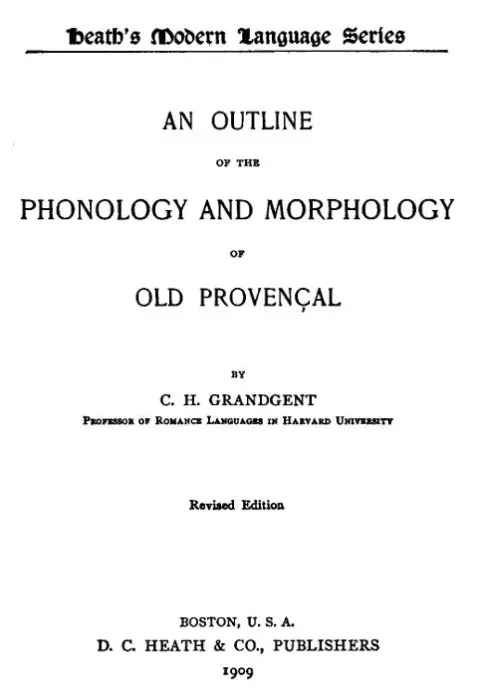
"An Outline of the Phonology and Morphology of Old Provençal" by C. H. Grandgent is a scientific publication written in the early 20th century. This work serves as a comprehensive guide for students of Romance Philology, specifically examining the phonetic and grammatical aspects of the Old Provençal language. It focuses on the literary language used mainly by the poets of Southern France during the 12th and 13th centuries. The opening portion of the work provides a preface from the author, outlining his extensive research journey that spanned two decades. Grandgent discusses the resources he utilized, including foundational grammars and various treatises on Provençal linguistics. He clarifies that while his study centers on the older literary language of Provençal, it also considers regional dialects to illuminate historical phonetic variations across time. The subsequent sections promise a detailed examination of phonology, accent, vowels, and consonants, ultimately aiming to present a systematic understanding for students of the language.
Introduction adapted from the source catalogue; source summaries may be automatically generated.
Free to read · English · 49,465 words · No account needed
MAKE TIME FOR A GOOD BOOK
On by default. Untick to stop anonymous reading totals. Each page counts after 10 seconds in view. How this works.
Anonymous counting is on unless you have switched it off.
193. Some dialects have an ending -a, -as, -a, -ám, -átz, an, borrowed from the present subjunctive and the old conditional, but added to the stem of the imperfect subjunctive: chantęssa, vendęssa, floríssa; fọssa.
[1] There should now be added: J. B. Beck, Die Melodien der
Troubadours, 1908.
[2] See B. Schädel in Rom., XXXVII, 140.
[3] See E. Bourciez, Les Mots espagnols comparés aux mots gascons.
[4] See C. Chabaneau, la Langue et la littérature du Limousin, in the Revue des langues romanes, XXXV, 379.
[5] See G. Paris, Origines de la poésie lyrique en France au moyen
âge.
[6] This h (coming from f) is peculiar to Gascon; the other dialects
have no h.
[7] G, b, d are sounded k, p, t only at the end of a word or
before a final s.
[8] G, b, d are sounded k, p, t only at the end of a word or
before a final s.
[9] Rr is generally distinguished from r, but there are a few examples of their confusion in rhyme.
[10] Ts is usually written c at the beginning of a word, z or tz
at the end.
[11] G has the sound of tš only at the end of a word or combined with
final z.
[12] Cf. French.
[13] Cf. Spanish.
[14] For some exceptions see Rom., XXXII, 591; P. Marchot, Phon.,
p. 9.
[15] Cf. R. Karch, Die nordfranzösischen Elemente im
Altprovenzalischen, 1901.
[16] See § 175, (4).
[17] There is no diphthong in the preterit ending -ęc: cazęc, etc.
[18] This view is a modification of the theory developed by C. Voretzsch in his admirable treatise, Zur Geschichte der Diphthongierung im Altprovenzalischen, Halle, 1900. That ę is not affected by an i in the following syllable is shown by such words as empęri, evangęli, saltęri, which must have been adopted fairly early. The same thing is true of ǫ: apostǫli, ǫli, etc.
[19] The diphthong of ǫ occurs, however, in this text, v. 203, in uel
< ŏculi.
[20] Derrier (derer, dereer), beside dereire, is manifestly due to the influence of primier. To the influence of the same ending -ier, as in carr(i)eira, is to be ascribed the diphthong in cad(i)eira < cathĕdra.
[21] The things just said of ę are true of ǫ: there is no breaking before u < l (tǫut = tǫlt) nor before ts, dz, s, z (nŏcet > nǫtz, ✱nŏptias > nǫssas).
[22] The conditions are not quite the same as for e: an ę does not break before a labial (nęps) nor before n´ (vęnha). Breaking before g and k seems more general for ǫ than for ę.
[23] So the second person forms cuebres, uebres, uefres, and the third person forms cuebre, uebre, uefre; cf. cǫbron, ǫbri, etc.
Your reading position is saved on this browser. Take it to another device with a library code. Reading pages adapt to text, rather than matching a printed edition.
BEHIND THE BOOK
This eBook is for the use of anyone anywhere in the United States and most other parts of the world at no cost and with almost no restrictions whatsoever. You may copy it, give it away or re-use it under the terms of the Project Gutenberg License included with this eBook or online at www.gutenberg.org. If you are not located in the United States, you will have to check the laws of the country where you are located before using this eBook. Read the source licence.
The original source file, including credits and licence, is retained by this library. Request an original-format copy at no charge. Please include the book title and Project Gutenberg identifier #49692.
KEEP YOUR CURIOSITY GOING
Charles G. (Charles Griffith) Ross
Hannah Webster Foster

Emily Lawless
Edwin Hamlin Carr

Charles De Lano Hine
Andrew Ure