
The Writing of News A Handbook with Chapters on Newspaper Correspondence and Copy Reading
Charles G. (Charles Griffith) Ross
THE CLASSIC COLLECTION · 1905
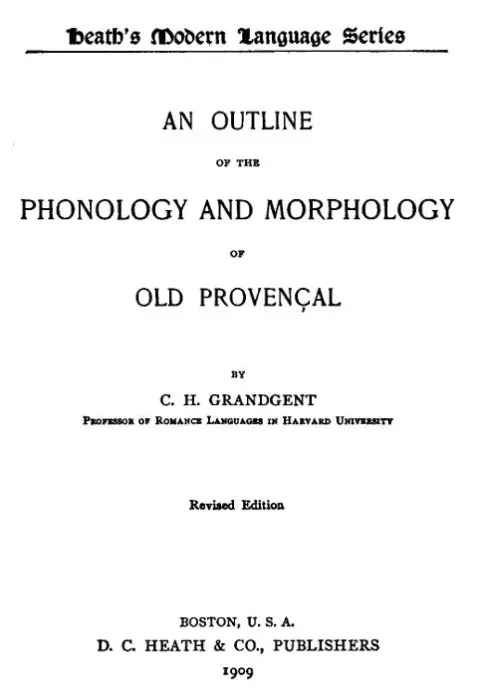
"An Outline of the Phonology and Morphology of Old Provençal" by C. H. Grandgent is a scientific publication written in the early 20th century. This work serves as a comprehensive guide for students of Romance Philology, specifically examining the phonetic and grammatical aspects of the Old Provençal language. It focuses on the literary language used mainly by the poets of Southern France during the 12th and 13th centuries. The opening portion of the work provides a preface from the author, outlining his extensive research journey that spanned two decades. Grandgent discusses the resources he utilized, including foundational grammars and various treatises on Provençal linguistics. He clarifies that while his study centers on the older literary language of Provençal, it also considers regional dialects to illuminate historical phonetic variations across time. The subsequent sections promise a detailed examination of phonology, accent, vowels, and consonants, ultimately aiming to present a systematic understanding for students of the language.
Introduction adapted from the source catalogue; source summaries may be automatically generated.
Free to read · English · 49,465 words · No account needed
MAKE TIME FOR A GOOD BOOK
On by default. Untick to stop anonymous reading totals. Each page counts after 10 seconds in view. How this works.
Anonymous counting is on unless you have switched it off.
Avẹr < habēre, podẹr < ✱pŏtēre pŏsse, volẹr < ✱vŏlēre vĕlle, sabẹr < ✱sapēre sapĕre will serve as examples (for the accentuation of the 3d pers. pl., see § 16, 2):--
(1) habuī >ac, aguí, aic, aiguí habuĭmus ✱aβwĭ́mu’ > aguẹm habuĭstī >aguíst habuĭstis >aguẹtz aguẹs habuit >ac habuĕrunt >ágron ágro, aguęron
1. For aguí (beguí, conoguí), see § 177, (1). For aic, aiguí, (cric), see § 181, (1). For aguęron (visquęron), see § 177, (3).
(2) pŏtuī > pǫc puǫc puęc potuĭmus ✱potwĭ́mu’ > poguẹm potuĭstī > poguíst potuĭstis > poguẹtz poguẹs pŏtuit > pǫc, pǫt potuĕrunt > pǫgron pǫgro
1. For puoc, see § 181, (1). Pot is apparently due to the combined influence of weak preterits and the parts of poder in which the dental is preserved.
(3) vŏluī > vǫlc, vuęlc, volguí voluĭmus ✱volwĭ́mu’ > volguẹm voluĭstī > volguíst voluĭstis > volguẹtz volguẹs vŏluit > vǫlc voluĕrunt > vǫlgron vǫlgro
1. For vuelc (tinc, vinc), see § 181, (1); for volguí
(venguí), § 177, (1).
(4) sapuī > saup, saubí sapuĭmus ✱sapwĭ́mu’ > saubẹm sapuĭstī > saubíst sapuĭstis > saubẹtz saubẹs sapuit > saup sapuĕrunt > sáubron sáubro, sáupron
1. For saubí, see § 177, (1). For sáupron (sáupra, saupés, saupút), see § 65, P, 3; cf. § 148, (2).
185. The old conditional came from the Latin pluperfect indicative, which had been supplanted in its pluperfect sense by a compound form, and was gradually restricted in its use to the functions of a preterit, a perfect conditional, and a simple conditional: see § 141, (2). In Provençal it had only the conditional meaning; and as the new conditional rendered it superfluous, it fell into disuse (with the exception of ágra and fọra) in the 13th and 14th centuries: see § 142, (2).
186. In the fourth conjugation the old conditional comes from the contracted form of the pluperfect (audīram < audīvĕram). Weak verbs of the third conjugation constructed a similar form (✱vendęram). First conjugation verbs started with the contracted pluperfect (amāram < amāvĕram), but in Provençal substituted ę for á, as in the preterit: § 175, (4). The Provençal types of the old conditional of weak verbs are, therefore, represented by: amęra, vendęra, auzíra. The inflection is as follows:--
amęra amerám
amęras amerátz
amęra amęran
auzíra auzirám
auzíras auzirátz
auzíra auzíran
Your reading position is saved on this browser. Take it to another device with a library code. Reading pages adapt to text, rather than matching a printed edition.
BEHIND THE BOOK
This eBook is for the use of anyone anywhere in the United States and most other parts of the world at no cost and with almost no restrictions whatsoever. You may copy it, give it away or re-use it under the terms of the Project Gutenberg License included with this eBook or online at www.gutenberg.org. If you are not located in the United States, you will have to check the laws of the country where you are located before using this eBook. Read the source licence.
The original source file, including credits and licence, is retained by this library. Request an original-format copy at no charge. Please include the book title and Project Gutenberg identifier #49692.
KEEP YOUR CURIOSITY GOING
Charles G. (Charles Griffith) Ross
Hannah Webster Foster

Emily Lawless
Edwin Hamlin Carr

Charles De Lano Hine
Andrew Ure