
The Writing of News A Handbook with Chapters on Newspaper Correspondence and Copy Reading
Charles G. (Charles Griffith) Ross
THE CLASSIC COLLECTION · 1905
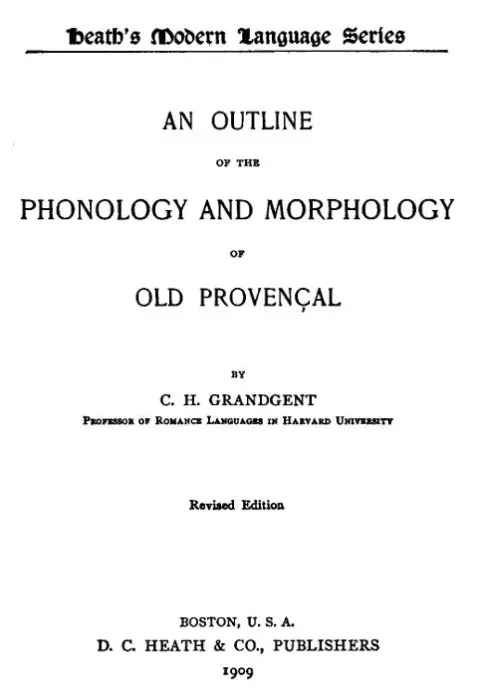
"An Outline of the Phonology and Morphology of Old Provençal" by C. H. Grandgent is a scientific publication written in the early 20th century. This work serves as a comprehensive guide for students of Romance Philology, specifically examining the phonetic and grammatical aspects of the Old Provençal language. It focuses on the literary language used mainly by the poets of Southern France during the 12th and 13th centuries. The opening portion of the work provides a preface from the author, outlining his extensive research journey that spanned two decades. Grandgent discusses the resources he utilized, including foundational grammars and various treatises on Provençal linguistics. He clarifies that while his study centers on the older literary language of Provençal, it also considers regional dialects to illuminate historical phonetic variations across time. The subsequent sections promise a detailed examination of phonology, accent, vowels, and consonants, ultimately aiming to present a systematic understanding for students of the language.
Introduction adapted from the source catalogue; source summaries may be automatically generated.
Free to read · English · 49,465 words · No account needed
MAKE TIME FOR A GOOD BOOK
On by default. Untick to stop anonymous reading totals. Each page counts after 10 seconds in view. How this works.
Anonymous counting is on unless you have switched it off.
(31) Volér (< ✱volēre = vĕlle): see § 137, (1). Pres. indicative: vuelh (< ✱vŏleo); vols (< ✱vŏles); vol (< ✱vŏlet); volém (< ✱volēmu’)[121]; volétz (< ✱volētis); vólon (< ✱vŏlent). Pres. subjunctive: vuelha (< ✱vŏleam), vuelhas, vuelha, vulhám, vulhátz, vuelhan. Imperative from subjunctive.
163. In verse the present subjunctive ending -ia sometimes counts as one syllable: si͡atz. Cf. § 153, 1.
164. (1) In the first person singular final -o and -em regularly disappeared: amo > am, amem > am. When, however, the -o or -em was preceded by a consonant group requiring a supporting vowel (§ 52), the ending was regularly retained as -e: dŭbĭto > dọpte, sŭffĕro > suffre, trĕmŭlem > tremble.
Through the analogy of ai, crẹi, dẹi, sọi, vẹi, and the 1st pers. sg. of the preterit, this -e was in the indicative generally changed at an early date to -i: ✱cŏpĕro > cǫbre cǫbri, ✱opĕro > ǫbre ǫbri; so ĭmpleo ✱ĭmplo > ompli. This -i (occasionally -e) was then taken as a distinctive ending of the 1st pers. sg., and was added to many verbs that needed no supporting vowel: auzir, au auze; azorar, azọr azọri; cantar, can canti; cọrre, cọr cọrri; mẹtre, mẹt mẹti; prezar, prętz pręzi; remirar, remir remire remiri; respondre, respon respondi; sentir, sen senti; vẹndre, vẹn vẹndi.
In the subjunctive, when a final vowel was required, -e was usually kept; it was also extended to some verbs that did not need it: acabe, dọne, mire, plọre. Very rarely an unnecessary -i was added instead of -e: laissar, lais laissi.
(2) The ending -am regularly gave -a: audiam > auia.
165. In the second person singular final -as regularly remained, and -ēs and -ī̆s became -s (or, when a supporting vowel was required, -es): amas > amas; valēs > vals, sapĭs > saps, partīs > partz; dŭbĭtēs > dọptes. Cf. § 82, S. Sometimes, especially in late texts, -s is expanded into -es: canz cantes, partz partes, saps sabes, vals vales; so floris florisses, etc.
Final -a remained, and -ē̆ and -ī fell: ama > ama, tĕne > ten, crēde > crẹ, partī > part.
166. In the third person singular final -at became -a, -ĕt and -ĭt fell (but remained as -e when a supporting vowel was needed): amat > ama, amet > am, tĕnet > ten te, vĕnit > ven ve; trĕmŭlet > tremble. Cf. § 82, T.
167. In the first person plural the final -s disappeared early, s being perhaps regarded as a distinctively second person ending[123]. The rare form ęsmes = sŭmus is the only one that retains the s: cf. § 162, (15).
Your reading position is saved on this browser. Take it to another device with a library code. Reading pages adapt to text, rather than matching a printed edition.
BEHIND THE BOOK
This eBook is for the use of anyone anywhere in the United States and most other parts of the world at no cost and with almost no restrictions whatsoever. You may copy it, give it away or re-use it under the terms of the Project Gutenberg License included with this eBook or online at www.gutenberg.org. If you are not located in the United States, you will have to check the laws of the country where you are located before using this eBook. Read the source licence.
The original source file, including credits and licence, is retained by this library. Request an original-format copy at no charge. Please include the book title and Project Gutenberg identifier #49692.
KEEP YOUR CURIOSITY GOING
Charles G. (Charles Griffith) Ross
Hannah Webster Foster

Emily Lawless
Edwin Hamlin Carr

Charles De Lano Hine
Andrew Ure