
The Writing of News A Handbook with Chapters on Newspaper Correspondence and Copy Reading
Charles G. (Charles Griffith) Ross
THE CLASSIC COLLECTION · 1905
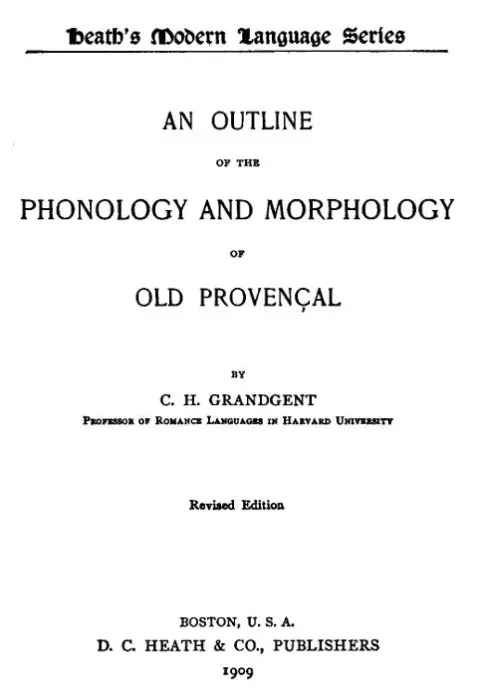
"An Outline of the Phonology and Morphology of Old Provençal" by C. H. Grandgent is a scientific publication written in the early 20th century. This work serves as a comprehensive guide for students of Romance Philology, specifically examining the phonetic and grammatical aspects of the Old Provençal language. It focuses on the literary language used mainly by the poets of Southern France during the 12th and 13th centuries. The opening portion of the work provides a preface from the author, outlining his extensive research journey that spanned two decades. Grandgent discusses the resources he utilized, including foundational grammars and various treatises on Provençal linguistics. He clarifies that while his study centers on the older literary language of Provençal, it also considers regional dialects to illuminate historical phonetic variations across time. The subsequent sections promise a detailed examination of phonology, accent, vowels, and consonants, ultimately aiming to present a systematic understanding for students of the language.
Introduction adapted from the source catalogue; source summaries may be automatically generated.
Free to read · English · 49,465 words · No account needed
MAKE TIME FOR A GOOD BOOK
On by default. Untick to stop anonymous reading totals. Each page counts after 10 seconds in view. How this works.
Anonymous counting is on unless you have switched it off.
161. Verbs in -ng- naturally developed a palatal consonant before e or i (§ 73, Ng´), but not before other vowels: cĭngĕre > cẹnher, cĭngo > cẹnc, cĭngit > cẹnh, cĭngam > cẹnga; so fẹnher, ọnher, plánher, pọnher, etc. The palatal was carried by analogy into the parts that were originally without it: hence the double forms cẹnc cẹnh, cẹngon cẹnhon, cẹnga cẹnha, etc. These double forms led tenẹr, venir to adopt tenc, venc, tenga, venga, beside the regular tenh, venh, tenha, venha. Such forms as these, supported by dẹrc < de-ērĭgo, dic < dīco, pręc < prĕco, sęc < ✱sequo, trac < ✱trago, etc., afforded a starting-point for an ending -c, adopted by some other verbs in the 1st pers. sg. of the present indicative: pĕrdo > pęrt pęrc, pr(eh)ĕndo > pren prenc, remaneo > remanh remanc, etc.
162. The following verbs have individual peculiarities that call for
special mention:--
(1) Anar (< annāre), ‘to go’, takes most of its present from vadĕre: indicative, vau vauc (analogy of estau estauc), vas, va vai (analogy of fai), anám, anátz, van vaun (analogy of estan estaun); subjunctive, an or vaza (< vadam) vaia (analogy of vai and of traia), vaga (analogy of traga), etc.; imperative, vai (analogy of fai), anátz.
(2) Aucire (< occīidĕre: § 43) has in the pres. indicative 3d sg. auci (< occīdit) and aucis (analogy of aucizém, aucizétz). Cf. auzir, caire, rire, traire, vezér. These forms were doubtless helped by the analogy of ditz (< dīcit), dütz, fatz, iatz, letz (< lĭcet), platz, tatz.
(3) Auzir (< audīre) has in the pres. indicative 3d sg. au (< audit) and aus (analogy of auzém, auzétz). Cf. aucire, caire, rire, traire, vezér. See also § 160.
(4) Aver (< habēre) has in the pres. indicative: ai (< habeo: § 73, βy), as, a, avém, avétz (see §§ 167, 168), an aun; see § 137, (1). There is no trace of ✱ho. Instead of ai, the dialects of Aude, Tarn, Tarn et Garonne, and Haute-Garonne have ei (cf. Gram., II, p. 304), which probably developed first in the future (§ 152, 1) through the analogy of the preterit ending -ei which took the place of -ai: amāvi ✱amai > ✱amai amei (§ 175), then amarai > amarei, then ai > ei. The pres. subjunctive is aia (< habeam: § 73, βy). For the imperative, see § 156.
(5) Caire cazér (< cadĕre ✱cadēre) has in the pres. indicative 3d sg. ca (< cadit) cai (analogy of brai < ✱bragit, fai, trai < ✱tragit, vai) cas (analogy of cazém, cazétz: cf. aucire, auzir, rire, traire, vezér).
Your reading position is saved on this browser. Take it to another device with a library code. Reading pages adapt to text, rather than matching a printed edition.
BEHIND THE BOOK
This eBook is for the use of anyone anywhere in the United States and most other parts of the world at no cost and with almost no restrictions whatsoever. You may copy it, give it away or re-use it under the terms of the Project Gutenberg License included with this eBook or online at www.gutenberg.org. If you are not located in the United States, you will have to check the laws of the country where you are located before using this eBook. Read the source licence.
The original source file, including credits and licence, is retained by this library. Request an original-format copy at no charge. Please include the book title and Project Gutenberg identifier #49692.
KEEP YOUR CURIOSITY GOING
Charles G. (Charles Griffith) Ross
Hannah Webster Foster

Emily Lawless
Edwin Hamlin Carr

Charles De Lano Hine
Andrew Ure