
Last letters from the living dead man
David Patterson (Spirit) Hatch
THE CLASSIC COLLECTION · 1909
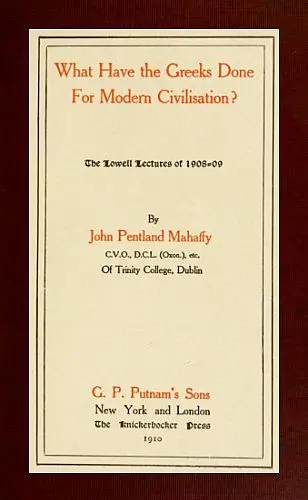
"What Have the Greeks Done for Modern Civilisation?" by J. P. Mahaffy is a series of lectures written in the early 20th century. The work explores the profound influence of ancient Greek culture on contemporary society, particularly focusing on the arts, philosophy, science, and education. Its purpose is to reevaluate the significance of Greek studies in modern education and society. The opening of the text introduces Mahaffy as a seasoned scholar delivering a series of lectures that aim to highlight the contributions of the Greeks to modern civilization. He expresses his initial doubts about the diminishing interest in Greek studies, particularly in America, and outlines the various domains—literature, art, politics, and science—through which Greek thought has indelibly shaped contemporary understanding. He emphasizes that understanding the Greek legacy is essential for appreciating the foundations upon which modern culture is built and suggests that reforming the teaching of Greek is vital to reviving its significance in educational curricula.
Introduction adapted from the source catalogue; source summaries may be automatically generated.
Free to read · English · 58,758 words · No account needed
MAKE TIME FOR A GOOD BOOK
On by default. Untick to stop anonymous reading totals. Each page counts after 10 seconds in view. How this works.
Anonymous counting is on unless you have switched it off.
Polybius, artistic conception of history, 79;
and Achæan League, 203;
on limitation of family, 207;
on ruin of Greece, 211
Pompeii, 145
Pope, Alexander, translation of Iliad, 51, 52, 53
Praxiteles unexcelled, 112
Praxiteles, Hermes, 33
Prometheus Vinctus, see Æschylus
Prose, Greek, knowledge of early development of, 65;
late origin, 66;
poetry more popular than, 66;
early attempt at, by Heracleitus, 67;
Hippocrates, 67;
beginnings among Dorians, 68;
prose adapted for a listening public, 86;
political essay, 86;
laws of composition devised by Isocrates, 88;
conversation easy, 90;
letter-writing, 92;
the novel, 93;
books of travel, 97
Puteoli, gateway into Italy, 145
Pythagoras, effect of influence, 221;
contemporaries and successors, 221
Pythagorean school, importance of arithmetic, 153;
theory of Descartes, 154;
speculations on series of units, 155;
specimens of treatment in arithmetic, 156;
results of researches, 156;
importance of numbers ten and twelve, 156;
discoverers and teachers of science, 166, 167
Pythagoreans, discover science of harmony, 143;
famous theory, 143
Racine and his plays, 48
Rambles and Studies in Greece, see J. P. Mahaffy
Renaissance (Renascence), 4;
artists of, 131
Rénan, Ernest, simplicity of style, 75
Renascence, 4
Representation, local, 189
Republic, see Plato
Research, original, requisite for, 235
Rogers’s translation of Aristophanes, 61
Roman life and culture, 18, 19
Roman Republic, effect of growth, 211
Romanesque architecture, example of tawdriness, 109
Romans, medium through which Greek learning was spread in
Western World, 3, 4, 18, 19, 85, 190, 195;
compared with the Greeks, 182
Romantic school, 59
Rome, Greek ruins in time of Renaissance, 146
Romeo and Juliet, see Shakespeare
Royal College of Physicians, Ireland, 173
Ruskin, John, style, 89
St. Angelo, castle of, 111
St. Mark’s at Venice, architecture of, 18, 109
Sakia, invention of, 165
Samson Agonistes, see Milton
Sappho, 37;
Horace’s version of, 53;
love for nature, 59
Satyric drama, 48
Science, definition of term as used, 147;
relation to philosophy, 168;
abstract thinking necessary to experiment and discovery, 235
Sciences of observation, 147
Scriptores Erotici Graeci, 95
Sculpture, Greek: reasons for pre-eminence 112, 113;
nude and draped figures, 112, 113;
Donatello’s problem, 113, 114;
use of bronze and marble, 116, 118;
development, 117, 118;
decay, 117;
never dissociated from painting, 118;
coloured statues, 118, 119;
principles of composition, 120;
second favourite form of composition, 122;
effect on Europe, 123
Shakespeare, indebted to Plutarch’s Lives, 45;
indirect knowledge of Greek poets, 46;
Milton on, 47, 48;
school of, defended 48
Antony and Cleopatra: source in Plutarch’s Lives, 45
Hamlet: Voltaire’s view of, 48
Macbeth: Voltaire’s view of, 48
Romeo and Juliet: Greek origin, 95
Shakespeare, school of, and Greek masters, 48
Shelley, combines Greek culture with Romantic imagination, 56,
and Pantheism, 228
Sicilian troubles, 186
Sidon, tomb of, 112
Silver Age of Greek Literature, 91
Simonides, Gray compared with, 54
Skellig Michael, beehive huts at, 99
Slavery, among Greeks, 188, 190;
Aristotle on, 189
Smyly, Prof., Essay; on Greek notation in arithmetic, 158
Social Life in Greece, see J. P. Mahaffy
Socrates, prosecution of, 215;
causes revolution in philosophy, 236, 237
Solon, use of verse, 39;
modern, 66;
reduces debts in Athens, 186
Sophist, of Plato, 152
Sophists, attitude toward scientific speculation, 237
Sophocles, Milton on, 47;
choruses, 51;
Whitelaw’s version of, 64;
music of, 136
Œdipus; and Milton’s Samson Agonistes, 49
Sophron, poet, 39
Sovranties, pass into aristocracies, 184, 185;
models in constitutional government, 184-186
Your reading position is saved on this browser. Take it to another device with a library code. Reading pages adapt to text, rather than matching a printed edition.
BEHIND THE BOOK
This eBook is for the use of anyone anywhere in the United States and most other parts of the world at no cost and with almost no restrictions whatsoever. You may copy it, give it away or re-use it under the terms of the Project Gutenberg License included with this eBook or online at www.gutenberg.org. If you are not located in the United States, you will have to check the laws of the country where you are located before using this eBook. Read the source licence.
The original source file, including credits and licence, is retained by this library. Request an original-format copy at no charge. Please include the book title and Project Gutenberg identifier #59132.
KEEP YOUR CURIOSITY GOING
David Patterson (Spirit) Hatch
Cécile Tormay

Moritz Busch
Coulson Kernahan
John L. Ransom

Ralph Waldo Emerson