
Last letters from the living dead man
David Patterson (Spirit) Hatch
THE CLASSIC COLLECTION · 1909
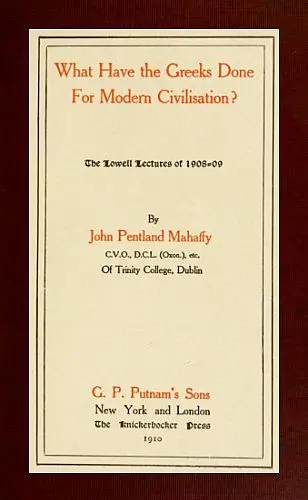
"What Have the Greeks Done for Modern Civilisation?" by J. P. Mahaffy is a series of lectures written in the early 20th century. The work explores the profound influence of ancient Greek culture on contemporary society, particularly focusing on the arts, philosophy, science, and education. Its purpose is to reevaluate the significance of Greek studies in modern education and society. The opening of the text introduces Mahaffy as a seasoned scholar delivering a series of lectures that aim to highlight the contributions of the Greeks to modern civilization. He expresses his initial doubts about the diminishing interest in Greek studies, particularly in America, and outlines the various domains—literature, art, politics, and science—through which Greek thought has indelibly shaped contemporary understanding. He emphasizes that understanding the Greek legacy is essential for appreciating the foundations upon which modern culture is built and suggests that reforming the teaching of Greek is vital to reviving its significance in educational curricula.
Introduction adapted from the source catalogue; source summaries may be automatically generated.
Free to read · English · 58,758 words · No account needed
MAKE TIME FOR A GOOD BOOK
On by default. Untick to stop anonymous reading totals. Each page counts after 10 seconds in view. How this works.
Anonymous counting is on unless you have switched it off.
Oratory, school of pleaders, 68;
treatment of subject, 69;
subject of great importance, 69, 70;
eloquence of debate and eloquence of display, 68, 81;
Greeks adverse to extemporaneous speaking, 81;
art of persuasion, 82;
arguments and manner of presenting, 82, 83;
legal rhetoric, 83;
speeches of Demosthenes, 83;
De Corona, 83;
Greek oratory of debate still the model of modern world, 85
Orchomenos, 101
Ornament, earlier in development than architecture, 99;
in pre-historic ages, 99;
in Doric temple, 104
Painting, 125 ff;
examples of Greek, 126, 127;
qualities requisite for success, 128;
Greek sense of form, 128;
Greek sense of colour, 128-130;
landscape little developed among Greeks, 130, 131;
portraits, 131;
mythical subjects, 131;
and sculpture, 131;
indirect influence on modern painting, 131, 132;
Greek vases, 132;
branch of decoration, 132, 133
Pantheism, doctrine of, 222-224;
positive side of, 223;
arguments for, 224;
how regarded by Greek public, 225;
and Wordsworth, Shelley, Tennyson, 228, 229
Pantheists, Greek, character of, 222;
legacy to mankind, 228;
effect on modern poetry, 228
Pantheon, 111
Pappus, work in geometry, 161
Papyrus I. of Turin, 197
Paradise Lost, see Milton
Parmenides, 236;
gives positive side of doctrine of pantheism, 223
Parthenon, unexcelled, 27;
J. Carrey’s drawings of, 52;
frieze, 113, 122;
horses of, 121;
ornamentation, 130
Pastoral poetry developed by Theocritus, 35
Pater, Walter, Marius the Epicurean, 244
Paul, Saint, on Stoicism, 245
Pausanias, and temple of Hera, 105;
and Tomb of the Minyæ, 108
Peisias, the Lycian, will of, 196
Peloponnesus, cities of, 201
Penrose, Mr., Greek critic, 27
Pericles studied oratory, 70
Peripatetic Mathematics, 170
Persians of Timotheus, see Timotheus
Peyron, Amédée, 197
Phædo, of Plato, 242
Phelps, W. L., on Gray, 54
Pherecydes of Syros, predecessor of Heracleitus, 67
Phidias, and the Laocoon, 116;
his ornamentation of the Parthenon, 121, 122;
his procession of figures, 122, 123
Philodemus, Tract on Music, on effect of music on morals, 138
Philosophy, relation to science, 169, 236;
secular and free, 215, 216
Phœnicia, influence on Greece, 11, 12
Phœnician alphabet, 12
Phormio, 71
Phrynichus, Fall of Miletus: displeasing to Attic audience, 73, 115
Physical geography, 169
Physics, mathematical, 162;
developed by Archimedes, 162;
development of hydrostatics and mechanics by Heron, 162, 167
Pindar, Cicero on, 50;
Horace’s appreciation, 53
Pindar, Odes, 27
Place-names, Greek, 7
Plato, influence on Wordsworth, 57;
as critic, 92;
on influence of music, 139, 141;
philosophy of, 237;
influence on modern thought, 237;
views of education, 237, 238;
theology, 238 ff;
on moral law, 239, 240;
on aristocracy of intellect, 241;
on immortality of soul, 242
Dialogues: model of conversation, 91;
logical studies in, 149;
character, 214;
subjects, 215
Phaedo: 242
Politicus: 238
Republic: picture of gloom, 116;
ideal for safeguard of society in, 238
Sophist: 152
Platonism, 228
Plautus, translation of Menander, 61, 209
Plutarch, model for modern biographers, 80 Lives: North’s translation furnished Shakespeare with subjects, 45, 80; influence on French Revolution, 46
Poetic, see Aristotle
Poetry, Greek: 31 ff;
carefully studied product, 32, 37;
dialects, 33, 40;
development, 34, 35;
pastoral, 35;
dramatic, 36;
lyric, 37;
form and spirit, 38;
diction and metre, 38;
best studied in the original, 38, 64;
examples of inferior, 38, 39;
associated with other arts, 39;
dignity and brevity, 40;
and modern poetry, 41 ff;
great epics, 41;
influence, 42 ff;
how far reduced to theory, 61-63;
translations, 45, 51, 52, 64;
indirect influence through Latin, 45;
and music, 136
Politics, causes of development, 182, 183
Politicus, of Plato, 238
Your reading position is saved on this browser. Take it to another device with a library code. Reading pages adapt to text, rather than matching a printed edition.
BEHIND THE BOOK
This eBook is for the use of anyone anywhere in the United States and most other parts of the world at no cost and with almost no restrictions whatsoever. You may copy it, give it away or re-use it under the terms of the Project Gutenberg License included with this eBook or online at www.gutenberg.org. If you are not located in the United States, you will have to check the laws of the country where you are located before using this eBook. Read the source licence.
The original source file, including credits and licence, is retained by this library. Request an original-format copy at no charge. Please include the book title and Project Gutenberg identifier #59132.
KEEP YOUR CURIOSITY GOING
David Patterson (Spirit) Hatch
Cécile Tormay

Moritz Busch
Coulson Kernahan
John L. Ransom

Ralph Waldo Emerson