
Last letters from the living dead man
David Patterson (Spirit) Hatch
THE CLASSIC COLLECTION · 1909
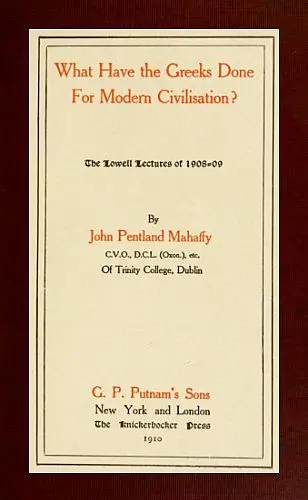
"What Have the Greeks Done for Modern Civilisation?" by J. P. Mahaffy is a series of lectures written in the early 20th century. The work explores the profound influence of ancient Greek culture on contemporary society, particularly focusing on the arts, philosophy, science, and education. Its purpose is to reevaluate the significance of Greek studies in modern education and society. The opening of the text introduces Mahaffy as a seasoned scholar delivering a series of lectures that aim to highlight the contributions of the Greeks to modern civilization. He expresses his initial doubts about the diminishing interest in Greek studies, particularly in America, and outlines the various domains—literature, art, politics, and science—through which Greek thought has indelibly shaped contemporary understanding. He emphasizes that understanding the Greek legacy is essential for appreciating the foundations upon which modern culture is built and suggests that reforming the teaching of Greek is vital to reviving its significance in educational curricula.
Introduction adapted from the source catalogue; source summaries may be automatically generated.
Free to read · English · 58,758 words · No account needed
MAKE TIME FOR A GOOD BOOK
On by default. Untick to stop anonymous reading totals. Each page counts after 10 seconds in view. How this works.
Anonymous counting is on unless you have switched it off.
Sparta, slaves in, 188;
power, 201
Spinoza, teachings of, 216;
Pantheist, 224
Statuary, portrait, 120
Stearne, John, Founder of Royal College of Physicians, Ireland, 173;
theorist and writer, 173;
on works of Hippocrates, 173;
and the Church, 176
Stoics, speculations, 244-246;
and Epicureans, 244-246
Stylists, modern English, 89
Swanwick, Miss, translations, 57
Swinburne, Algernon, writer of plays after Greek models, 58
Atalanta: choruses, 40, 58
Erechtheus; 58
Syracuse, 68
Taylor, Jeremy, style influenced by Isocrates, 90
Temples, Greek: Doric ornament, 104;
features, 105;
at Tiryns, 105;
Hera at Olympia, 105;
distinction between dwellings and, 106;
construction, 106;
compared with houses, 107;
proportions, 107;
furnish models for all Europe, 110
Tennyson, influenced by Theocritus, 36, 59, 60;
and Euripides, 60;
and Pantheism, 228, 229
Terence, translation of Menander, 61, 209
Thales, his primitive element of the world, 216, 217;
predicts an eclipse, 217
Themistocles, studied oratory, 70
Theocritus, Virgil’s translations, 24;
pastoral poet, 35;
goes back to life of people, 35, 36;
influence on Tennyson, 36, 59, 60;
idealises the commonplace, 38;
delights in nature, 59;
best translation of, 64
Idylls: 96
Theognis, use of verse, 39
Theon of Smyrna, 167
Theophrastus, collaborator with Aristotle, 169
Thirlwall, history written without first-hand knowledge of Greece, 56
“Three tragic poets,” the, 47, 49
Thucydides, has given to world model of the science of history, 71;
subject, 71, 77, 78;
compared with Herodotus, 76, 78;
subtle artist, 76;
style, 77;
picture of politics in Greece, 77;
artistic scheme, 78;
diction, 78;
obscurity, 78, 79;
on war, 200
Thucydides Mythistoricus, see Cornford
Timotheus, Persians: inferior poetry, 38, 39, 63;
Wilamowitz on, 39
Tiryns, remains of temples at, 105
Tombs, domed or circular buildings, 110;
Pantheon, 110;
Castle of St. Angelo, 111;
Invalides in Paris, 111;
Mausoleum of Queen Victoria, 111;
Treasure House of Atreus, 111;
Tomb of the Minyæ, 111;
early, in Ireland, 111
Tract on the Sublime, translated by Burke, 92;
point of view of, 92
Tragedy, Greek: material, 42;
Milton’s view of, 47, 48
Travels, not thoroughly Greek, 97
Treaties, between Greek city-states, 198
Trinity College, Dublin: some of the requisites for degree, 179
Turin, Academy of, Transactions; referred to, 197
Unions or leagues, question as to rights of contracting parties, 202, 203; European examples, 204
Your reading position is saved on this browser. Take it to another device with a library code. Reading pages adapt to text, rather than matching a printed edition.
BEHIND THE BOOK
This eBook is for the use of anyone anywhere in the United States and most other parts of the world at no cost and with almost no restrictions whatsoever. You may copy it, give it away or re-use it under the terms of the Project Gutenberg License included with this eBook or online at www.gutenberg.org. If you are not located in the United States, you will have to check the laws of the country where you are located before using this eBook. Read the source licence.
The original source file, including credits and licence, is retained by this library. Request an original-format copy at no charge. Please include the book title and Project Gutenberg identifier #59132.
KEEP YOUR CURIOSITY GOING
David Patterson (Spirit) Hatch
Cécile Tormay

Moritz Busch
Coulson Kernahan
John L. Ransom

Ralph Waldo Emerson