
Last letters from the living dead man
David Patterson (Spirit) Hatch
THE CLASSIC COLLECTION · 1909
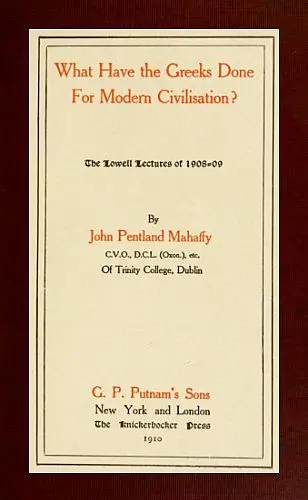
"What Have the Greeks Done for Modern Civilisation?" by J. P. Mahaffy is a series of lectures written in the early 20th century. The work explores the profound influence of ancient Greek culture on contemporary society, particularly focusing on the arts, philosophy, science, and education. Its purpose is to reevaluate the significance of Greek studies in modern education and society. The opening of the text introduces Mahaffy as a seasoned scholar delivering a series of lectures that aim to highlight the contributions of the Greeks to modern civilization. He expresses his initial doubts about the diminishing interest in Greek studies, particularly in America, and outlines the various domains—literature, art, politics, and science—through which Greek thought has indelibly shaped contemporary understanding. He emphasizes that understanding the Greek legacy is essential for appreciating the foundations upon which modern culture is built and suggests that reforming the teaching of Greek is vital to reviving its significance in educational curricula.
Introduction adapted from the source catalogue; source summaries may be automatically generated.
Free to read · English · 58,758 words · No account needed
MAKE TIME FOR A GOOD BOOK
On by default. Untick to stop anonymous reading totals. Each page counts after 10 seconds in view. How this works.
Anonymous counting is on unless you have switched it off.
Macbeth, of Shakespeare, 48
Macedonian power, 205, 211
Machinery, inventions of Heron, 162-164;
moving force of automatic sakia, 165
Mad Herakles, see Euripides
Magee, Archbishop, style of eloquence, 89;
modelled after Chalmers, 90;
style based upon principles of Isocrates, 90
Mahaffy, J. P., Epoch of Irish History: referred to, 173
History of Greek Literature: on poetry, 31;
on obscurity of Thucydides, 79;
on Isocrates and Demosthenes, 82;
on conversation, 91
Rambles and Studies in Greece: on persistence
of characteristics, 15, 16
Social Life in Greece: main thesis, 15
Marius the Epicurean, by Walter Pater, 244
Mathematics, school of Pythagoras, 153, 155, 156, 161, 167;
theory of Descartes, 154;
arithmetic, 153, 154;
geometry, 158;
mathematical physics, 162;
library of Greek, 166;
pure, 166, 169;
Peripatetic, 170
Mausollus of Halicarnassus, tyrant, 205
Mechanics, development by Archimedes, Heron, and Alexandrian school, 162
Mediæval schools, training in logic, 150, 151
Medicine, formulated by Greeks, 147;
school of Hippocrates, 171 ff;
mediæval, 174, 175;
and superstition, 174, 175;
resurrection of, 176
Menander, character of plays, 34, 94;
translations by Plautus and Terence, 61, 208, 209;
influence, 61;
portrays Attic society, 208-210;
fragments of plays discovered in Egypt, 209
Meredith, George, characteristic of his work, 79
Merope, of Matthew Arnold, 58
Middle Ages, a period of gloom, 114, 115;
conditions in, 181;
causes of retrogression in, 182
Miletus, fall of, checks the development of Greek prose, 67;
temple, statues at entrance, 120
Milton, John, poetic vision disturbed by political controversies, 42;
influenced by Greek epic, 42;
influenced by Greek drama, 46;
poetic style and metre, 46;
Matthew Arnold on, 46;
defence of dramatic poetry, 47;
on Shakespeare and Greek masters, 47;
on Greek tragedy, 47-49;
choruses and lyrical monodies, 50;
inspired by Isocrates, 88, 90
Areopagitica: style, 88
Comus: lyric sweetness, 51
Paradise Lost: best modern epic, 42;
compared with the Iliad, 43;
divine and human in, 43;
redundancy of similes, 43;
and Argonautics, 43;
and Prometheus Vinctus, 47
Samson Agonistes: Greek form, 47, 49, 50;
borrowings from Œdipus and Prometheus, 49;
development influenced by Euripides, 49;
Greek spirit, 50;
lyrics and choral odes, 50, 51;
Sir Egerton Brydges on, 50
Mimes, see Herondas
Minyæ, Tomb of the, 101, 108, 111
Motion and matter, 234
Mummius, cause of conquest of, 211
Music, first beginnings, 99, 133 ff;
notation related to meaning, 125;
existing specimens of Greek, fragmentary, 134;
comparison of Greek with Japanese, 135;
Greek scales, 135, 142-144;
and Greek poetry, 136;
relation to education, 136, 137, 144;
effect upon morals, 137-140, 144;
Greek music source of modern, 141;
simplicity, 141;
Greek works on, 141;
Plato on instrumental and vocal, 141;
extant Greek tracts on, 142;
Hungarian, 142;
problems of Greek, 142;
scientific basis of harmony discovered by Pythagoreans, 143;
Pythagorean theory, 143;
Aristotle on melody, 144;
summary of Greek music, 144
Naples, 145
Natural history, collection of facts by Greeks, 147
Natural philosophy, 236
Nike of Samothrace, 117
Novel, development among Greeks, 93, 94;
and Menander’s plays, 94;
main topic imported from East, 94
Ode on a Greek Vase, by Keats, 132
Ode to St. Cecilia, see Dryden
Odyssey, world epic, 27, 41;
imitated, 41;
unequalled, 42
Œdipus, see Sophocles
Optics, Euclid’s work on, 166
Your reading position is saved on this browser. Take it to another device with a library code. Reading pages adapt to text, rather than matching a printed edition.
BEHIND THE BOOK
This eBook is for the use of anyone anywhere in the United States and most other parts of the world at no cost and with almost no restrictions whatsoever. You may copy it, give it away or re-use it under the terms of the Project Gutenberg License included with this eBook or online at www.gutenberg.org. If you are not located in the United States, you will have to check the laws of the country where you are located before using this eBook. Read the source licence.
The original source file, including credits and licence, is retained by this library. Request an original-format copy at no charge. Please include the book title and Project Gutenberg identifier #59132.
KEEP YOUR CURIOSITY GOING
David Patterson (Spirit) Hatch
Cécile Tormay

Moritz Busch
Coulson Kernahan
John L. Ransom

Ralph Waldo Emerson