
Last letters from the living dead man
David Patterson (Spirit) Hatch
THE CLASSIC COLLECTION · 1909
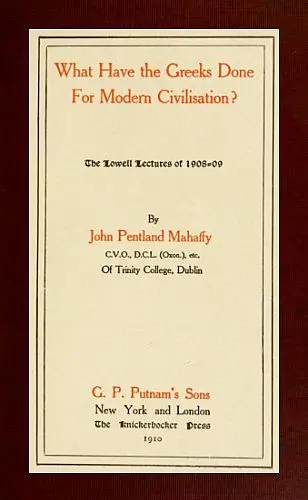
"What Have the Greeks Done for Modern Civilisation?" by J. P. Mahaffy is a series of lectures written in the early 20th century. The work explores the profound influence of ancient Greek culture on contemporary society, particularly focusing on the arts, philosophy, science, and education. Its purpose is to reevaluate the significance of Greek studies in modern education and society. The opening of the text introduces Mahaffy as a seasoned scholar delivering a series of lectures that aim to highlight the contributions of the Greeks to modern civilization. He expresses his initial doubts about the diminishing interest in Greek studies, particularly in America, and outlines the various domains—literature, art, politics, and science—through which Greek thought has indelibly shaped contemporary understanding. He emphasizes that understanding the Greek legacy is essential for appreciating the foundations upon which modern culture is built and suggests that reforming the teaching of Greek is vital to reviving its significance in educational curricula.
Introduction adapted from the source catalogue; source summaries may be automatically generated.
Free to read · English · 58,758 words · No account needed
MAKE TIME FOR A GOOD BOOK
On by default. Untick to stop anonymous reading totals. Each page counts after 10 seconds in view. How this works.
Anonymous counting is on unless you have switched it off.
Dante, gloomy splendour, 19
Inferno: 27
Daphnis and Chloe, author unknown, 96;
best specimen of Greek novel, 96
Dark Ages, conditions in, 181;
causes of retrogression, 282
Darwin, Charles, on sense of colour, 128
Death penalty, 192
Debts, reduction of by Solon, 186
Decline and Fall of the Roman Empire, see Gibbon
Decoration, painting a branch of, 132, 133;
household, 145, 146
De Corona, see Demosthenes
De Finibus of Cicero, 245
De Jure Pacis et Belli, by Hugo Grotius, 198
Delos, discoveries at, 145
Delphi, treasury of Siphnos, 122;
hymn discovered at, 134
Democritus, development of Atomic theory, 231, 232; consequences to which his theory led him, 233
Demosthenes, combined orator and politician, 70;
character of orations, 83, 84
De Corona: greatest
Greek oration, 83;
style, 84
Derby, Lord, translator, 57
Descartes, teachings of, 216, 224;
on colour, 216;
on extension and thought, 224
Diagoras of Melos, atheist, 215
Dialects, Homeric, 33, 40, 41;
main cause of their use, 40
Dialogues of Plato, see Plato
Diatonic scale, basis of Greek music as well as of modern, 135, 142-144
Didot, Epistolographi Graeci, 92
Dikæarchus, collaborator with Aristotle, 169
Dion Chrysostom, rhetor and sophist, 93
Dionysius of Halicarnassus, essays of, 92
Dionysius of Syracuse, tyrant, 205
Diophantus, work in arithmetic and algebra, 161, 162, 167
Donatello’s problem, 113
Dorians, literary prose had its origin among them, 67, 68
Doric choral hymns, 41
Doric pillar, 104
Doric temple, 104
Dörpfeld, Dr., Greek critic, 27;
discoveries at Tiryns, 105
Drama, Greek, beginnings, 36;
influence, 46 ff, 57, 58
Dryden, John, translation of Virgil, 53;
model for Gray, 54
Ode to St. Cecilia: shows Greek influence, 55
Eclogues of Virgil, 24
Education, Greek: ethical inquiry, 215;
subjects of thought, 215;
relation of
music to, 136, 137, 144;
relation of mathematics and science to philosophy, 179;
higher: and Greek studies, 20;
relation of mathematics and philosophy, 179;
essential element, 214;
best exponent, 215;
relation to character, 241
Egypt, greatness, 5;
influence on Greece, 11
Egyptian art, influence on Greek art, 145
Elea, school of, founder, 221
Eleusinian Mysteries, 115
Empedocles, wrote in verse, 39;
principal feature of his system, 229;
postulated principles of Love and Hate, 230, 231
Entretiens sur l’architecture, see Viollet-le-Duc
Epic poetry, Greek, 41;
modern, 42;
influence, 42
Epicteta, will of, 196
Epicureans, on music and morals, 138;
and Stoics, 244
Epicurus, system of, 245
Epidauros, place of pilgrimage, 176
Epistolographi Graeci, 92
Epoch of Irish History, see Mahaffy, J. P.
Erechtheus of Swinburne, 58
Etruscans, and the arch, 105;
culture of, 110
Euclid, how attained perfection, 158, 159;
on optics, 166;
father of geometry, 167;
founds Peripatetic Mathematics, 170
Elements: summary of all principles discovered previously, 158;
three kinds of data, 159;
careful definitions, 159;
misfortune of, 160;
thirteen books, 160, 161
Eudemus the Rhodian, collaborator with Aristotle, 169;
his history of sciences, 170
Eudoxus, astronomer, 167
Euripides, Milton’s view of, 47;
introduces “vulgar and trivial persons” into his plays, 48;
influence on development of Samson Agonistes, 49;
choruses of, 51;
Browning’s version of his plays, 57-58, 64;
and Tennyson, 60;
Medea, 62
Alkestis: Browning’s version of, 57
Iphigenia in Aulis: type of heroine, 62;
Aristotle’s criticism of, 62, 72
Mad Herakles: Browning’s version of, 57
Everyman, represents horrors of Middle Ages, 115
Excursion, see Wordsworth
Fall of Miletus, see Phrynichus
Faust, see Goethe
Federation, early example, 203
Fick, Augustus, on place-names, 7
Your reading position is saved on this browser. Take it to another device with a library code. Reading pages adapt to text, rather than matching a printed edition.
BEHIND THE BOOK
This eBook is for the use of anyone anywhere in the United States and most other parts of the world at no cost and with almost no restrictions whatsoever. You may copy it, give it away or re-use it under the terms of the Project Gutenberg License included with this eBook or online at www.gutenberg.org. If you are not located in the United States, you will have to check the laws of the country where you are located before using this eBook. Read the source licence.
The original source file, including credits and licence, is retained by this library. Request an original-format copy at no charge. Please include the book title and Project Gutenberg identifier #59132.
KEEP YOUR CURIOSITY GOING
David Patterson (Spirit) Hatch
Cécile Tormay

Moritz Busch
Coulson Kernahan
John L. Ransom

Ralph Waldo Emerson