
Last letters from the living dead man
David Patterson (Spirit) Hatch
THE CLASSIC COLLECTION · 1909
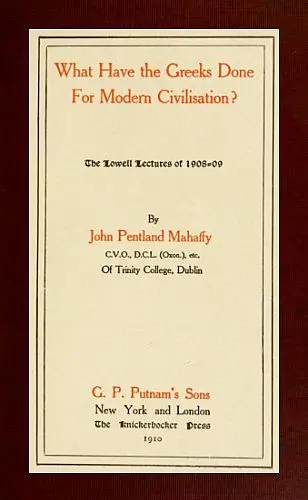
"What Have the Greeks Done for Modern Civilisation?" by J. P. Mahaffy is a series of lectures written in the early 20th century. The work explores the profound influence of ancient Greek culture on contemporary society, particularly focusing on the arts, philosophy, science, and education. Its purpose is to reevaluate the significance of Greek studies in modern education and society. The opening of the text introduces Mahaffy as a seasoned scholar delivering a series of lectures that aim to highlight the contributions of the Greeks to modern civilization. He expresses his initial doubts about the diminishing interest in Greek studies, particularly in America, and outlines the various domains—literature, art, politics, and science—through which Greek thought has indelibly shaped contemporary understanding. He emphasizes that understanding the Greek legacy is essential for appreciating the foundations upon which modern culture is built and suggests that reforming the teaching of Greek is vital to reviving its significance in educational curricula.
Introduction adapted from the source catalogue; source summaries may be automatically generated.
Free to read · English · 58,758 words · No account needed
MAKE TIME FOR A GOOD BOOK
On by default. Untick to stop anonymous reading totals. Each page counts after 10 seconds in view. How this works.
Anonymous counting is on unless you have switched it off.
Land legislation in Greece compared with that in Ireland and Scotland, 187
Language, perfected use of, by Greeks, 148;
analysis of, 149;
Greek: Non-Aryan roots, 7;
permanence, 14
Laocoon, 116
Laplace’s theory, 220
Latin, place in higher education, 22, 23;
medium of Greek influence, 45
Latin culture, why not permanent, 182;
compared with Greek, 182
Latin races, 3
Latin Vulgate, the, St. Jerome compares it with Greek
and Hebrew originals, 19
Law, Greek, Attic Code model for Romans and other nations, 190;
criminal, 191 ff;
compared with that of Modern Europe, 192;
safety of citizens, 192;
death penalty, 192, 193;
civil, 193-198;
contracts, 194;
testaments or wills, 194-197;
international, 198 ff
Leighton, Lord, influenced by Greek art, 131, 132
Lepanto, battle, 72
Letter-writing, Greek letters not remarkable, 93;
Cicero’s formulæ, 93;
exceptions, 93
Leucippus, development of Atomic theory, 231;
father of modern systems, 236
Literary criticism, beginnings, 91;
models, 92;
Tract on the Sublime, 92
Loans, 194
Local government, not representative, but popular, 189, 190
Locke, teachings of, 216
Logic, approached by Greeks through analysis of language, 148;
beginnings of logical studies, 149;
treatises of Aristotle on theory of Reasoning, 149, 150;
importance of common logic, 150;
small attention paid to, in American education, 150, 152;
English and European training in, 151;
power of, on Greek minds, 151, 152;
and Greek mathematics, 153
Lourdes, place of pilgrimage, 177
Lucretius, claims, 4
Lyric poetry, beginnings, 37;
influence, 53-57, 59, 60
Lysias, presentation of argument in character, 83
Your reading position is saved on this browser. Take it to another device with a library code. Reading pages adapt to text, rather than matching a printed edition.
BEHIND THE BOOK
This eBook is for the use of anyone anywhere in the United States and most other parts of the world at no cost and with almost no restrictions whatsoever. You may copy it, give it away or re-use it under the terms of the Project Gutenberg License included with this eBook or online at www.gutenberg.org. If you are not located in the United States, you will have to check the laws of the country where you are located before using this eBook. Read the source licence.
The original source file, including credits and licence, is retained by this library. Request an original-format copy at no charge. Please include the book title and Project Gutenberg identifier #59132.
KEEP YOUR CURIOSITY GOING
David Patterson (Spirit) Hatch
Cécile Tormay

Moritz Busch
Coulson Kernahan
John L. Ransom

Ralph Waldo Emerson