
Last letters from the living dead man
David Patterson (Spirit) Hatch
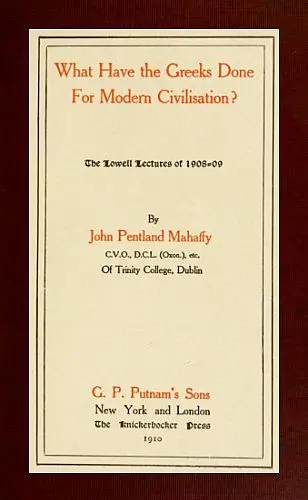
THE CLASSIC COLLECTION · 1909
"What Have the Greeks Done for Modern Civilisation?" by J. P. Mahaffy is a series of lectures written in the early 20th century. The work explores the profound influence of ancient Greek culture on contemporary society, particularly focusing on the arts, philosophy, science, and education. Its purpose is to reevaluate the significance of Greek studies in modern education and society. The opening of the text introduces Mahaffy as a seasoned scholar delivering a series of lectures that aim to highlight the contributions of the Greeks to modern civilization. He expresses his initial doubts about the diminishing interest in Greek studies, particularly in America, and outlines the various domains—literature, art, politics, and science—through which Greek thought has indelibly shaped contemporary understanding. He emphasizes that understanding the Greek legacy is essential for appreciating the foundations upon which modern culture is built and suggests that reforming the teaching of Greek is vital to reviving its significance in educational curricula.
Introduction adapted from the source catalogue; source summaries may be automatically generated.
Free to read · English · 58,758 words · No account needed
MAKE TIME FOR A GOOD BOOK
On by default. Untick to stop anonymous reading totals. Each page counts after 10 seconds in view. How this works.
Anonymous counting is on unless you have switched it off.
Xanthus the Lydian, historian, 71
Xenophanes, founder of school of Elea, 221;
doctrine of, 222
Xenophon, historian, 79
Cyrus: 94
Hiero: picture of gloom, 116
Zeno, Eleatic, theory of sound, 225, 226
Zeno, the Stoic, 245
Zoölogy promoted by Aristotle, 171
[1] The recent book of August Fick upon the place-names in Greek lands shows that the great majority are not Greek, and this is particularly the case with Attica, the purest home of culture, showing that even here there survived a large indigenous population. This is the new signification of the Athenian claim to be autochthonous, or native children of the soil.
[2] The readers of my Rambles and Studies in Greece will remember how I was once shipwrecked in the very harbour of Ægina, and compelled to seek hospitality in a modest private house. When I saw the woman of the house in the morning, by the light of day, I shouted to my companions that one of the figures of the Parthenon had walked into the room. The splendid type was there in its perfection.
[3] The Odyssey of Homer, the two tragedies on Œdipus of Sophocles, the Birds and Frogs of Aristophanes, the Pythian odes of Pindar, not to speak of smaller gems such as the scraps of Sappho and Simonides, the Idylls of Theocritus.
[4] Of course this common inference may be quite mistaken. Artificial things are often a real and great improvement on nature.
[5] This is probably the case with Hipponax.
[6] This remark is from Hare’s almost forgotten Guesses at Truth, an
excellent book.
“Keen were his pangs but keener far to feel He nursed the pinion which
impelled the steel”
is straight from Æschylus.
[8] I know no translation of the whole seven plays of Æschylus that I can recommend, though there be many admirable versions of the Agamemnon, but among the English reproductions of Sophocles let me call your attention to that of Mr. Whitelaw, of most of Euripides to that of Mr. Way. Both of these are eminently the work of scholars who are also poets.
[9] I need hardly add that the brilliant comedies of Aristophanes are to be found in the well known books of J. Hookham Frere and of Mr. Rogers, who has quite recently brought out another play.
[10] I say fresco because this is usually occupied with historical
scenes.
[11] The reader can now consult the brilliant and suggestive Thucydides Mythistoricus of Mr. Cornford on this aspect of the historian and his work.
[12] Book iii., 82-4
[13] Cf. for example what Herodotus tells us in his fourth book of
the affairs of Cyrene.
[14] I must refer the audience for details to the chapter on Thucydides in my History of Greek Literature.
Your reading position is saved on this browser. Take it to another device with a library code. Reading pages adapt to text, rather than matching a printed edition.
BEHIND THE BOOK
This eBook is for the use of anyone anywhere in the United States and most other parts of the world at no cost and with almost no restrictions whatsoever. You may copy it, give it away or re-use it under the terms of the Project Gutenberg License included with this eBook or online at www.gutenberg.org. If you are not located in the United States, you will have to check the laws of the country where you are located before using this eBook. Read the source licence.
The original source file, including credits and licence, is retained by this library. Request an original-format copy at no charge. Please include the book title and Project Gutenberg identifier #59132.
KEEP YOUR CURIOSITY GOING
David Patterson (Spirit) Hatch
Cécile Tormay

Moritz Busch
Coulson Kernahan
John L. Ransom

Ralph Waldo Emerson