
Last letters from the living dead man
David Patterson (Spirit) Hatch
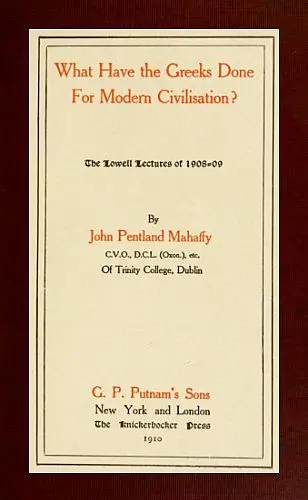
THE CLASSIC COLLECTION · 1909
"What Have the Greeks Done for Modern Civilisation?" by J. P. Mahaffy is a series of lectures written in the early 20th century. The work explores the profound influence of ancient Greek culture on contemporary society, particularly focusing on the arts, philosophy, science, and education. Its purpose is to reevaluate the significance of Greek studies in modern education and society. The opening of the text introduces Mahaffy as a seasoned scholar delivering a series of lectures that aim to highlight the contributions of the Greeks to modern civilization. He expresses his initial doubts about the diminishing interest in Greek studies, particularly in America, and outlines the various domains—literature, art, politics, and science—through which Greek thought has indelibly shaped contemporary understanding. He emphasizes that understanding the Greek legacy is essential for appreciating the foundations upon which modern culture is built and suggests that reforming the teaching of Greek is vital to reviving its significance in educational curricula.
Introduction adapted from the source catalogue; source summaries may be automatically generated.
Free to read · English · 58,758 words · No account needed
MAKE TIME FOR A GOOD BOOK
On by default. Untick to stop anonymous reading totals. Each page counts after 10 seconds in view. How this works.
Anonymous counting is on unless you have switched it off.
It is of course an illogical division to separate art from literature. Among the Greeks, at all events, literature in all its forms, was not only an art but the most perfect art. No statue of Lysippus is more perfect than a drama of Sophocles. But for convenience’ sake, and in this age where literature is seldom an art, we may speak of Greek art as that division of their work where they dealt not with words, but with other materials, and where they combined the uses of life with the love of the beautiful, as no other nation ever did. We may add that in regard to Greek influence on modern life (which is our proper subject), none has been greater and more permanent than that of art in this sense. Thousands of men have copied, or imagined they copied, Greek art, who were never able to read one word of Greek and who never cared one jot about Greek literature. I take to-day its more solid and larger expressions--architecture and sculpture, reserving for my next lecture the more subjective arts and those of mere ornament.
It is not true, as you might suppose, that these latter were later in development than the art of architecture. Far from it. In rude pre-historic ages, when the knowledge of building had not advanced beyond the question of mere safety, we find delicate and beautiful ornaments put upon arms and on personal decorations. The most elaborate tattooing of the savage is consistent with extreme rudeness in his dwelling.[20]
The earliest form of house we know, which was designed not only for shelter and durability, but also for safety, is the underground beehive house. Beehive huts of stone are common in many nations, and may perhaps best be seen now in the huts of the monks on the wild rock of Skellig Michael, which is the nearest land in the British Islands to the traveller coming from America. But such huts are not easily defended against an enemy. This latter advantage is obtained by making the hut a chamber underground,[21] and only to be entered by a passage long, narrow, and low, in fact a sort of horizontal shaft into which the enemy can only creep on hands and feet, and so can have his head chopped off as soon as it appears within the chamber, without possibility of using his weapons. I have seen this form of house in the most primitive village of the stone and bone age, which is known as the Weem of Scale, on a very wild bay of the main island of the Orkneys, looking northwest into the Atlantic. There, under the sands accumulated by the gales of thousands of years, we find small subterranean huts, with nooks in the stone work to hold rude vessels and implements, and with a low covered way for the owner to creep in and find himself at home. The weapons found in such houses, many of which are yet unexplored, are either of stone or bone or shell. These dwellings, once a very general type--for remember, similar wants in mankind produce similar satisfactions of that want in the most widely severed parts of the world--usually come to us in the stage of survival, when men had already learned other kinds of architecture. Hence they often preserved for the dwellings of the dead this type of underground beehive house with a long and narrow approach, though as time went on the house was made higher, and the avenue of approach better (as we have it in the famous New Grange in Ireland), and they even ornamented the inner surface of the slabs that formed the walls. As usual, the prehistoric Greeks did it all more perfectly than the rest of the world. The beehive house known in former days as the Treasury of Atreus, but now recognised as a tomb of some prehistoric king, is a splendid building fifty feet high, and made of thirty-three horizontal courses of stone overlapping as they rise, with the inner surfaces cut to form a conical chamber. Not only are large lintel stones used, but there were rosettes of bronze ornamenting the inner surface of the walls, and the stately avenue (dromos) lined with stone work of great finish and open to the sky, led to an ornamented gate or entrance. A restoration of this entrance, made by the aid of the actual pillars carried home long ago by the Marquis of Sligo, now astonishes the student of prehistoric art in the British Museum.[22] Why do I, however, delay over this very perfect and beautiful kind of building of which another noted specimen is the Tomb of the Minyæ at Orchomenos in Bœotia?[23] In the first place, to show you how the highly developed and finished forms were the gradual perfection of the oldest and rudest protected house, to which they merely added height, careful finish, and ornament, which ornament we know from Egyptian parallels to date some fifteen centuries before Christ; secondly, to bring home to you the important fact that the beehive or round house was at an early date abandoned to the use of the dead, and not employed for the use of the living till quite late in Greek history, when a few round public buildings show that the idea had not been lost. The men that built the great and elaborate tomb of Atreus probably never themselves lived in a round or beehive, but in a square house. They only maintained the round form out of respect for the dead, and indeed for the sake of the safety of the treasures buried with the dead.
Your reading position is saved on this browser. Take it to another device with a library code. Reading pages adapt to text, rather than matching a printed edition.
BEHIND THE BOOK
This eBook is for the use of anyone anywhere in the United States and most other parts of the world at no cost and with almost no restrictions whatsoever. You may copy it, give it away or re-use it under the terms of the Project Gutenberg License included with this eBook or online at www.gutenberg.org. If you are not located in the United States, you will have to check the laws of the country where you are located before using this eBook. Read the source licence.
The original source file, including credits and licence, is retained by this library. Request an original-format copy at no charge. Please include the book title and Project Gutenberg identifier #59132.
KEEP YOUR CURIOSITY GOING
David Patterson (Spirit) Hatch
Cécile Tormay

Moritz Busch
Coulson Kernahan
John L. Ransom

Ralph Waldo Emerson