
Jocelyn
John Galsworthy
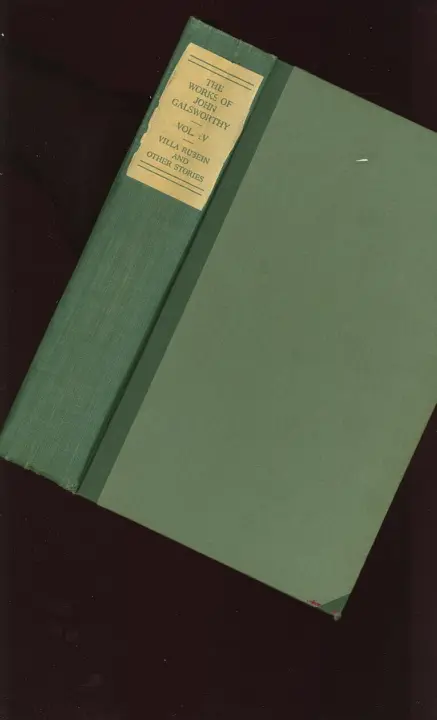
THE CLASSIC COLLECTION · 1920
"Villa Rubein and Other Stories" by John Galsworthy is a collection of short stories likely written during the early 20th century. The stories explore themes of human emotion and the complexity of relationships, often set against a backdrop of social dynamics and individual aspirations. The opening story introduces the central character, Harz, a painter who is deeply engaged in his creative process and his interactions with a mixed household at Villa Rubein, highlighting the contrasts between artistic ambition and societal expectations. The opening of the story unfolds with Harz, an artist, as he navigates his daily life in Botzen, where he meets Edmund Dawney, a doctor; their conversations reveal contrasting views on passion and duty towards their respective professions. Harz is depicted as passionate and driven by a desire to create, while Dawney is practical and focused on social success. When Harz's isolation in his creative pursuits is interrupted by interactions with the family at Villa Rubein—including the innocent and curious young girl Greta- an unexpected warmth begins to bloom. The narrative transitions into deeper explorations of relationships and the philosophical underpinnings of art and life, setting the stage for both personal and artistic growth throughout the collection.
Introduction adapted from the source catalogue; source summaries may be automatically generated.
Free to read · English · 96,246 words · No account needed
MAKE TIME FOR A GOOD BOOK
On by default. Untick to stop anonymous reading totals. Each page counts after 10 seconds in view. How this works.
Anonymous counting is on unless you have switched it off.
Walking along the river wall at Botzen, Edmund Dawney said to Alois Harz: “Would you care to know the family at that pink house, Villa Rubein?”
Harz answered with a smile:
“Perhaps.”
“Come with me then this afternoon.”
They had stopped before an old house with a blind, deserted look, that stood by itself on the wall; Harz pushed the door open.
“Come in, you don't want breakfast yet. I'm going to paint the river
to-day.”
He ran up the bare broad stairs, and Dawney followed leisurely, his
thumbs hooked in the armholes of his waistcoat, and his head thrown
back.
In the attic which filled the whole top story, Harz had pulled a canvas to the window. He was a young man of middle height, square shouldered, active, with an angular face, high cheek-bones, and a strong, sharp chin. His eyes were piercing and steel-blue, his eyebrows very flexible, nose long and thin with a high bridge; and his dark, unparted hair fitted him like a cap. His clothes looked as if he never gave them a second thought.
This room, which served for studio, bedroom, and sitting-room, was bare and dusty. Below the window the river in spring flood rushed down the valley, a stream, of molten bronze. Harz dodged before the canvas like a fencer finding his distance; Dawney took his seat on a packingcase.
“The snows have gone with a rush this year,” he drawled. “The Talfer comes down brown, the Eisack comes down blue; they flow into the Etsch and make it green; a parable of the Spring for you, my painter.”
Harz mixed his colours.
“I've no time for parables,” he said, “no time for anything. If I could be guaranteed to live to ninety-nine, like Titian—he had a chance. Look at that poor fellow who was killed the other day! All that struggle, and then—just at the turn!”
He spoke English with a foreign accent; his voice was rather harsh, but
his smile very kindly.
Dawney lit a cigarette.
“You painters,” he said, “are better off than most of us. You can strike out your own line. Now if I choose to treat a case out of the ordinary way and the patient dies, I'm ruined.”
“My dear Doctor—if I don't paint what the public likes, I starve; all the same I'm going to paint in my own way; in the end I shall come out on top.”
“It pays to work in the groove, my friend, until you've made your name; after that—do what you like, they'll lick your boots all the same.”
“Ah, you don't love your work.”
Your reading position is saved on this browser. Take it to another device with a library code. Reading pages adapt to text, rather than matching a printed edition.
John Galsworthy
John Galsworthy
John Galsworthy

John Galsworthy
BEHIND THE BOOK
This eBook is for the use of anyone anywhere in the United States and most other parts of the world at no cost and with almost no restrictions whatsoever. You may copy it, give it away or re-use it under the terms of the Project Gutenberg License included with this eBook or online at www.gutenberg.org. If you are not located in the United States, you will have to check the laws of the country where you are located before using this eBook. Read the source licence.
The original source file, including credits and licence, is retained by this library. Request an original-format copy at no charge. Please include the book title and Project Gutenberg identifier #2639.
KEEP YOUR CURIOSITY GOING
Coulson Kernahan

Maurice Baring
Frances Wright
Cécile Tormay

Frederic Jesup Stimson

W. H. P. (William Henry Pope) Jarvis