
Jocelyn
John Galsworthy
THE CLASSIC COLLECTION · 1920
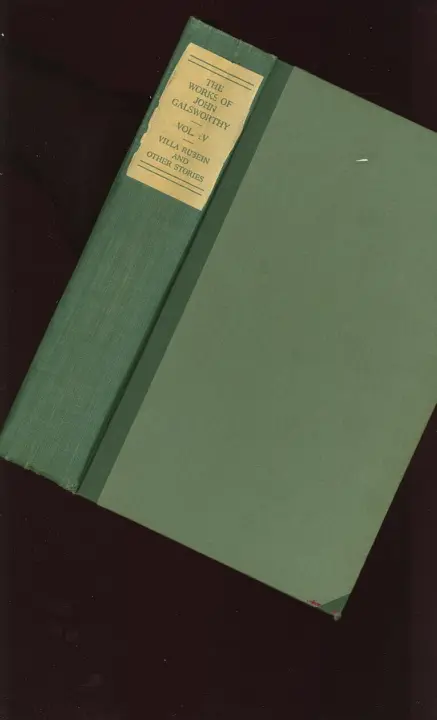
"Villa Rubein and Other Stories" by John Galsworthy is a collection of short stories likely written during the early 20th century. The stories explore themes of human emotion and the complexity of relationships, often set against a backdrop of social dynamics and individual aspirations. The opening story introduces the central character, Harz, a painter who is deeply engaged in his creative process and his interactions with a mixed household at Villa Rubein, highlighting the contrasts between artistic ambition and societal expectations. The opening of the story unfolds with Harz, an artist, as he navigates his daily life in Botzen, where he meets Edmund Dawney, a doctor; their conversations reveal contrasting views on passion and duty towards their respective professions. Harz is depicted as passionate and driven by a desire to create, while Dawney is practical and focused on social success. When Harz's isolation in his creative pursuits is interrupted by interactions with the family at Villa Rubein—including the innocent and curious young girl Greta- an unexpected warmth begins to bloom. The narrative transitions into deeper explorations of relationships and the philosophical underpinnings of art and life, setting the stage for both personal and artistic growth throughout the collection.
Introduction adapted from the source catalogue; source summaries may be automatically generated.
Free to read · English · 96,246 words · No account needed
MAKE TIME FOR A GOOD BOOK
On by default. Untick to stop anonymous reading totals. Each page counts after 10 seconds in view. How this works.
Anonymous counting is on unless you have switched it off.
Arrived at the inn where they were to pass the night, Swithin waited, hoping to get into the house without a “scene,” but when at last he alighted the girls were in the doorway, and Margit greeted him with an admiring murmur, in which, however, he seemed to detect irony. Rozsi, pale and tremulous, with a half-scared look, gave him her hand, and, quickly withdrawing it, shrank behind her sister. When they had gone up to their room Swithin sought Boleskey. His spirits had risen remarkably. “Tell the landlord to get us supper,” he said; “we'll crack a bottle to our luck.” He hurried on the landlord's preparations. The window of the room faced a wood, so near that he could almost touch the trees. The scent from the pines blew in on him. He turned away from that scented darkness, and began to draw the corks of winebottles. The sound seemed to conjure up Boleskey. He came in, splashed all over, smelling slightly of stables; soon after, Margit appeared, fresh and serene, but Rozsi did not come.
“Where is your sister?” Swithin said. Rozsi, it seemed, was tired. “It will do her good to eat,” said Swithin. And Boleskey, murmuring, “She must drink to our country,” went out to summon her, Margit followed him, while Swithin cut up a chicken. They came back without her. She had “a megrim of the spirit.”
Swithin's face fell. “Look here!” he said, “I'll go and try. Don't wait
for me.”
“Yes,” answered Boleskey, sinking mournfully into a chair; “try, brother, try--by all means, try.”
Swithin walked down the corridor with an odd, sweet, sinking sensation in his chest; and tapped on Rozsi's door. In a minute, she peeped forth, with her hair loose, and wondering eyes.
“Rozsi,” he stammered, “what makes you afraid of me, now?”
She stared at him, but did not answer.
“Why won't you come?”
Still she did not speak, but suddenly stretched out to him her bare arm. Swithin pressed his face to it. With a shiver, she whispered above him, “I will come,” and gently shut the door.
Swithin stealthily retraced his steps, and paused a minute outside the sitting-room to regain his self-control.
The sight of Boleskey with a bottle in his hand steadied him.
“She is coming,” he said. And very soon she did come, her thick hair roughly twisted in a plait.
Swithin sat between the girls; but did not talk, for he was really hungry. Boleskey too was silent, plunged in gloom; Rozsi was dumb; Margit alone chattered.
Your reading position is saved on this browser. Take it to another device with a library code. Reading pages adapt to text, rather than matching a printed edition.
John Galsworthy
John Galsworthy
John Galsworthy

John Galsworthy
BEHIND THE BOOK
This eBook is for the use of anyone anywhere in the United States and most other parts of the world at no cost and with almost no restrictions whatsoever. You may copy it, give it away or re-use it under the terms of the Project Gutenberg License included with this eBook or online at www.gutenberg.org. If you are not located in the United States, you will have to check the laws of the country where you are located before using this eBook. Read the source licence.
The original source file, including credits and licence, is retained by this library. Request an original-format copy at no charge. Please include the book title and Project Gutenberg identifier #2639.
KEEP YOUR CURIOSITY GOING
Coulson Kernahan

Maurice Baring
Frances Wright
Cécile Tormay

Frederic Jesup Stimson

W. H. P. (William Henry Pope) Jarvis