
Jocelyn
John Galsworthy
THE CLASSIC COLLECTION · 1920
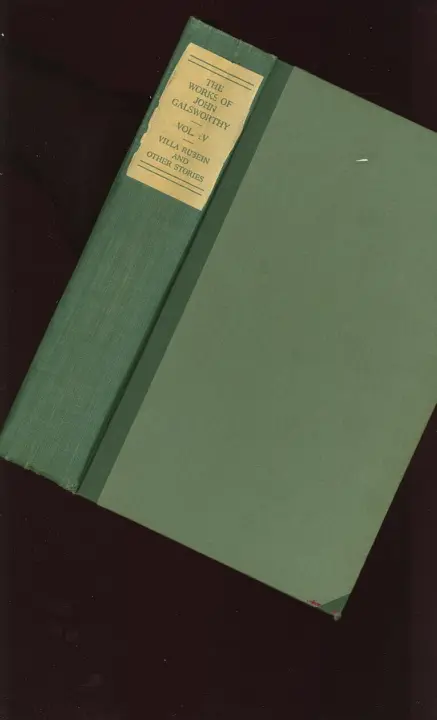
"Villa Rubein and Other Stories" by John Galsworthy is a collection of short stories likely written during the early 20th century. The stories explore themes of human emotion and the complexity of relationships, often set against a backdrop of social dynamics and individual aspirations. The opening story introduces the central character, Harz, a painter who is deeply engaged in his creative process and his interactions with a mixed household at Villa Rubein, highlighting the contrasts between artistic ambition and societal expectations. The opening of the story unfolds with Harz, an artist, as he navigates his daily life in Botzen, where he meets Edmund Dawney, a doctor; their conversations reveal contrasting views on passion and duty towards their respective professions. Harz is depicted as passionate and driven by a desire to create, while Dawney is practical and focused on social success. When Harz's isolation in his creative pursuits is interrupted by interactions with the family at Villa Rubein—including the innocent and curious young girl Greta- an unexpected warmth begins to bloom. The narrative transitions into deeper explorations of relationships and the philosophical underpinnings of art and life, setting the stage for both personal and artistic growth throughout the collection.
Introduction adapted from the source catalogue; source summaries may be automatically generated.
Free to read · English · 96,246 words · No account needed
MAKE TIME FOR A GOOD BOOK
On by default. Untick to stop anonymous reading totals. Each page counts after 10 seconds in view. How this works.
Anonymous counting is on unless you have switched it off.
Hidden by the shade of rose-bushes Greta lay stretched at length, cheek on arm, sleeping the sleep of the unrighteous. Through the flowers the sun flicked her parted lips with kisses, and spilled the withered petals on her. In a denser islet of shade, Scruff lay snapping at a fly. His head lolled drowsily in the middle of a snap, and snapped in the middle of a loll.
At three o'clock Miss Naylor too came out, carrying a basket and pair of scissors. Lifting her skirts to avoid the lakes of water left by the garden hose, she stopped in front of a rose-bush, and began to snip off the shrivelled flowers. The little lady's silvered head and thin, brown face sustained the shower of sunlight unprotected, and had a gentle dignity in their freedom.
Presently, as the scissors flittered in and out of the leaves, she,
began talking to herself.
“If girls were more like what they used to be, this would not have happened. Perhaps we don't understand; it's very easy to forget.” Burying her nose and lips in a rose, she sniffed. “Poor dear girl! It's such a pity his father is—a—”
“A farmer,” said a sleepy voice behind the rosebush.
Miss Naylor leaped. “Greta! How you startled me! A farmer—that is—an—an agriculturalist!”
“A farmer with vineyards—he told us, and he is not ashamed. Why is it a pity, Miss Naylor?”
Miss Naylor's lips looked very thin.
“For many reasons, of which you know nothing.”
“That is what you always say,” pursued the sleepy voice; “and that is why, when I am to be married, there shall also be a pity.”
“Greta!” Miss Naylor cried, “it is not proper for a girl of your age to
talk like that.”
“Why?” said Greta. “Because it is the truth?”
Miss Naylor made no reply to this, but vexedly cut off a sound rose, which she hastily picked up and regarded with contrition. Greta spoke again:
“Chris said: 'I have got the pictures, I shall tell her'. but I shall tell you instead, because it was I that told the story.”
Miss Naylor stared, wrinkling her nose, and holding the scissors wide
apart....
“Last night,” said Greta slowly, “I and Chris went to his studio and took his pictures, and so, because the gate was shut, I came back to tell it; and when you asked me where Chris was, I told it; because she was in the studio all night, and I and Scruff sat up all night, and in the morning we brought the pictures, and hid them under our beds, and that is why—we—are—so—sleepy.”
Your reading position is saved on this browser. Take it to another device with a library code. Reading pages adapt to text, rather than matching a printed edition.
John Galsworthy
John Galsworthy
John Galsworthy

John Galsworthy
BEHIND THE BOOK
This eBook is for the use of anyone anywhere in the United States and most other parts of the world at no cost and with almost no restrictions whatsoever. You may copy it, give it away or re-use it under the terms of the Project Gutenberg License included with this eBook or online at www.gutenberg.org. If you are not located in the United States, you will have to check the laws of the country where you are located before using this eBook. Read the source licence.
The original source file, including credits and licence, is retained by this library. Request an original-format copy at no charge. Please include the book title and Project Gutenberg identifier #2639.
KEEP YOUR CURIOSITY GOING
Coulson Kernahan

Maurice Baring
Frances Wright
Cécile Tormay

Frederic Jesup Stimson

W. H. P. (William Henry Pope) Jarvis