
Jocelyn
John Galsworthy
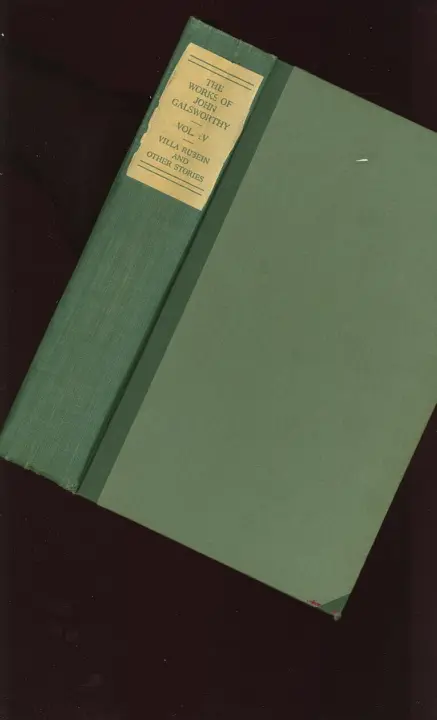
THE CLASSIC COLLECTION · 1920
"Villa Rubein and Other Stories" by John Galsworthy is a collection of short stories likely written during the early 20th century. The stories explore themes of human emotion and the complexity of relationships, often set against a backdrop of social dynamics and individual aspirations. The opening story introduces the central character, Harz, a painter who is deeply engaged in his creative process and his interactions with a mixed household at Villa Rubein, highlighting the contrasts between artistic ambition and societal expectations. The opening of the story unfolds with Harz, an artist, as he navigates his daily life in Botzen, where he meets Edmund Dawney, a doctor; their conversations reveal contrasting views on passion and duty towards their respective professions. Harz is depicted as passionate and driven by a desire to create, while Dawney is practical and focused on social success. When Harz's isolation in his creative pursuits is interrupted by interactions with the family at Villa Rubein—including the innocent and curious young girl Greta- an unexpected warmth begins to bloom. The narrative transitions into deeper explorations of relationships and the philosophical underpinnings of art and life, setting the stage for both personal and artistic growth throughout the collection.
Introduction adapted from the source catalogue; source summaries may be automatically generated.
Free to read · English · 96,246 words · No account needed
MAKE TIME FOR A GOOD BOOK
On by default. Untick to stop anonymous reading totals. Each page counts after 10 seconds in view. How this works.
Anonymous counting is on unless you have switched it off.
It was Herr Paul, holding a cigar in one hand, his hat in the other, and
breathing hard.
“Pardon!” he said huskily, “your stairs are steep, and dark! mais en, fin! nous voila! I have ventured to come for a talk.” His glance fell on the cloaked figure in the shadow.
“Pardon! A thousand pardons! I had no idea! I beg you to forgive this indiscretion! I may take it you resign pretensions then? You have a lady here—I have nothing more to say; I only beg a million pardons for intruding. A thousand times forgive me! Good-night!”
He bowed and turned to go. Christian stepped forward, and let the hood
fall from her head.
“It's I!”
Herr Paul pirouetted.
“Good God!” he stammered, dropping cigar and hat. “Good God!”
The lantern flared suddenly, revealing his crimson, shaking cheeks.
“You came here, at night! You, the daughter of my wife!” His eyes wandered with a dull glare round the room.
“Take care!” cried Harz: “If you say a word against her—-”
The two men stared at each other's eyes. And without warning, the lantern flickered and went out. Christian drew the cloak round her again. Herr Paul's voice broke the silence; he had recovered his self-possession.
“Ah! ah!” he said: “Darkness! Tant mieux! The right thing for what we have to say. Since we do not esteem each other, it is well not to see too much.”
“Just so,” said Harz.
Christian had come close to them. Her pale face and great shining eyes could just be seen through the gloom.
Herr Paul waved his arm; the gesture was impressive, annihilating.
“This is a matter, I believe, between two men,” he said, addressing Harz. “Let us come to the point. I will do you the credit to suppose that you have a marriage in view. You know, perhaps, that Miss Devorell has no money till I die?”
“Yes.”
“And I am passably young! You have money, then?”
“No.”
“In that case, you would propose to live on air?”
“No, to work; it has been done before.”
“It is calculated to increase hunger! You are prepared to take Miss Devorell, a young lady accustomed to luxury, into places like—this!” he peered about him, “into places that smell of paint, into the milieu of 'the people,' into the society of Bohemians—who knows? of anarchists, perhaps?”
Harz clenched his hands: “I will answer no more questions.”
“In that event, we reach the ultimatum,” said Herr Paul. “Listen, Herr Outlaw! If you have not left the country by noon to-morrow, you shall be introduced to the police!”
Your reading position is saved on this browser. Take it to another device with a library code. Reading pages adapt to text, rather than matching a printed edition.
John Galsworthy
John Galsworthy
John Galsworthy

John Galsworthy
BEHIND THE BOOK
This eBook is for the use of anyone anywhere in the United States and most other parts of the world at no cost and with almost no restrictions whatsoever. You may copy it, give it away or re-use it under the terms of the Project Gutenberg License included with this eBook or online at www.gutenberg.org. If you are not located in the United States, you will have to check the laws of the country where you are located before using this eBook. Read the source licence.
The original source file, including credits and licence, is retained by this library. Request an original-format copy at no charge. Please include the book title and Project Gutenberg identifier #2639.
KEEP YOUR CURIOSITY GOING
Coulson Kernahan

Maurice Baring
Frances Wright
Cécile Tormay

Frederic Jesup Stimson

W. H. P. (William Henry Pope) Jarvis