
Jocelyn
John Galsworthy
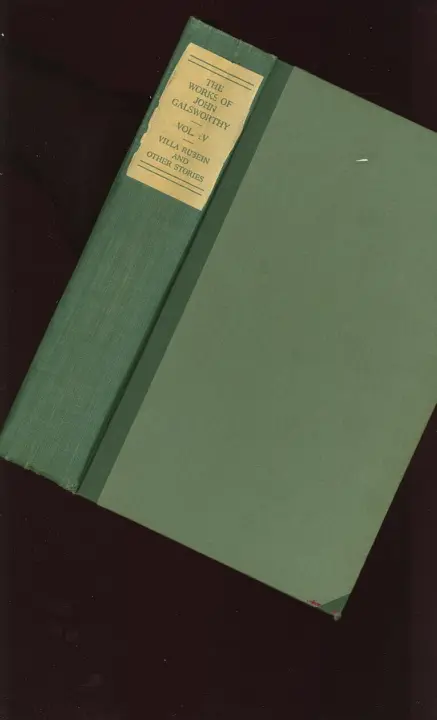
THE CLASSIC COLLECTION · 1920
"Villa Rubein and Other Stories" by John Galsworthy is a collection of short stories likely written during the early 20th century. The stories explore themes of human emotion and the complexity of relationships, often set against a backdrop of social dynamics and individual aspirations. The opening story introduces the central character, Harz, a painter who is deeply engaged in his creative process and his interactions with a mixed household at Villa Rubein, highlighting the contrasts between artistic ambition and societal expectations. The opening of the story unfolds with Harz, an artist, as he navigates his daily life in Botzen, where he meets Edmund Dawney, a doctor; their conversations reveal contrasting views on passion and duty towards their respective professions. Harz is depicted as passionate and driven by a desire to create, while Dawney is practical and focused on social success. When Harz's isolation in his creative pursuits is interrupted by interactions with the family at Villa Rubein—including the innocent and curious young girl Greta- an unexpected warmth begins to bloom. The narrative transitions into deeper explorations of relationships and the philosophical underpinnings of art and life, setting the stage for both personal and artistic growth throughout the collection.
Introduction adapted from the source catalogue; source summaries may be automatically generated.
Free to read · English · 96,246 words · No account needed
MAKE TIME FOR A GOOD BOOK
On by default. Untick to stop anonymous reading totals. Each page counts after 10 seconds in view. How this works.
Anonymous counting is on unless you have switched it off.
Dawney answered slowly: “Never so happy as when my hands are full. But I want to make money, to get known, to have a good time, good cigars, good wine. I hate discomfort. No, my boy, I must work it on the usual lines; I don't like it, but I must lump it. One starts in life with some notion of the ideal—it's gone by the board with me. I've got to shove along until I've made my name, and then, my little man—then—”
“Then you'll be soft!”
“You pay dearly for that first period!”
“Take my chance of that; there's no other way.”
“Make one!”
“Humph!”
Harz poised his brush, as though it were a spear:
“A man must do the best in him. If he has to suffer—let him!”
Dawney stretched his large soft body; a calculating look had come into
his eyes.
“You're a tough little man!” he said.
“I've had to be tough.”
Dawney rose; tobacco smoke was wreathed round his unruffled hair.
“Touching Villa Rubein,” he said, “shall I call for you? It's a mixed household, English mostly—very decent people.”
“No, thank you. I shall be painting all day. Haven't time to know the sort of people who expect one to change one's clothes.”
“As you like; ta-to!” And, puffing out his chest, Dawney vanished through a blanket looped across the doorway.
Harz set a pot of coffee on a spirit-lamp, and cut himself some bread. Through the window the freshness of the morning came; the scent of sap and blossom and young leaves; the scent of earth, and the mountains freed from winter; the new flights and songs of birds; all the odorous, enchanted, restless Spring.
There suddenly appeared through the doorway a white rough-haired terrier dog, black-marked about the face, with shaggy tan eyebrows. He sniffed at Harz, showed the whites round his eyes, and uttered a sharp bark. A young voice called:
“Scruff! Thou naughty dog!” Light footsteps were heard on the stairs; from the distance a thin, high voice called:
“Greta! You mustn't go up there!”
A little girl of twelve, with long fair hair under a wide-brimmed hat,
slipped in.
Her blue eyes opened wide, her face flushed up. That face was not regular; its cheek-bones were rather prominent, the nose was flattish; there was about it an air, innocent, reflecting, quizzical, shy.
“Oh!” she said.
Harz smiled: “Good-morning! This your dog?”
She did not answer, but looked at him with soft bewilderment; then running to the dog seized him by the collar.
“Scr-ruff! Thou naughty dog—the baddest dog!” The ends of her hair fell about him; she looked up at Harz, who said:
Your reading position is saved on this browser. Take it to another device with a library code. Reading pages adapt to text, rather than matching a printed edition.
John Galsworthy
John Galsworthy
John Galsworthy

John Galsworthy
BEHIND THE BOOK
This eBook is for the use of anyone anywhere in the United States and most other parts of the world at no cost and with almost no restrictions whatsoever. You may copy it, give it away or re-use it under the terms of the Project Gutenberg License included with this eBook or online at www.gutenberg.org. If you are not located in the United States, you will have to check the laws of the country where you are located before using this eBook. Read the source licence.
The original source file, including credits and licence, is retained by this library. Request an original-format copy at no charge. Please include the book title and Project Gutenberg identifier #2639.
KEEP YOUR CURIOSITY GOING
Coulson Kernahan

Maurice Baring
Frances Wright
Cécile Tormay

Frederic Jesup Stimson

W. H. P. (William Henry Pope) Jarvis