
Jocelyn
John Galsworthy
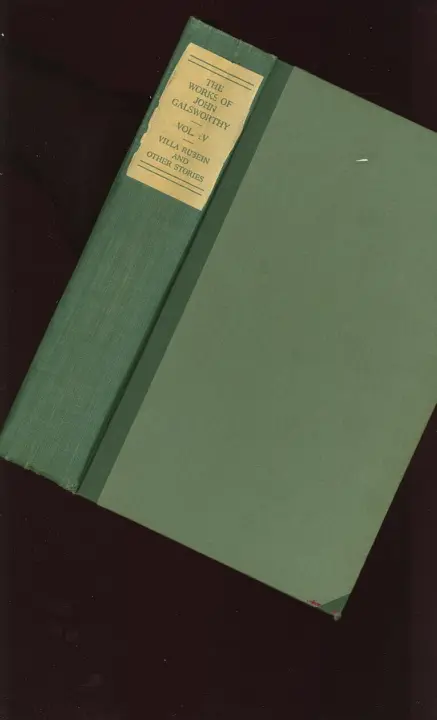
THE CLASSIC COLLECTION · 1920
"Villa Rubein and Other Stories" by John Galsworthy is a collection of short stories likely written during the early 20th century. The stories explore themes of human emotion and the complexity of relationships, often set against a backdrop of social dynamics and individual aspirations. The opening story introduces the central character, Harz, a painter who is deeply engaged in his creative process and his interactions with a mixed household at Villa Rubein, highlighting the contrasts between artistic ambition and societal expectations. The opening of the story unfolds with Harz, an artist, as he navigates his daily life in Botzen, where he meets Edmund Dawney, a doctor; their conversations reveal contrasting views on passion and duty towards their respective professions. Harz is depicted as passionate and driven by a desire to create, while Dawney is practical and focused on social success. When Harz's isolation in his creative pursuits is interrupted by interactions with the family at Villa Rubein—including the innocent and curious young girl Greta- an unexpected warmth begins to bloom. The narrative transitions into deeper explorations of relationships and the philosophical underpinnings of art and life, setting the stage for both personal and artistic growth throughout the collection.
Introduction adapted from the source catalogue; source summaries may be automatically generated.
Free to read · English · 96,246 words · No account needed
MAKE TIME FOR A GOOD BOOK
On by default. Untick to stop anonymous reading totals. Each page counts after 10 seconds in view. How this works.
Anonymous counting is on unless you have switched it off.
There was one other guest at dinner, a well-groomed person with pale, fattish face, dark eyes, and hair thin on the temples, whose clothes had a military cut. He looked like a man fond of ease, who had gone out of his groove, and collided with life. Herr Paul introduced him as Count Mario Sarelli.
Two hanging lamps with crimson shades threw a rosy light over the table, where, in the centre stood a silver basket, full of irises. Through the open windows the garden was all clusters of black foliage in the dying light. Moths fluttered round the lamps; Greta, following them with her eyes, gave quite audible sighs of pleasure when they escaped. Both girls wore white, and Harz, who sat opposite Christian, kept looking at her, and wondering why he had not painted her in that dress.
Mrs. Decie understood the art of dining—the dinner, ordered by Herr Paul, was admirable; the servants silent as their shadows; there was always a hum of conversation.
Sarelli, who sat on her right hand, seemed to partake of little except olives, which he dipped into a glass of sherry. He turned his black, solemn eyes silently from face to face, now and then asking the meaning of an English word. After a discussion on modern Rome, it was debated whether or no a criminal could be told by the expression of his face.
“Crime,” said Mrs. Decie, passing her hand across her brow—“crime is but the hallmark of strong individuality.”
Miss Naylor, gushing rather pink, stammered: “A great crime must show itself—a murder. Why, of course!”
“If that were so,” said Dawney, “we should only have to look about us—no more detectives.”
Miss Naylor rejoined with slight severity: “I cannot conceive that such a thing can pass the human face by, leaving no impression!”
Harz said abruptly: “There are worse things than murder.”
“Ah! par exemple!” said Sarelli.
There was a slight stir all round the table.
“Verry good,” cried out Herr Paul, “a vot' sante, cher.”
Miss Naylor shivered, as if some one had put a penny down her back; and Mrs. Decie, leaning towards Harz, smiled like one who has made a pet dog do a trick. Christian alone was motionless, looking thoughtfully at Harz.
“I saw a man tried for murder once,” he said, “a murder for revenge; I watched the judge, and I thought all the time: 'I'd rather be that murderer than you; I've never seen a meaner face; you crawl through life; you're not a criminal, simply because you haven't the courage.'”
Your reading position is saved on this browser. Take it to another device with a library code. Reading pages adapt to text, rather than matching a printed edition.
John Galsworthy
John Galsworthy
John Galsworthy

John Galsworthy
BEHIND THE BOOK
This eBook is for the use of anyone anywhere in the United States and most other parts of the world at no cost and with almost no restrictions whatsoever. You may copy it, give it away or re-use it under the terms of the Project Gutenberg License included with this eBook or online at www.gutenberg.org. If you are not located in the United States, you will have to check the laws of the country where you are located before using this eBook. Read the source licence.
The original source file, including credits and licence, is retained by this library. Request an original-format copy at no charge. Please include the book title and Project Gutenberg identifier #2639.
KEEP YOUR CURIOSITY GOING
Coulson Kernahan

Maurice Baring
Frances Wright
Cécile Tormay

Frederic Jesup Stimson

W. H. P. (William Henry Pope) Jarvis