
The Yoke of the Thorah
Henry Harland
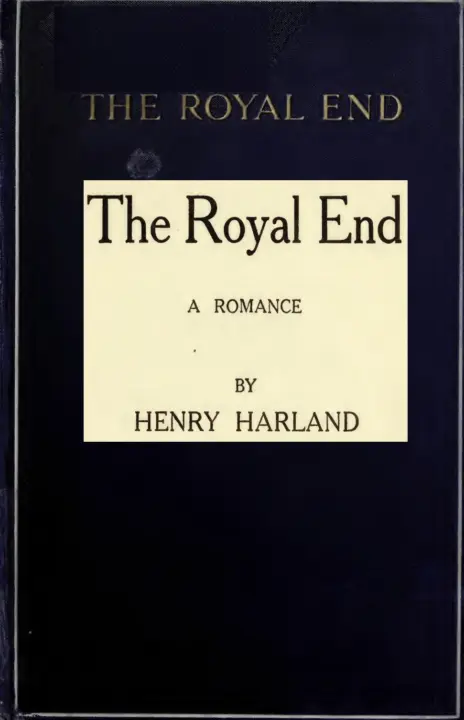
THE CLASSIC COLLECTION · 1909
"The Royal End: A Romance" by Henry Harland is a novel written in the early 20th century. The story is set in Venice and follows the intricate lives of its main characters, specifically Lucilla Dor and her companion Ruth Adgate, as they encounter a charming man named Bertram and navigate romantic entanglements amid social expectations. As Balzatore, the dog, flits through scenes of flirtation and adventure, themes of admiration, social status, and identity come to the forefront, evoking the challenges of love against a backdrop of societal intrigue. At the start of the novel, the setting is established as Lucilla and Ruth dine at a hotel in Venice, where they unknowingly attract the attention of Bertram and his canine companion, Balzatore. This signals the beginning of a romantic entanglement fueled by misunderstandings and societal norms. As the characters interact against the enchanting backdrop of the city, the narrative delves into their personalities, exploring Lucilla's flirtatiousness and Ruth's contrasting reserve. Their evening takes a turn when they find themselves stranded on the Lido, ultimately leading to Bertram's gallant intervention. The opening sets a tone rich with fascination and sharp social commentary as the characters' complexities begin to intertwine.
Introduction adapted from the source catalogue; source summaries may be automatically generated.
Free to read · English · 55,898 words · No account needed
MAKE TIME FOR A GOOD BOOK
On by default. Untick to stop anonymous reading totals. Each page counts after 10 seconds in view. How this works.
Anonymous counting is on unless you have switched it off.
And when she and Lucilla, under their sunshades, were alone in the garden-paths, “The outlook is magnificent,” she vowed, with enthusiasm. “You have Florence at your feet. Superb. Oh, the lovely roses! I might pick one--a little one? Yes? Ah, so kind. I wanted to ask about your charming little friend, that nice Miss Adgate.”
“Oh?” said Lucilla, in a tone of some remoteness.
But the Duchess did not appear to notice it. “Yes,” she blithely pursued. “You don't mind? My son has told me so much about her. She is an American, I think?”
“Yes,” said Lucilla.
The Duchess's eyes glowed with admiration.
“Your ilex trees are wonderful--I have never seen grander ones. I am really envious. She has nice manners, and is distinguished-looking as well as pretty. I believe she is also--how do you say in English--très bien dotée?”
“She has about thirty thousand a year, I believe,” said Lucilla.
The Duchess stood still and all but gasped. “Thirty thousand pounds? Pounds sterling?” Then she resumed her walk. “But that is princely. That is nearly a million francs.”
“It is a decent income,” Lucilla admitted.
“And she is also, of course, what you call--well born?” the Duchess threw out, as if the question were superfluous and its answer foregone.
“She is what we call a gentlewoman,” answered Lucilla.
“To be sure--of course,” said the Duchess, “but--but without a title?”
“In England titles are not necessary to gentility--as I believe they are in Austria,” Lucilla mentioned.
“To be sure--of course,” said the Duchess. “Her parents, I think, are
not living?”
“No--they are dead,” Lucilla redundantly responded.
“Ah, so sad,” murmured the Duchess, with a sympathetic movement of her bonnet. “But then she is quite absolute mistress of her fortune? What a responsibility for one so young. And to crown all, she is a good pious Catholic?”
“She is a Catholic,” said Lucilla.
“The house, from here, is really imposing--really signorile,” the Duchess declared, considering it through her silver-framed double eyeglass. “There are no houses like these old Florentine villas. Ah, they were a lovely race. You see, my son is very much interested in her. I have never known him to show so much interest in a girl before. It is natural I should wish to inform myself, is it not? If you will allow me, dear Lady Dor, to make you a confidence, I should be so glad to see him married.”
“Yes,” said Lucilla. “I suppose,” she hesitated, “I suppose it is quite possible for him, in spite of his belonging to a reigning house, to marry a commoner?”
The Duchess looked vague. “A reigning house?” she repeated, politely
uncomprehending.
Your reading position is saved on this browser. Take it to another device with a library code. Reading pages adapt to text, rather than matching a printed edition.
Henry Harland

Henry Harland

Henry Harland

Henry Harland
BEHIND THE BOOK
This eBook is for the use of anyone anywhere in the United States and most other parts of the world at no cost and with almost no restrictions whatsoever. You may copy it, give it away or re-use it under the terms of the Project Gutenberg License included with this eBook or online at www.gutenberg.org. If you are not located in the United States, you will have to check the laws of the country where you are located before using this eBook. Read the source licence.
The original source file, including credits and licence, is retained by this library. Request an original-format copy at no charge. Please include the book title and Project Gutenberg identifier #51980.
KEEP YOUR CURIOSITY GOING
Coulson Kernahan

Maurice Baring
Frances Wright
Cécile Tormay

Frederic Jesup Stimson

W. H. P. (William Henry Pope) Jarvis