
The Yoke of the Thorah
Henry Harland
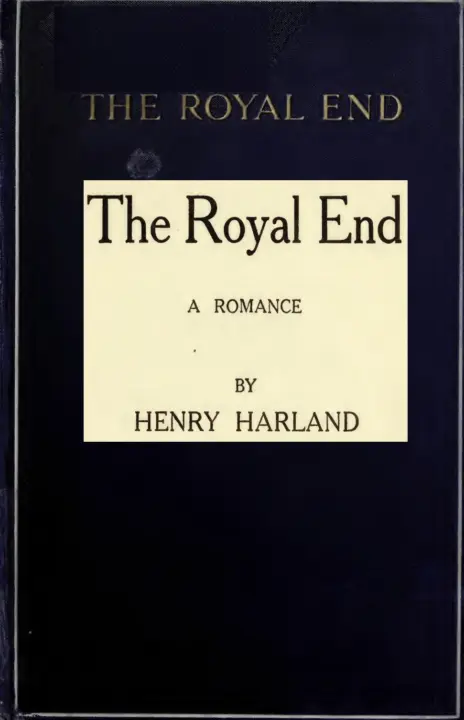
THE CLASSIC COLLECTION · 1909
"The Royal End: A Romance" by Henry Harland is a novel written in the early 20th century. The story is set in Venice and follows the intricate lives of its main characters, specifically Lucilla Dor and her companion Ruth Adgate, as they encounter a charming man named Bertram and navigate romantic entanglements amid social expectations. As Balzatore, the dog, flits through scenes of flirtation and adventure, themes of admiration, social status, and identity come to the forefront, evoking the challenges of love against a backdrop of societal intrigue. At the start of the novel, the setting is established as Lucilla and Ruth dine at a hotel in Venice, where they unknowingly attract the attention of Bertram and his canine companion, Balzatore. This signals the beginning of a romantic entanglement fueled by misunderstandings and societal norms. As the characters interact against the enchanting backdrop of the city, the narrative delves into their personalities, exploring Lucilla's flirtatiousness and Ruth's contrasting reserve. Their evening takes a turn when they find themselves stranded on the Lido, ultimately leading to Bertram's gallant intervention. The opening sets a tone rich with fascination and sharp social commentary as the characters' complexities begin to intertwine.
Introduction adapted from the source catalogue; source summaries may be automatically generated.
Free to read · English · 55,898 words · No account needed
MAKE TIME FOR A GOOD BOOK
On by default. Untick to stop anonymous reading totals. Each page counts after 10 seconds in view. How this works.
Anonymous counting is on unless you have switched it off.
Ruth and Lucilla had been dining at the Lido, at the new hotel there, I forget its name, the only decent hotel, in a sandy garden near the Stabilimento. They had dined in the air, of course, on the terrace, whence they could watch the sunset burn and die over Venice, and the moon come up out of the Adriatic. Balzatore had been dining with Bertram at a neighbouring table.
But now, her eyes intently lifted, as in prayer, Lucilla began to adjust
her veil.
“We can't stop here nibbling figs forever,” she premised, with the drawl, whimsically plaintive, that she is apt to assume in her regretful moods. “I think it's time to return to our mosquitoes.”
So they paid their bill, and set off, through the warm night and the moonlight and the silence, down the wide avenue of plane-trees that leads from the sea to the lagoon. In the moonlight and the silence, they were themselves silent at first, walking slowly, feeling the pleasant solemnity of things. Then, all at once, Lucilla softly sighed.
“Poor Byron,” she said, as from the depths of a pious reverie.
“Byron?” wondered Ruth, called perhaps from reveries of her own. “Why?”
“He used to come here to ride,” explained Lucilla, in a breaking voice.
I'm afraid Ruth tittered. Afterwards they were silent again, the silence of the night reasserting itself, and holding them like music, till, by and by, their progress ended at the landing-stage where they had left their gondola.
“But what has become of the wretched thing?” asked Lucilla, looking blankly this way and that. For the solitary gondola tied up there wasn't theirs. She turned vaguely to the men in charge of it, meditating enquiries: when one of them, with the intuition and the aplomb of his race, took the words out of her mouth.
“Pardon, Lordessa,” he said, touching his hat. “If you are seeking the boatmen who brought you here, they went back as soon as they had put you ashore.”
Lucilla eyed him coldly, distrustfully.
“Went back?” she doubted. “But I told them to wait.”
The man shrugged, a shrug of sympathy, of fatalism. “Ech!” he said. “They could not have understood.”
Lucilla frowned, weighing credibilities; then her brow cleared, as in
sudden illumination.
“But I did not pay them,” she remembered, and cited the circumstance as
conclusive.
The man, however, made light of it. “Ech!” he said, with genial confidence. “They belong to your hotel. You will pay them to-morrow.”
“And, anyhow, my dear,” suggested Ruth, intervening, “as they're nowhere in mortal sight...”
Your reading position is saved on this browser. Take it to another device with a library code. Reading pages adapt to text, rather than matching a printed edition.
Henry Harland

Henry Harland

Henry Harland

Henry Harland
BEHIND THE BOOK
This eBook is for the use of anyone anywhere in the United States and most other parts of the world at no cost and with almost no restrictions whatsoever. You may copy it, give it away or re-use it under the terms of the Project Gutenberg License included with this eBook or online at www.gutenberg.org. If you are not located in the United States, you will have to check the laws of the country where you are located before using this eBook. Read the source licence.
The original source file, including credits and licence, is retained by this library. Request an original-format copy at no charge. Please include the book title and Project Gutenberg identifier #51980.
KEEP YOUR CURIOSITY GOING
Coulson Kernahan

Maurice Baring
Frances Wright
Cécile Tormay

Frederic Jesup Stimson

W. H. P. (William Henry Pope) Jarvis