
The Yoke of the Thorah
Henry Harland
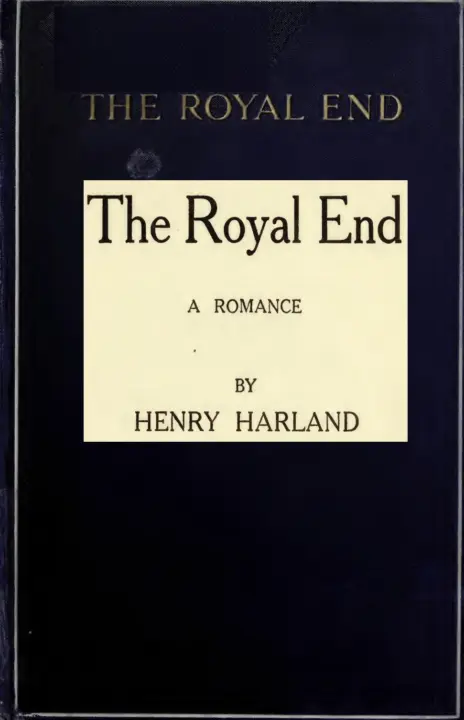
THE CLASSIC COLLECTION · 1909
"The Royal End: A Romance" by Henry Harland is a novel written in the early 20th century. The story is set in Venice and follows the intricate lives of its main characters, specifically Lucilla Dor and her companion Ruth Adgate, as they encounter a charming man named Bertram and navigate romantic entanglements amid social expectations. As Balzatore, the dog, flits through scenes of flirtation and adventure, themes of admiration, social status, and identity come to the forefront, evoking the challenges of love against a backdrop of societal intrigue. At the start of the novel, the setting is established as Lucilla and Ruth dine at a hotel in Venice, where they unknowingly attract the attention of Bertram and his canine companion, Balzatore. This signals the beginning of a romantic entanglement fueled by misunderstandings and societal norms. As the characters interact against the enchanting backdrop of the city, the narrative delves into their personalities, exploring Lucilla's flirtatiousness and Ruth's contrasting reserve. Their evening takes a turn when they find themselves stranded on the Lido, ultimately leading to Bertram's gallant intervention. The opening sets a tone rich with fascination and sharp social commentary as the characters' complexities begin to intertwine.
Introduction adapted from the source catalogue; source summaries may be automatically generated.
Free to read · English · 55,898 words · No account needed
MAKE TIME FOR A GOOD BOOK
On by default. Untick to stop anonymous reading totals. Each page counts after 10 seconds in view. How this works.
Anonymous counting is on unless you have switched it off.
One heard a tattoo of scampering paws, a sibilance of swift breathing; and a cold wet nose, followed by a warm furry head, was thrust from behind under Lucilla's hand.
Startled, she gave an inevitable little feminine cry, and half turned round--to recognise her late admirer. “Hello, old fellow--is this you?” she greeted him, patting his shoulder, stroking his silky ears. “You take one rather by surprise, you know. Yes, you are a very beautiful, nice, friendly collie, all the same; and I never saw so handsome a coat, or so splendid a tail, or such soulful poetic eyes. I am very glad to renew your acquaintance.” Balzatore waved his splendid tail as if it were a banner; rubbed his jowl against Lucilla's knee; caracoled and pranced before her, to display his graces; cocked his head, and blinked with self-satisfaction; sat down on his haunches, and, tongue lolling from his black muzzle, panted exultantly, “There! You see how cleverly I have brought it off.”
“Ecco. That is our Signore's dog,” announced the man who had promised intercession. “He himself will not be far behind.”
At the word, appeared, approaching, the tall and slender figure of Bertram, to whom, in a sudden contrapuntal outburst, both gondoliers began to speak Venetian. They spoke rapidly, turbulently almost, with many modulations, with lavish gestures, vividly, feelingly, each exposed the ladies' case.
Bertram, his grey eyes smiling (you know that rather deep-in, flickering smile of goodwill of theirs), removed his panama hat and said, in perfectly English English, with the accent of a man praying a particular favour, “I beg you to let them take you to your hotel.”
The next instant, the gondoliers steadying their craft, Lucilla murmuring what she could by way of thanks, he had helped them aboard, and, after a quick order to the men, was bowing god-speed to them from the landing-stage, while one hand, by the collar, held captive a tugging, impetuous Balzatore.
“But you?” exclaimed Lucilla, puzzled. “Do you not also go to Venice?”
“Oh, they will come back for me,” said Bertram, lightly.
She gave a slight movement to her head, slight but decisive, a movement
that implied finality.
“We can't think of such a thing,” in the tone of an ultimatum she declared. “It's extremely good of you to offer us a lift--but we simply can't accept it if it means inconvenience to yourself.”
And Bertram, of course, at once ceded the point.
Bowing again, “Thank you very much,” he said. “I wasn't sure we shouldn't be in your way.”
He took his seat, keeping Balzatore restive between his knees.
Your reading position is saved on this browser. Take it to another device with a library code. Reading pages adapt to text, rather than matching a printed edition.
Henry Harland

Henry Harland

Henry Harland

Henry Harland
BEHIND THE BOOK
This eBook is for the use of anyone anywhere in the United States and most other parts of the world at no cost and with almost no restrictions whatsoever. You may copy it, give it away or re-use it under the terms of the Project Gutenberg License included with this eBook or online at www.gutenberg.org. If you are not located in the United States, you will have to check the laws of the country where you are located before using this eBook. Read the source licence.
The original source file, including credits and licence, is retained by this library. Request an original-format copy at no charge. Please include the book title and Project Gutenberg identifier #51980.
KEEP YOUR CURIOSITY GOING
Coulson Kernahan

Maurice Baring
Frances Wright
Cécile Tormay

Frederic Jesup Stimson

W. H. P. (William Henry Pope) Jarvis