
The Yoke of the Thorah
Henry Harland
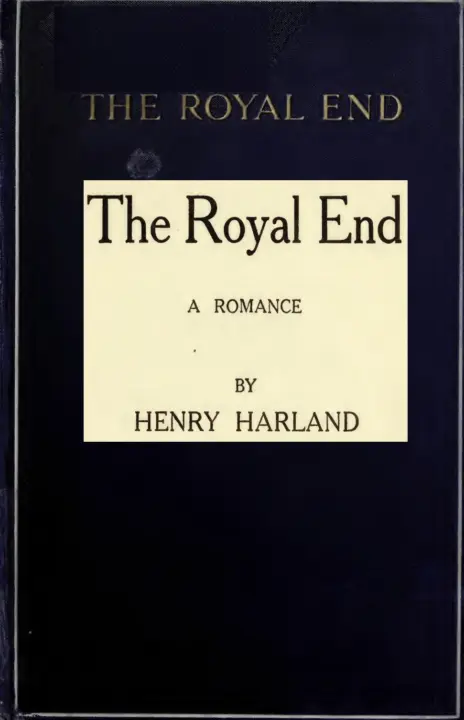
THE CLASSIC COLLECTION · 1909
"The Royal End: A Romance" by Henry Harland is a novel written in the early 20th century. The story is set in Venice and follows the intricate lives of its main characters, specifically Lucilla Dor and her companion Ruth Adgate, as they encounter a charming man named Bertram and navigate romantic entanglements amid social expectations. As Balzatore, the dog, flits through scenes of flirtation and adventure, themes of admiration, social status, and identity come to the forefront, evoking the challenges of love against a backdrop of societal intrigue. At the start of the novel, the setting is established as Lucilla and Ruth dine at a hotel in Venice, where they unknowingly attract the attention of Bertram and his canine companion, Balzatore. This signals the beginning of a romantic entanglement fueled by misunderstandings and societal norms. As the characters interact against the enchanting backdrop of the city, the narrative delves into their personalities, exploring Lucilla's flirtatiousness and Ruth's contrasting reserve. Their evening takes a turn when they find themselves stranded on the Lido, ultimately leading to Bertram's gallant intervention. The opening sets a tone rich with fascination and sharp social commentary as the characters' complexities begin to intertwine.
Introduction adapted from the source catalogue; source summaries may be automatically generated.
Free to read · English · 55,898 words · No account needed
MAKE TIME FOR A GOOD BOOK
On by default. Untick to stop anonymous reading totals. Each page counts after 10 seconds in view. How this works.
Anonymous counting is on unless you have switched it off.
Young Rutherford bounded from his chair. The tall clock in the hall, as though loth to mark the passage of Time,--Time,--who had been its friend for something more than a hundred and fifty years,--the steadfast old clock began to mark three very slow, slow notes.
“Miss Adgate, forgive me! I suppose I ought to go, you should be left to rest!” he held out his hand. “I've never known any pleasure comparable to this afternoon's. May I come again? The whole of Oldbridge shall envy me to-day,--I'm too vain not to tell them where I've lunched. Good-bye, goodbye,” he repeated. He gave Ruth a furtive glance and flushed, very red.
“Good-bye, Rutherford,” said General Adgate. He smiled indulgence to the young man who still malingered. “We'll see you to-night,” he reassured him, with a nod. “Ruth, you're to make yourself splendid tonight. I'm to take you to dine at the Wetherbys. They are giving a dinner party in your honour, for knowing you were not ridden yet with engagements I accepted for you. There will be some sort of a reception afterwards--you'd call it At Home wouldn't you? Everyone's coming. Everybody wants to meet Miss Adgate.” He laughed, as though well pleased.
“I believe he's proud of me,” thought Miss Adgate, gratefully.
The door at last closed on Rutherford. Niece and uncle stood together in the hall, where the voice of the family time-piece, its brass face marking the phases of the sun and moon, underlined the pervading stillness of the house with an austere, admonitative, solemn “tick-tack!”
“Ruth,” said her uncle abruptly, “why did you come to America?”
“Why?--To see you, of course,” Ruth said, her tone one of innocent surprise, but she felt a little guilty catch at her heart.
“Oh,--me!” her uncle said. “You young witch, you never crossed the seas to look at an old man. It was as much my business to cross them to look after you. Come,” said he, with a look of raillery, “there was some precipitating cause. You came in a hurry. Something happened--for you might have put your journey off for another year. Something occurred, to induce you--to come--in a hurry.”
Ruth hesitated. She gave a light laugh--then she looked away. “Shall I really tell you?” she asked.
“The sooner you tell me,” said the old General, “the better,--for then we'll understand one another.”
“I left Europe,”--Ruth said, embarrassed, “because--because--I wanted to see--my uncle--and have a look at my ancestral acres!” she still prevaricated, yet dimpling with amusement.
“Your ancestral acres!”--repeated her uncle, sceptically. “Well?” he
encouraged.
“Oh--well--because,--if you must have another reason still, well--because--well--I felt sore.”
Your reading position is saved on this browser. Take it to another device with a library code. Reading pages adapt to text, rather than matching a printed edition.
Henry Harland

Henry Harland

Henry Harland

Henry Harland
BEHIND THE BOOK
This eBook is for the use of anyone anywhere in the United States and most other parts of the world at no cost and with almost no restrictions whatsoever. You may copy it, give it away or re-use it under the terms of the Project Gutenberg License included with this eBook or online at www.gutenberg.org. If you are not located in the United States, you will have to check the laws of the country where you are located before using this eBook. Read the source licence.
The original source file, including credits and licence, is retained by this library. Request an original-format copy at no charge. Please include the book title and Project Gutenberg identifier #51980.
KEEP YOUR CURIOSITY GOING
Coulson Kernahan

Maurice Baring
Frances Wright
Cécile Tormay

Frederic Jesup Stimson

W. H. P. (William Henry Pope) Jarvis