
The Yoke of the Thorah
Henry Harland
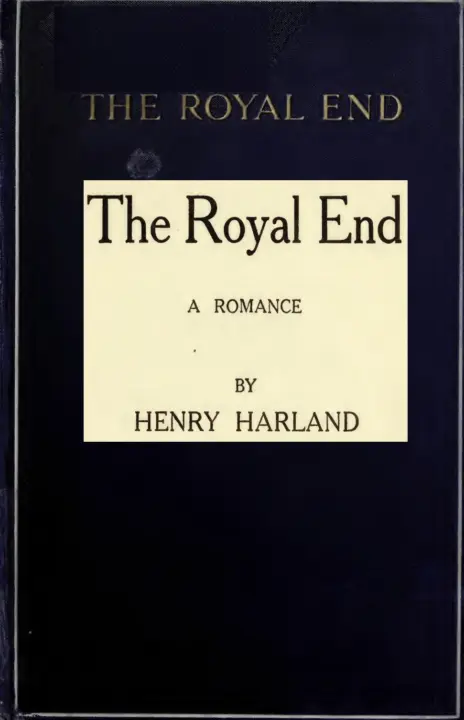
THE CLASSIC COLLECTION · 1909
"The Royal End: A Romance" by Henry Harland is a novel written in the early 20th century. The story is set in Venice and follows the intricate lives of its main characters, specifically Lucilla Dor and her companion Ruth Adgate, as they encounter a charming man named Bertram and navigate romantic entanglements amid social expectations. As Balzatore, the dog, flits through scenes of flirtation and adventure, themes of admiration, social status, and identity come to the forefront, evoking the challenges of love against a backdrop of societal intrigue. At the start of the novel, the setting is established as Lucilla and Ruth dine at a hotel in Venice, where they unknowingly attract the attention of Bertram and his canine companion, Balzatore. This signals the beginning of a romantic entanglement fueled by misunderstandings and societal norms. As the characters interact against the enchanting backdrop of the city, the narrative delves into their personalities, exploring Lucilla's flirtatiousness and Ruth's contrasting reserve. Their evening takes a turn when they find themselves stranded on the Lido, ultimately leading to Bertram's gallant intervention. The opening sets a tone rich with fascination and sharp social commentary as the characters' complexities begin to intertwine.
Introduction adapted from the source catalogue; source summaries may be automatically generated.
Free to read · English · 55,898 words · No account needed
MAKE TIME FOR A GOOD BOOK
On by default. Untick to stop anonymous reading totals. Each page counts after 10 seconds in view. How this works.
Anonymous counting is on unless you have switched it off.
And for a moment they sped in silence, up a side street, into an open square of shops and brick buildings, for all the world like the High Street of any English Provincial town.
“But how English it looks!” Ruth exclaimed.
“Does it? Why not?” said General Adgate. “However,” he added, “we pride ourselves, further on, that we're distinctively American.”
The brick buildings surely enough dissolved into avenues set with superb elms. Big comfortable houses encircled by verandas,--many adorned with those fluted Corinthian columns, mark in Oldbridge of the early nineteenth century,--all snugly set back among flower gardens and lawns, emanated peace, prosperity, good will.
“This place must be Arcady in summer.... How charming it is,” Ruth cried, delighted. “These gardens in flower, these trees in leaf----”
“It's not so bad,” said General Adgate, dryly. “Longfellow christened it the Rose of New England.”
“But------,” he added, “we call this the City of Oldbridge, a modern matter. You, Ruth, belong to the Court End of the town--you are of what we call the Old Town.”
Vastly amused at the distinction, a Yankee Faubourg Saint Germain, Ruth plied him with questions. In five minutes the agreeable news that she,--the last of the house of Adgate in America, Ruth Adgate verily the salt of the earth, tracing a clean English ancestry back to the crusades, to mistier periods beyond, here held her Yankee acres in grant first from an English Sovereign, and, without a drop of blood-shed from Indian Sachems,--gave to her humourous sense of proportion somewhat to smile over.
On they went,--under endless prospects of arching elm trees, whose branches threw oblique attenuated shadows among the rays of the descending sun. A few soft clouds at the horizon were tinted rosy and red. Then the very blue, blue sky, suffused with violet and rose, suddenly flared. Far and wide, from earth to zenith, far and wide the sky burst into a glorious scarlet conflagration.
The city lay behind, meadows stretched broadly at either side, and to the right a pretty line of hill and wood etched itself against the blushing clouds.
“The beginning of your acres, my dear,” said the old man, bowing his head. “There they lie, untouched, just as James the First ceded them to your forefathers, just as the Indian Sachems of the Mohegan Tribe confirming the gift, withdrew from 'em. The bit of wood there is known to this day as the Wigwam and the last Indian hut in this State disappeared when it was destroyed by fire a hundred years ago.”
Your reading position is saved on this browser. Take it to another device with a library code. Reading pages adapt to text, rather than matching a printed edition.
Henry Harland

Henry Harland

Henry Harland

Henry Harland
BEHIND THE BOOK
This eBook is for the use of anyone anywhere in the United States and most other parts of the world at no cost and with almost no restrictions whatsoever. You may copy it, give it away or re-use it under the terms of the Project Gutenberg License included with this eBook or online at www.gutenberg.org. If you are not located in the United States, you will have to check the laws of the country where you are located before using this eBook. Read the source licence.
The original source file, including credits and licence, is retained by this library. Request an original-format copy at no charge. Please include the book title and Project Gutenberg identifier #51980.
KEEP YOUR CURIOSITY GOING
Coulson Kernahan

Maurice Baring
Frances Wright
Cécile Tormay

Frederic Jesup Stimson

W. H. P. (William Henry Pope) Jarvis