
The Yoke of the Thorah
Henry Harland
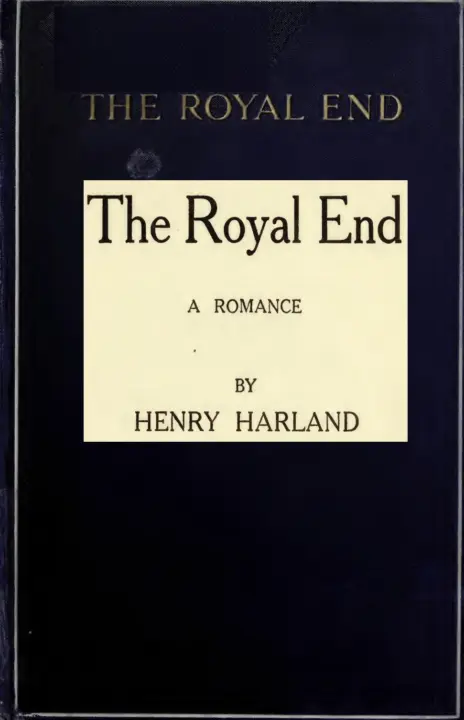
THE CLASSIC COLLECTION · 1909
"The Royal End: A Romance" by Henry Harland is a novel written in the early 20th century. The story is set in Venice and follows the intricate lives of its main characters, specifically Lucilla Dor and her companion Ruth Adgate, as they encounter a charming man named Bertram and navigate romantic entanglements amid social expectations. As Balzatore, the dog, flits through scenes of flirtation and adventure, themes of admiration, social status, and identity come to the forefront, evoking the challenges of love against a backdrop of societal intrigue. At the start of the novel, the setting is established as Lucilla and Ruth dine at a hotel in Venice, where they unknowingly attract the attention of Bertram and his canine companion, Balzatore. This signals the beginning of a romantic entanglement fueled by misunderstandings and societal norms. As the characters interact against the enchanting backdrop of the city, the narrative delves into their personalities, exploring Lucilla's flirtatiousness and Ruth's contrasting reserve. Their evening takes a turn when they find themselves stranded on the Lido, ultimately leading to Bertram's gallant intervention. The opening sets a tone rich with fascination and sharp social commentary as the characters' complexities begin to intertwine.
Introduction adapted from the source catalogue; source summaries may be automatically generated.
Free to read · English · 55,898 words · No account needed
MAKE TIME FOR A GOOD BOOK
On by default. Untick to stop anonymous reading totals. Each page counts after 10 seconds in view. How this works.
Anonymous counting is on unless you have switched it off.
The gondoliers bent rhythmically to their oars, the gondola went gently plump-plump, plash-plash, over the smooth water, stirring faint intermittent breezes; far and wide the lagoon lay dim and blue in a fume of moonlight, silent, secret, even somehow almost sinister in its untranslatable suggestions; and before them rose the domes and palaces of Venice, pale and luminous, with purple blacknesses of shadow, unreal, mysterious, dream-compelling, as a city built of cloud.
“Perilous seas in faery lands forlorn,” Lucilla--need I mention?--quoted to herself, and if she didn't quote it aloud, that, I suppose, was due to the presence of Bertram. She and Ruth sat close together, with their faces towards the prow, where, like a battle-axe clearing their way of unseen foes, the ferro swayed and gleamed; he, sidewise, removed a little to their left. And all three were mum as strangers in a railway carriage. But, like strangers in a railway carriage, they were no doubt more or less automatically, subconsciously, taking one another in, observing, classifying. “I wonder whether he's really English,” Lucilla thought. He spoke and dressed like an Englishman, to be sure, yet so many Italians nowadays do that; and, with a private gondola, he presumably lived in Venice; and there was something--in the aquiline cut of his features?--in his pointed beard?--that seemed foreign. “Anyhow, he's a gentleman,” she gratefully reflected; and thereat, her imagination taking wing, “Suppose he had been an ogre or a bounder?--or a flamboyant native lady-killer?--or a little fat oily crafaud de Juif? Besides, he has nice eyes.”
About the nationality of his guests, Bertram, of course, could entertain no question, nor about their place in the world; in their frocks, their hats, their poise of head, turn of hand, in the general unself-conscious selfassurance of their bearing, they wore their social history for daws to peck at; one's eye, as it rested on them, instinctively supplied a background of Mayfair, with a perspective of country houses. A thing that teased him, however, was an absurd sense that he had somewhere seen Lucilla before, seen her, known her, though he perfectly knew he hadn't. Her youthfully mature beauty, her bigness, plumpness, smoothness, her blondeur; those deceptively child-like blue eyes of hers, with their superficial effect of wondering innocence, and their interior sparkle of observant, experienced humour, under those improbably dark and regular brows--such delicate and equal crescents as to avow themselves the creation of her pencil; the glossy abundance of her light-brown hair; her full, soft, pleasure-loving mouth and chin, their affluent good-nature tempered by the danger you divined of a caustic wit in the upward perk of her rather short nose; the whole easygoing, indolent, sensuous--sociable, comfortable, indulgent--watchful, critical, ironic--aura of the woman: no, he told himself, she was not a person he could ever have known and forgotten, she was too distinctly differentiated an individual. Then how account for that teasing sense of recognition? He couldn't account for it, and he couldn't shake it off.
Your reading position is saved on this browser. Take it to another device with a library code. Reading pages adapt to text, rather than matching a printed edition.
Henry Harland

Henry Harland

Henry Harland

Henry Harland
BEHIND THE BOOK
This eBook is for the use of anyone anywhere in the United States and most other parts of the world at no cost and with almost no restrictions whatsoever. You may copy it, give it away or re-use it under the terms of the Project Gutenberg License included with this eBook or online at www.gutenberg.org. If you are not located in the United States, you will have to check the laws of the country where you are located before using this eBook. Read the source licence.
The original source file, including credits and licence, is retained by this library. Request an original-format copy at no charge. Please include the book title and Project Gutenberg identifier #51980.
KEEP YOUR CURIOSITY GOING
Coulson Kernahan

Maurice Baring
Frances Wright
Cécile Tormay

Frederic Jesup Stimson

W. H. P. (William Henry Pope) Jarvis