
The Yoke of the Thorah
Henry Harland
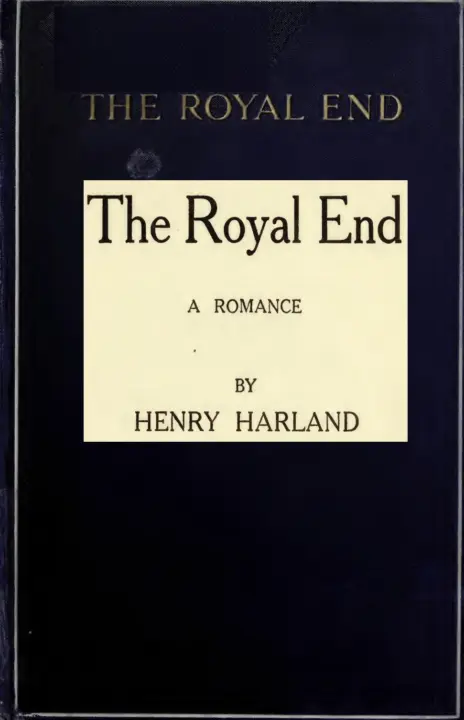
THE CLASSIC COLLECTION · 1909
"The Royal End: A Romance" by Henry Harland is a novel written in the early 20th century. The story is set in Venice and follows the intricate lives of its main characters, specifically Lucilla Dor and her companion Ruth Adgate, as they encounter a charming man named Bertram and navigate romantic entanglements amid social expectations. As Balzatore, the dog, flits through scenes of flirtation and adventure, themes of admiration, social status, and identity come to the forefront, evoking the challenges of love against a backdrop of societal intrigue. At the start of the novel, the setting is established as Lucilla and Ruth dine at a hotel in Venice, where they unknowingly attract the attention of Bertram and his canine companion, Balzatore. This signals the beginning of a romantic entanglement fueled by misunderstandings and societal norms. As the characters interact against the enchanting backdrop of the city, the narrative delves into their personalities, exploring Lucilla's flirtatiousness and Ruth's contrasting reserve. Their evening takes a turn when they find themselves stranded on the Lido, ultimately leading to Bertram's gallant intervention. The opening sets a tone rich with fascination and sharp social commentary as the characters' complexities begin to intertwine.
Introduction adapted from the source catalogue; source summaries may be automatically generated.
Free to read · English · 55,898 words · No account needed
MAKE TIME FOR A GOOD BOOK
On by default. Untick to stop anonymous reading totals. Each page counts after 10 seconds in view. How this works.
Anonymous counting is on unless you have switched it off.
“I'm afraid we were, rather,” Bertram seriously answered her. “If History speaks the truth, I'm afraid we rather led the country a dance.”
“In that respect you couldn't have held a candle to your successors,”
put in Ponty.
“The Ceresini really are a handful. Let alone their extravagances, and their squabbles with their wives--I've seen Massimiliano staggering-drunk in the streets of his own capital. And then, if you drag in History, History never does speak truth.”
“I marvel the people stand it,” said Lucilla.
“They won't stand it for ever,” said Bertram. “Some day there'll be a
revolution.”
“Well----? But then----? Won't your party come in?” she asked.
“Then,” he predicted, “after perhaps a little interregnum, during which they'll try a republic, Altronde will be noiselessly absorbed by the Kingdom of Italy.”
“History never speaks truth, and prophets (with the best will in the world) seldom do,” said Ponty. “Believe as much or as little of Bertram's vaticination as your fancy pleases. In a nation of hot-blooded Southrons like the Altrondesi, anything is possible. For my part, I shouldn't be surprised if their legitimate sovereign were recalled in triumph to-morrow.”
“Perish the thought,” cried Bertram, throwing up his hand, “unless you can provide a substitute to fill what would then become my highly uncomfortable situation.”
Ruth was looking curiously at Pontycroft. “What has History been doing,” she inquired, “to get into your bad graces?”
Pontycroft turned towards her, and made a portentous face.
“History,” he informed her in his deepest voice, “is the medium in which lies are preserved for posterity, just as flies are preserved in amber. History consists of the opinions formed by fallible and often foolish literary men from the testimony of fallible, contradictory, often dishonest, and rarely dispassionate witnesses. The witnesses, either with malice aforethought, or because their faculties are untrained, see falsely, malobserve; then they make false, or at best, faulty records of their malobservations. A century later comes your Historian; studies these false, faulty, contradictory records; picks and chooses among 'em; forms an opinion, the character of which will be entirely determined by his own character--his temperament, prejudices, kind and degree of intelligence, and so forth; and finally publishes his opinion under the title of The History of Ballywhack. But the history, please to remark, remains nothing more nor less than an exposition of the private views of Mr. Jones. And please to remark further that no two histories of Ballywhack will be in the least agreement--except upon unessentials. So that if Mr. Jones's history is true, those of Messrs. Brown and Robinson must necessarily be false. No, no, no; if you go to seek Truth in the printed page, seek it in novels, seek it in poems, seek it in fairy tales or fashion papers, but don't waste your time seeking it in histories.”
Your reading position is saved on this browser. Take it to another device with a library code. Reading pages adapt to text, rather than matching a printed edition.
Henry Harland

Henry Harland

Henry Harland

Henry Harland
BEHIND THE BOOK
This eBook is for the use of anyone anywhere in the United States and most other parts of the world at no cost and with almost no restrictions whatsoever. You may copy it, give it away or re-use it under the terms of the Project Gutenberg License included with this eBook or online at www.gutenberg.org. If you are not located in the United States, you will have to check the laws of the country where you are located before using this eBook. Read the source licence.
The original source file, including credits and licence, is retained by this library. Request an original-format copy at no charge. Please include the book title and Project Gutenberg identifier #51980.
KEEP YOUR CURIOSITY GOING
Coulson Kernahan

Maurice Baring
Frances Wright
Cécile Tormay

Frederic Jesup Stimson

W. H. P. (William Henry Pope) Jarvis