
The Yoke of the Thorah
Henry Harland
THE CLASSIC COLLECTION · 1909
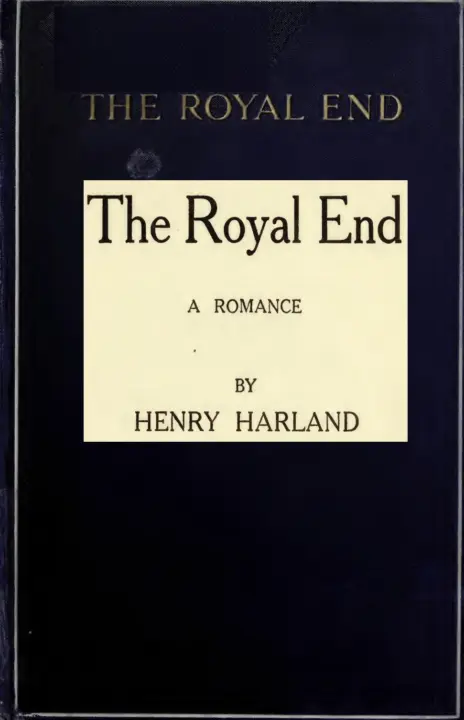
"The Royal End: A Romance" by Henry Harland is a novel written in the early 20th century. The story is set in Venice and follows the intricate lives of its main characters, specifically Lucilla Dor and her companion Ruth Adgate, as they encounter a charming man named Bertram and navigate romantic entanglements amid social expectations. As Balzatore, the dog, flits through scenes of flirtation and adventure, themes of admiration, social status, and identity come to the forefront, evoking the challenges of love against a backdrop of societal intrigue. At the start of the novel, the setting is established as Lucilla and Ruth dine at a hotel in Venice, where they unknowingly attract the attention of Bertram and his canine companion, Balzatore. This signals the beginning of a romantic entanglement fueled by misunderstandings and societal norms. As the characters interact against the enchanting backdrop of the city, the narrative delves into their personalities, exploring Lucilla's flirtatiousness and Ruth's contrasting reserve. Their evening takes a turn when they find themselves stranded on the Lido, ultimately leading to Bertram's gallant intervention. The opening sets a tone rich with fascination and sharp social commentary as the characters' complexities begin to intertwine.
Introduction adapted from the source catalogue; source summaries may be automatically generated.
Free to read · English · 55,898 words · No account needed
MAKE TIME FOR A GOOD BOOK
On by default. Untick to stop anonymous reading totals. Each page counts after 10 seconds in view. How this works.
Anonymous counting is on unless you have switched it off.
“I dare say there are always the Botticellis,” Bertram admitted, laughing. “But the Ponte Vecchio doesn't count--the people there are all Jews. I was thinking of the Florentines.”
“Ah, yes; I see,” said Ruth. “They're chiefly retired Anglo-Indians,
aren't they?”
“Well, isn't that,” demanded Bertram, with livelier laughter, “an entire concession of my point?”
“What are you people so silent about?” asked Pontycroft, coming up with Lucilla from the lawn. Lucilla sank with an ouf of thankfulness into one of the cushioned chairs. Ponty seated himself on the balustrade, near Bertram, and swung his legs.
“Never play lawn-golf with Lucilla,” he warned his listeners. “She cheats like everything. She even poked a ball into a hole with her toe.”
“A very good way of making it go in,” Lucilla answered. “Besides, if I cheated, it was for two good purposes: first, to hurry up the game, which would otherwise have lasted till I dropped; and then to show you how much more inventive and resourceful women are than men.”
She fanned her soft face gently with her pocket-handkerchief.
Ponty turned to Bertram. “Tell us the latest secret tidings from Altronde. What are the prospects of the rightful party?”
“Oh yes, do tell us of Altronde,” said Lucilla, dropping her handkerchief into her lap, and looking up with eagerness in her soft eyes. “I've never met a Pretender before. Do tell us all about it.”
Bertram laughed. “Alas,” he said, “there's nothing about it. There are no tidings from Altronde, and the rightful party (if there is one) has no prospects. And I am not a Pretender--I am merely the son of a Pretender, and my father maintains his pretensions merely as a matter of form--not to let them, in a legal sense, lapse. He is as well aware as any one that there'll never be a restoration.”
“Oh?” said Lucilla, her eyes darkening with disappointment; then, hope dying hard: “But one constantly sees paragraphs in the papers headed 'Unrest in Altronde,' and they seem to enjoy a change of ministry with each new moon.”
“Yes,” admitted Bertram, “there's plenty of unrest--the people being exorbitant drinkers of coffee; and as every deputy aspires to be a minister in turn, they change their ministry as often as they have a leisure moment. 'Tis a state very much divided against itself. But there's one thing they're in a vast majority agreed upon, and that is that they don't want a return of the Bertrandoni.”
“Were you such dreadful tyrants?” questioned Ruth, artlessly serious.
Pontycroft laughed aloud.
“There spoke the free-born daughter of America,” he cried.
Your reading position is saved on this browser. Take it to another device with a library code. Reading pages adapt to text, rather than matching a printed edition.
Henry Harland

Henry Harland

Henry Harland

Henry Harland
BEHIND THE BOOK
This eBook is for the use of anyone anywhere in the United States and most other parts of the world at no cost and with almost no restrictions whatsoever. You may copy it, give it away or re-use it under the terms of the Project Gutenberg License included with this eBook or online at www.gutenberg.org. If you are not located in the United States, you will have to check the laws of the country where you are located before using this eBook. Read the source licence.
The original source file, including credits and licence, is retained by this library. Request an original-format copy at no charge. Please include the book title and Project Gutenberg identifier #51980.
KEEP YOUR CURIOSITY GOING
Coulson Kernahan

Maurice Baring
Frances Wright
Cécile Tormay

Frederic Jesup Stimson

W. H. P. (William Henry Pope) Jarvis