THE CLASSIC COLLECTION✦A dead man’s diaryCLASSIC FREE BOOKS
A dead man’s diary
Coulson Kernahan
THE CLASSIC COLLECTION · 1916
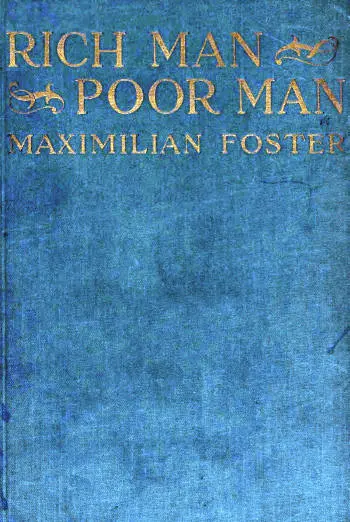
"Rich Man, Poor Man" by Maximilian Foster is a novel written in the early 20th century. The story explores themes of class, wealth, and personal connections, particularly focusing on the lives of Mr. Mapleson, a timid clerk in New York City, and Bab Wynne, a spirited young woman who is on the verge of discovering her true heritage. The interplay between these characters and their relationships will likely form a central part of the narrative as the plot unfolds. At the start of the novel, we meet Mr. Mapleson, an elderly clerk whose life appears mundane and lonely. On Christmas Eve, his character is established as he reflects on the loneliness and alienation he experiences, despite the joyful holiday spirit surrounding him. Meanwhile, the narrative shifts to Bab Wynne, who is depicted with a spirited demeanor that subtly suggests her yearning for a more exciting life, free from the confines of her boarding house existence. The initial chapters set the stage for a forthcoming transformation in their lives, hinting at the intertwining fates of the characters against the backdrop of societal expectations and personal dreams.
Introduction adapted from the source catalogue; source summaries may be automatically generated.
Free to read · English · 58,624 words · No account needed
MAKE TIME FOR A GOOD BOOK
On by default. Untick to stop anonymous reading totals. Each page counts after 10 seconds in view. How this works.
Anonymous counting is on unless you have switched it off.
Varick did not move away. Instead he stood looking down at her, his gray eyes dwelling on hers, and in them was a gleam of interest she had seen there more than once of late. It was as if recently Varick had found in her face something he had not found there before. That something, too, seemed to inspire in him a growing look of reflection.
Bab, in spite of her good looks, was not vain. At the same time, though, neither was she blind. She gazed at Varick curiously.
"Well?" she inquired presently.
Varick seemed suddenly to recollect.
"Thanks!" he said; and in turn she laughed back: "You're welcome!"
She had just spoken when out in the dimly lighted hall Bab saw Mr. Mapleson emerge suddenly from the stairway, and on stealthy tiptoes dart out of view toward the kitchen. A muffled exclamation escaped her, and as he heard it Varick looked at her vaguely.
"I beg pardon?" he inquired.
"Nothing--it was just someone in the hall," Bab evasively answered; and her face thoughtful now, she finished arranging the table. Planted on the hearthrug, Varick watched her. However, though she was quite conscious of this, she gave little heed to it. Her brow puckered itself still more in thought.
"You're not going to be home tonight, are you?" she inquired presently. When Varick said no, that he'd be out all the evening, Bab perched herself on the serving table in the corner, and sat swinging her shapely, slender heels. "I suppose you're going to a party, aren't you?" she suggested.
Again he smiled.
"Why, yes, Bab--why?"
"Oh, I don't know," she murmured as aimlessly. Then her eyes growing vague, she drew a little breath.
"There'll be a tree, I suppose?" Varick nodded. Yes, there would be a tree. "And you'll dance besides, I shouldn't wonder?" added Bab, drawing in her breath again, a pensive sigh. "I imagine, too, there'll be a lot of girls there--pretty girls?"
She could see him stare, curious at her tone, her questioning; but now she hardly cared. There was something Bab meant to ask him presently, though how she was to do it she still was not quite sure.
"Funny," she murmured, her tone as if she mused; "do you know, I've
never been at a dance!"
Varick stared anew. "Really?"
"Honor bright!" said Bab, aware of his astonishment. She had a way, when others amused her, of drolly twisting up one corner of her mouth; and then as her smile broadened, rippling over her face, Bab's small nose would wrinkle up like a rabbit's, obscuring temporarily the freckles on each side of it. "Give you my word!" she avowed.
Your reading position is saved on this browser. Take it to another device with a library code. Reading pages adapt to text, rather than matching a printed edition.
BEHIND THE BOOK
This eBook is for the use of anyone anywhere in the United States and most other parts of the world at no cost and with almost no restrictions whatsoever. You may copy it, give it away or re-use it under the terms of the Project Gutenberg License included with this eBook or online at www.gutenberg.org. If you are not located in the United States, you will have to check the laws of the country where you are located before using this eBook. Read the source licence.
The original source file, including credits and licence, is retained by this library. Request an original-format copy at no charge. Please include the book title and Project Gutenberg identifier #46945.
KEEP YOUR CURIOSITY GOING
Coulson Kernahan

Maurice Baring
Frances Wright
Cécile Tormay

Frederic Jesup Stimson

W. H. P. (William Henry Pope) Jarvis